Charts that refuse to behave the way your backtest promised are maddeningly familiar. Price gaps after economic releases, stubborn trends that ignore indicators, and sudden swings driven by headlines expose a simple truth: mastering the market requires more than a single trick.
Traders who last treat analysis as a toolbox, not a religion. Combine technical analysis for structure, fundamental analysis for directional bias, and sentiment analysis to sense crowd dynamics — and the fog clears. This guide starts from the concrete moments every trader knows and builds toward techniques that actually change trade outcomes.

Foundations of Forex Market Analysis
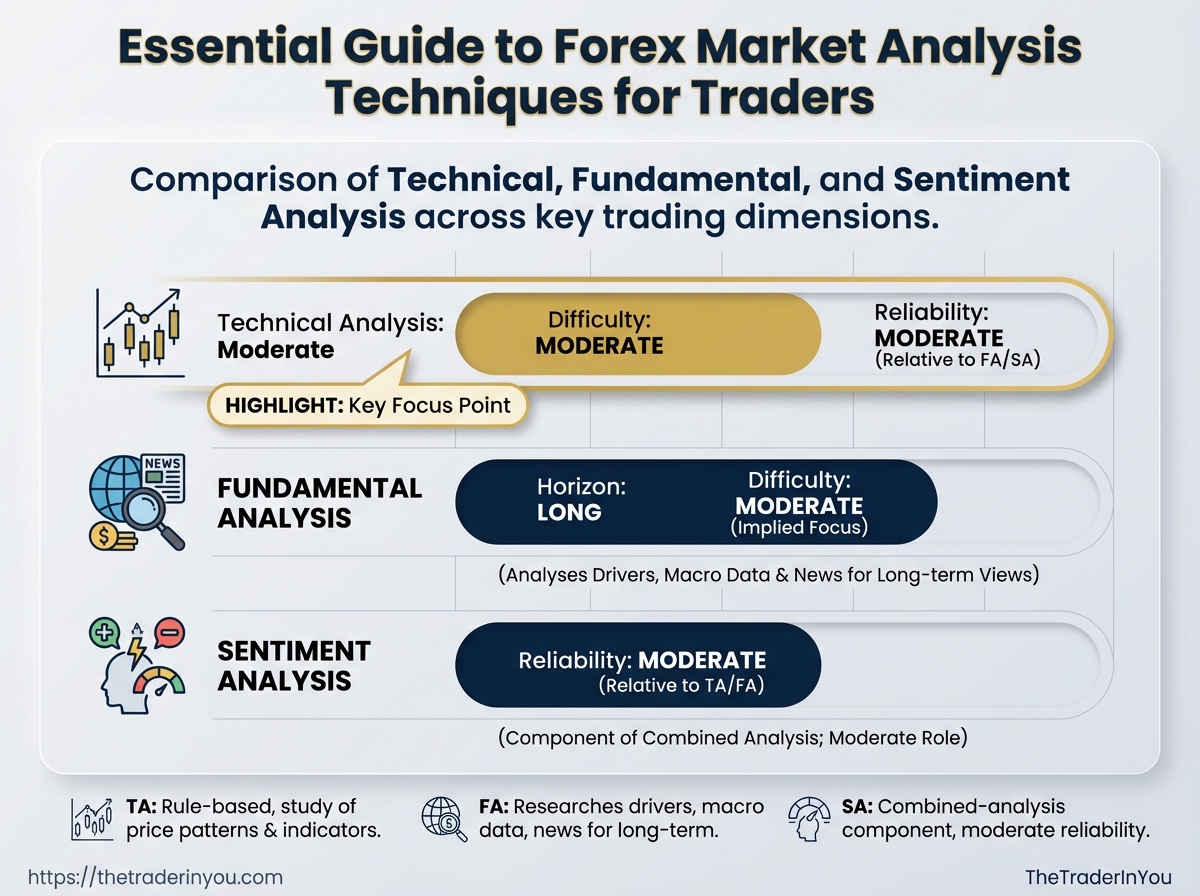
Effective forex trading rests on three distinct but complementary analysis approaches: technical, fundamental, and sentiment. Each answers a different question about price: what the chart is doing, why it might move, and how other market participants are positioned. Understanding their strengths and limits lets a trader pick the right mix for a given timeframe and edge.
Technical analysis: Technical analysis uses price, volume, and pattern tools to identify entry and exit points. Common tools include moving averages (e.g., 50-period MA), support and resistance, Fibonacci retracements, and oscillators like RSI. Technical work is strongest on shorter to medium horizons where order flow and liquidity shape moves rapidly.
Fundamental analysis: Fundamental analysis examines macro drivers and economic data that change currency valuations over time. interest-rate announcements, GDP prints, employment reports, and central bank guidance. Fundamentals dominate longer horizons and explain trend initiation or regime shifts.
Sentiment analysis: Sentiment analysis measures positioning and crowd psychology to reveal potential reversals or trend continuations. Typical inputs: CFTC COT reports, retail broker positioning, and flow indicators. Sentiment can be the early warning that a technical breakout lacks follow-through because positioning is stretched.
How to think about combining methods by timeframe: 1. Short-term scalps (minutes–hours): Technical first, sentiment second. 2. Intraday to swing (hours–days): Technicals for timing, sentiment for confirmation, fundamentals for high-impact events. 3. Medium-to-long-term (weeks–months+): Fundamentals drive direction, technicals set entries, sentiment times tops/bottoms.
Practical examples and signals Interest-rate announcement: Use fundamental calendar to mark risk windows; avoid value trades immediately around the release unless volatility edges are explicitly part of the plan. Moving average crossover: A 20/50 MA crossover can be a trade trigger—validate with volume or a momentum oscillator. * COT report extreme: Extreme net-long in specs often precedes corrective moves; pair that with failed technical structure for higher-confidence setups.
Side-by-side comparison of technical, fundamental, and sentiment analysis for quick decision-making
| Analysis Type | Primary Tools / Data | Best Timeframes | Strengths | Limitations |
|---|---|---|---|---|
| Technical | Price charts, 50/200 MA, RSI, volume |
Intraday → weeks | Fast signals, precise entries | False signals in news-driven markets |
| Fundamental | Economic calendar, central bank minutes, rates | Weeks → years | Explains trends, regime shifts | Poor timing, noisy short-term impact |
| Sentiment | CFTC COT, broker flow, options skew | Days → months | Contrarian edges, crowd extremes | Data lag (COT), interpretation ambiguity |
Market practice shows that the highest-probability setups often use one method for direction and another for timing. When execution speed matters, choose a broker known for tight spreads and reliable fills—HotForex trading platform and Exness are commonly evaluated for execution quality, while Explore XM trading options is another widely referenced choice. Combine the right tools for your timeframe and trade with clarity rather than clutter; that difference is what separates consistent results from noise-driven frustration.
Technical Analysis Techniques
Reading price structure visually is the most practical starting point: trendlines and channels reveal where buyers and sellers repeatedly defend levels, moving averages confirm the prevailing bias, and oscillators like RSI and MACD filter noise and time entries. These three techniques, used together, turn raw charts into a disciplined process for trade selection and risk control.
Drawing trendlines and channels Start with swing points: Connect at least two higher lows for an uptrend line, two lower highs for a downtrend line. Validate with price reaction: A trendline gains credibility after three touches without clean breaches. * Channels: Draw a parallel line through the opposite set of swing points to create a price channel; breakouts and fades inside the channel are actionable setups.
Using moving averages for trend confirmation 1. Choose smoothing: SMA for smoother, lagging signals; EMA for more responsive reads. 2. Common combinations: 50/200 for long-bias regime, 9/21 for short-term momentum. 3. Interpret crossovers: a faster MA crossing above a slower MA shows trend acceleration; price staying above 200 MA indicates a primary uptrend.
Combining oscillators (RSI + MACD) to filter trades RSI (Relative Strength Index): Measures momentum on a 0–100 scale; look for divergence and overbought/oversold rejection rather than raw extremes. MACD: Tracks moving-average convergence/divergence and gives histogram momentum; use MACD histogram to spot momentum shifts before crossovers. * How to combine: Require MACD histogram to confirm momentum direction and RSI to avoid fading extreme readings. For example, after a trendline bounce, enter long only if MACD histogram is rising and RSI is above 40.
Practical example: after an up-channel retest, price makes a higher low at the lower channel boundary. The 21 EMA is sloping up and above the 50 SMA. MACD histogram shows rising bars from negative territory and RSI reads 48. That confluence favors a low-risk long with stop below the channel.
Core chart techniques and indicators
| Indicator | Measures | Best For | Typical Signal | Timeframe |
|---|---|---|---|---|
| Moving Average (SMA/EMA) | Trend direction, smoothing | Trend confirmation, dynamic support/resistance | Crossovers, price relative to MA | Intraday–monthly |
| MACD | Momentum and trend change (MACD line, signal line, histogram) | Momentum shifts, early trend reversals | Signal line crossover, histogram divergence | 1h–daily |
| RSI | Momentum strength (0–100) | Overbought/oversold, divergence | Readings >70/<30, bullish/bearish divergence | 15m–daily |
| Bollinger Bands | Volatility range around SMA | Volatility expansion/contraction, mean reversion | Band squeeze, band-break follow-through | 5m–daily |
| Fibonacci retracement | Potential support/resistance levels from prior moves | Pullback targets, confluence zones | Price reaction at 38.2/50/61.8% levels | Any timeframe |
Key insight: combining a price-structure tool (trendline/channel), a trend filter (MA), and momentum confirmation (MACD + RSI) reduces false signals and improves entry timing compared with using any single indicator.
These techniques work because each addresses a different market question: where is price likely to react, is the trend intact, and does momentum support a move. Use them together and trades feel less like guesses and more like controlled experiments with measurable outcomes.
Fundamental Analysis for Forex Traders
Fundamental analysis in FX is about understanding which macro forces move currencies and why those moves matter for positioning and risk. Start by focusing on a handful of high-impact indicators, then fold those signals into a practical event-driven workflow that controls position size, timing, and exit rules. Traders who treat economic releases as a source of probability change rather than certainty make steadier returns.
Major economic indicators, typical market reaction, and volatility expectations to help traders prioritize events
| Indicator | Typical Impact on FX | Frequency | Expected Volatility |
|---|---|---|---|
| Interest Rate Decision | Strong directional moves for currency; hawkish → currency strengthens | Varies (central bank schedule) | High |
| Non-Farm Payrolls (NFP) | Large USD swings; surprise > consensus fuels trend | Monthly (first Friday) | Very High |
| CPI / Inflation Data | Drives rate-expectation shifts; affects all major crosses | Monthly | High |
| GDP Releases | Medium-term trend confirmation; bigger on revisions | Quarterly | Medium–High |
| Trade Balance | Structural currency pressure for commodity/exporters | Monthly/quarterly | Low–Medium |
Key insight: Prioritize Interest Rate Decision, NFP, and CPI when allocating capital for event trades—these usually produce the largest short-term volatility and alter central-bank expectations that move markets for weeks.
Interest Rate Decision: Central bank policy announcement that sets the nominal rate; market reacts to the decision and the forward guidance.
Non-Farm Payrolls (NFP): Monthly US jobs measure excluding agriculture; large surprises move the USD sharply.
CPI / Inflation Data: Consumer price inflation readings; primary driver of rate expectations.
GDP Releases: Broad measure of economic output; revisions can shift medium-term FX trends.
Trade Balance: The gap between exports and imports; important for currencies of trade-dependent economies.
Using economic calendars and volatility expectations to set risk
- Use calendars: Mark release times and pre-market consensus, then identify the 30–60 minute window of elevated risk.
- Scale position: Reduce size proportionally to expected volatility—smaller for
High, smallest forVery High. - Widen stops: Anticipate spread widening around releases; use limit entries post-release rather than market entries during flashes.
- Scan the economic calendar for the week and flag
High/Very Highevents. - Define a maximum capital-at-risk per event (e.g., 0.5%).
- Predefine entry logic: wait 5–15 minutes post-release for initial move confirmation.
- Set stop and target based on ATR expansion and pre-event technical levels.
- Pre-event: Check market-implied rates via swaps or futures to gauge surprises priced in.
- Position sizing: Cut usual size by 50% if volatility is rated High/Very High.
- Execution: Wait for the first 5 minutes, then enter on a retrace toward the initial move if momentum aligns.
- Manage: Trail stops with a shorter ATR multiple until volatility normalizes.
Example workflow for trading a central-bank announcement
Trading macro events well means trading with humility: the biggest wins come from disciplined sizing and waiting for confirmation rather than predicting every headline. Consider a demo run for several months to calibrate stop widths and sizing using this workflow before committing live capital.
Sentiment Analysis & Positioning
Market sentiment is the invisible hand behind many price moves; reading it narrows the edge between guessing and sizing a trade with intent. Use a mix of long-horizon institutional reads and high-frequency retail signals, then let the technical setup answer whether to act now or wait for confirmation.
Practical signals and how they behave
- CFTC COT (Commitments of Traders): slow, reliable snapshot of large spec and commercial flows — useful for spotting structural positioning extremes across weeks.
- Broker positioning heatmaps: near real-time view of where retail money is clustered — great for contrarian signals and stop-hunt awareness.
- Retail/social sentiment aggregators: high-frequency mood indicators from platforms and chatrooms — good for spotting momentum fuel or exhaustion.
- Volatility indices (e.g., VIX, implied vols): measure fear/risk appetite — useful to scale position size and set wider or tighter stops.
How to interpret extremes versus trends
- Look for consensus extremes first.
- Then ask whether the sentiment is trending or peaking.
- Combine timing with technical confirmation.
When multiple signals (COT extremes, crowded broker positioning, overheated retail sentiment) align, probabilities shift toward mean reversion or a violent corrective move.
Trending sentiment (consistent buying over weeks in COT and rising implied vol) supports trend-following entries. Peaking sentiment (sharp retail euphoria, heatmap crowding) favors disciplined fade strategies.
Sentiment says who is in the market; price patterns say when. Use RSI divergence, VWAP re-tests, or support/resistance breaks to trigger the trade.
Concrete example: a currency pair shows long-biased COT positions and rising retail long concentration on broker heatmaps, while price fails to break a prior high and RSI shows negative divergence. That’s a setup for a measured short — sentiment suggests crowding, technicals give the trigger.
Sentiment tools (COT, broker heatmaps, social metrics) on accessibility, timeliness, and reliability
| Tool | Data Type | Update Frequency | Best Use | Limitations |
|---|---|---|---|---|
| CFTC COT Report | Institutional positioning by category | Weekly | Spot structural extremes, multi-week trends | Lagging; needs context with price/action |
| Broker Positioning Heatmaps | Aggregated client longs/shorts | Real-time / Intraday | Identify crowding, contrarian entries | Biased to retail sample; broker-specific |
| Retail Sentiment (social/trade platforms) | Aggregated social mentions/trade ratios | Minutes to daily | Detect retail euphoria or panic | Noisy; susceptible to bots and echo chambers |
| Volatility Indices | Implied volatility measures | Real-time | Scale risk, time stops, and option trades | Can spike on headlines; doesn’t show direction |
This mix of signals keeps the trader honest: institutional flows reveal the bigger picture, retail and heatmaps show crowd behavior, and volatility tells how aggressive sizing should be. Combining them with concrete technical triggers turns sentiment from noise into executable positioning.
Combining Techniques: Building a Repeatable Analysis Workflow
A reliable trading edge comes from blending complementary techniques into a clear, repeatable process. Start with a compact routine that forces consistency: a macro check to set bias, a focused technical scan to identify setups, a sentiment filter to size conviction, and a disciplined execution + review loop. When these steps live in a template you actually use every day, noise falls away and quality signals repeat.
Trading journal: A place to record setups, R:R, and outcomes.
Charting platform: Ability to save layouts, indicators, and templates (multi-timeframe support recommended).
Economic calendar: Real-time updates with event impact flags.
- Assemble the inputs.
- Open a macro dashboard (FX indices, yields, commodity moves) to define bias.
- Run a
technical scanacross saved watchlists for specific patterns (breakouts, mean-reverts). - Cross-check with a sentiment check (positioning, volatility, retail bias).
- Prioritize candidates into a watchlist ranked by confluence and tradeability.
- Execute using predefined
risk rules, then log the trade immediately.
How to prioritize signals across methods
- High confluence: Price at a structural level + supportive indicator + low-impact macro → top priority.
- Medium confluence: Good technical setup without macro support → conditional trade with reduced size.
- Low confluence: Isolated signal or event-driven noise → monitor only.
Daily/weekly workflow timeline showing tasks, time commitment, and output (bias, watchlist, trade plan)
| Step | Task | Time Estimate | Output |
|---|---|---|---|
| Macro Scan | Review indices, yields, FX strength, commodity moves | 15 minutes | Bias (bull/bear/neutral) |
| Economic Calendar Review | Check high-impact events for the session/week | 10 minutes | Event list + risk windows |
| Technical Scan | Run saved scans, validate setups on multiple timeframes | 30 minutes | Ranked watchlist |
| Sentiment Check | Verify positioning, VIX/volatility, retail flow | 10 minutes | Conviction score |
| Trade Execution & Risk | Place orders with stops/size per rules | Varies (5–30 minutes) | Live trade(s) with R:R noted | | Review | Log outcomes, update journal, tag lessons | 20 minutes | Trade review + performance notes |
Key insight: A compact daily routine (about 1–2 hours) creates repeatability. Prioritizing by confluence and conviction reduces random entries and keeps risk consistent, which over time improves signal-to-noise in a trader’s P&L.
An example trade using the workflow: macro bias shows USD strength, technical scan flags a EUR/USD rejection at a weekly resistance, sentiment shows crowded long retail positions — take a short with conservative size and a clear stop, then log the result. Follow this pattern for every trade and the process becomes the edge rather than hope.
Tools, Platforms, and Data Sources
For serious trading, pick tools that match the strategy: chart-heavy technical traders need fast, flexible charting and replay features; quant traders need clean API access and tick-level data; discretionary traders benefit from consolidated news and economic calendars. A practical toolkit blends a charting platform, a reliable data feed, a broker with tight execution, and one or two specialist services (news, positioning, or backtest engine).
- Charting & analysis: fast drawing, custom indicators, strategy backtest
- Data feeds & execution: low-latency price streams, gapless history, broker API access
- News & macro: reliable economic calendars, consolidated headlines, sentiment/positioning feeds
Platforms/tools on cost, best use-case, and integration with brokers
This mix shows how platforms trade off cost, depth, and integration. TradingView and MT4/5 cover most retail needs; Bloomberg/Refinitiv are for institutional workflows; QuantConnect and NinjaTrader serve quant/algo builders. Broker-provided tools often give the smoothest execution path — for example, Exness and other brokers simplify order routing and access to raw spreads. Choose based on the data fidelity and automation needs of your strategy, then prioritize platforms that let you export and verify raw fills for realistic backtests.
Risk Management and Backtesting Analysis Techniques
Backtesting and forward testing are the only reliable ways to know whether a trading idea survives the messy reality of markets, and risk sizing decides whether a surviving idea survives your account. A backtest checks historical performance under controlled assumptions; forward testing validates the same rules in live or simulated market conditions; risk sizing translates expected edge into position sizes that keep drawdowns tolerable and returns compounding.
Backtesting: A systematic replay of historical data using your exact entry, exit, and money-management rules.
Forward testing (paper trading): Running the strategy in real time with simulated or small live orders to confirm execution, slippage, and behavioural fit.
Risk sizing: Allocating capital per trade based on volatility, drawdown tolerance, and the statistical edge of the system.
How to run a meaningful backtest:
- Define rules precisely and encode them so the engine replicates every decision.
- Use clean, granular data (tick or 1-minute for intraday; daily for swing strategies), including corporate actions.
- Include realistic costs: spreads, commissions, slippage, and margin/borrowing costs.
- Test across multiple market regimes and instruments to detect curve-fitting.
- Run walk-forward or out-of-sample slices to validate robustness.
Practical forward-testing and iteration:
- Start small: run 30–100 trades in demo before scaling.
- Measure execution gaps: track average slippage and order fill rates.
- Behavioural check: confirm the strategy fits the trader’s capacity and psychology.
Risk-sizing approaches that work in practice:
Fixed fractional: risk a fixed percent of equity per trade (common: 1–2%). Volatility-adjusted: size positions using position = risk_amount / (ATR multiplier) to equalise risk across different volatilities. Kelly fraction (scaled): compute Kelly for edge, then scale down (e.g., 1/4 Kelly) to limit variance. * Portfolio-level risk: cap total market exposure and set stop-to-equity ratios to control correlated drawdowns.
Performance metrics (definition, formula, what it reveals about a strategy)
| Metric | Definition | Formula / How to calculate | Interpretation |
|---|---|---|---|
| Win Rate | Proportion of winning trades | |
Higher win rate can be attractive but says nothing about payoff size |
| Average Win / Loss | Mean profit on winners vs mean loss on losers | Avg(win) / Avg(loss) |
Values >1 indicate winners are larger than losers; critical with low win rate |
| Expectancy | Average profit per trade | Expectancy = (WinRate AvgWin) - (LossRate AvgLoss) |
Positive expectancy means statistical edge over many trades |
| Max Drawdown | Largest peak-to-trough equity decline | Max peak - subsequent trough |
Shows worst historical loss and informs sizing limits |
| Sharpe Ratio | Risk-adjusted return relative to volatility | (Return - RiskFree) / StdDev(return) |
Higher values suggest better return per unit volatility |
Key insight: these metrics together reveal edge, variability, and survivability; none alone is decisive.
A practical workflow combines rigorous backtesting with a disciplined forward test and conservative risk sizing—run the numbers, feel the strategy in real time, then scale slowly so statistical realities match balance-sheet reality.
Quick Reference (Cheat Sheet)
Here are the short signal checks and a compact daily workflow traders use to decide quickly and act without over-analysis. These are practical, rule-of-thumb checks you can scan in 60 seconds before taking a trade.
Condensed checklist table combining signals, triggers, and immediate actions for quick reference
| Signal / Event | Trigger | Immediate Action | Notes |
|---|---|---|---|
| Moving Average Cross | EMA50 crosses above/below EMA200 |
Enter long on bullish cross after pullback; tighten stops on bearish cross | Use higher-timeframe confirmation; avoid choppy ranges |
| Break of Key Support/Resistance | Clear close beyond level with volume increase | Wait for retest; enter on validated retest or use stop-entry beyond breakpoint | False breaks common around news; require momentum |
| High-Impact Economic Release | Scheduled release (NFP, CPI, RBA rate) | Avoid new directional entries until 15–30m after release; trade volatility fades | Use implied volatility tools or avoid wide spreads |
| COT Extreme Positioning | Large net long/short from CFTC COT extremes | Lean contrarian when positioning is at multi-month extremes | Best used with trend context and liquidity checks |
| Daily Trend Confirmation | Price consistently above/below EMA50 + RSI(14) trending |
Trade with trend bias; scale into winners, use wider stops against major trend | Combine with structure: higher highs/lows or lower highs/lows |
Quick signal checks — glance list:
- Price vs EMA50: price above = bias long, below = bias short.
- Momentum check:
RSI(14)between 50–70 = healthy trend, >70 = possible exhaustion. - Volume spike: confirmation for breakouts only when volume > recent average.
- Correlation check: major FX pairs vs USD index to spot cross-filter.
- Spread/Slippage: widen during macro events—avoid thin liquidity times.
Daily workflow
- Review economic calendar and mark high-impact releases for the session.
- Scan higher timeframes (4H, Daily) for trend and major S/R levels.
- Open intraday watchlist: 3–6 instruments that match trend and liquidity.
- Apply quick signal checks from above; set entries, stops, and a clear R:R.
- End-of-day: log trades, note rule deviations, and update plan.
Moving Average Cross: Simple crossover of EMAs used for trend bias.
COT Extreme Positioning: Weekly CFTC data showing large spec positioning relative to history.
The cheat sheet is meant to speed decisions without replacing discipline — use it to reduce hesitation, not to shortcut your edge. Keep this beside your desk and tighten rules first, then execution will follow.
📥 Download: Forex Market Analysis Checklist (PDF)
FAQ
Short answers first: trading questions usually break down into three buckets — timeframe and method fit, decision hygiene to avoid paralysis, and where to go next for learning and tools. Pick a timeframe that matches available time and temperament, use simple rules to prevent over-analysis, and choose platforms and resources that support your chosen approach. Below are common FAQs with practical, actionable answers and quick examples.
What timeframe should I trade?
- Scalping: for traders with live attention and fast execution; requires tight
stop-lossand low latency. - Swing trading: for part-time traders who can check charts several times daily; uses multi-day setups and wider stops.
- Position trading: for long-term investors focusing on macro trends and fundamental drivers.
A practical way to pick: test a single timeframe for 30–60 trades and measure win rate and stress level. If monitoring feels like a second job, move to a longer timeframe.
How do I stop over-analysis?
- Define the rule set and write it down.
- Use a checklist for entries — no trade without every box checked.
- Limit pre-trade research to one clear metric (e.g., trend + momentum).
- Rule-based trading: Creates clear stop points and reduces indecision.
- Pre-trade checklist: Keeps focus on high-probability setups.
- Trade timer: Enforce a maximum decision window (e.g., 15 minutes).
> “Consistent rules beat hunches over time.”
Which platforms and tools should I use?
- Execution: choose a broker with low spreads and reliable fills.
- Analysis: use charting that supports
multi-timeframeanalysis and alerts. - Backtesting: pick tools that let you test strategy logic on historical data.
Consider brokers such as Exness when reliability and execution matter; compare demo accounts before funding.
Where to read next and practice safely?
- Paper trade for 3 months or 100 trades.
- Keep a trade journal with rules, emotions, and outcomes.
- Study one topic at a time (risk management, entries, exits).
Risk management: Position size so a loss never exceeds a small, predefined percentage of capital.
These answers should help reduce friction between learning and doing — practical rules and a short testing program will reveal what actually works for you. Keep refining with small, measurable experiments rather than endless theory.
Resource List
A concise set of go-to tools and pages for daily forex analysis, strategy testing, and broker due diligence. These resources cover real-time calendars and market positioning data, charting and execution platforms, plus internal broker reviews and comparison pages to speed account selection. Use the calendar and COT reports to plan around liquidity events, rely on TradingView or MT4/MT5 for charting and EAs, and consult broker reviews before opening live accounts.
- Economic Calendar: Quick checks for scheduled data releases and expected volatility.
- COT Reports: Weekly positioning snapshots that help spot large-trader trends.
- TradingView: Flexible charting with community ideas and script sharing.
- MetaTrader 4/5: Execution, expert advisors, and local strategy backtests.
- Broker reviews & comparison pages: Read reviews, then compare spreads, regulation, and execution quality.
Organize recommended resources with purpose and link type for quick access
| Resource | Type | Best For | Link / Note |
|---|---|---|---|
| Economic Calendar | Data feed | Tracking macro events, NFP, CPI | Official calendar pages on major financial sites; use to schedule trades |
| COT Reports | Weekly report | Spotting large speculator and commercial flows | CFTC weekly published data; use COT to confirm trend bias |
| TradingView | Charting platform | Visual analysis, custom indicators, screener | Real-time charts, social ideas, Pine Script for custom indicators |
| MetaTrader 4/5 | Execution & backtesting | EAs, strategy testing, automated execution | MT4 for stability, MT5 for multi-asset and improved tick data |
| IC Markets (broker review) | Broker review | Tight spreads, ECN-style execution | Internal broker review page covering spreads, regulation, execution |
| XM (broker review) | Broker review | Beginner-friendly accounts, educational material | Explore XM trading options — review with pros/cons |
| Compare Forex Brokers (site page) | Internal comparison | Side-by-side spreads, fees, regulation | Site comparison tool that filters by region and account type |
| The Best Forex Brokers (site page) | Internal roundup | Shortlist for different trader profiles | Curated picks with quick-entry links and verification notes |
Key insight: The table groups tactical market tools (calendars, COT), analysis platforms (TradingView, MT4/5), and decision-stage content (broker reviews/comparisons). Start analysis with the economic calendar, validate conviction with COT and charts, then check execution considerations in broker reviews before risking capital.
Pair these resources with a simple workflow—scan the calendar, confirm direction with COT and price action, then run entries on your chosen platform—and the time spent researching converts directly into cleaner trade decisions.
Conclusion
Trading that matches backtests more often comes down to disciplined process rather than a single indicator. Combine the foundations — clear edge definition, technical patterns, fundamental context, and sentiment checks — into a repeatable workflow. When charts gap after an NFP print or a trend refuses to break despite indicator signals, tight trade rules, pre-event sizing, and post-event recovery plans keep drawdowns manageable. Expect questions like “How do I avoid whipsaws?” (use confluence and time‑frame alignment) and “When should I ignore news-driven moves?” (only when position size and stop rules absorb the volatility). Build rules that protect capital first and let the edge express itself second.
Put learning into action with three concrete steps: backtest your rules on honest data, paper-trade the refined setup for at least 60 trades, and log every trade with rationale and outcome. Small examples in the article — a trend-follow system surviving a weekend gap by fixed sizing, and a mean‑reversion pair that only trades outside correlated drawdown windows — show how rules reduce emotional mistakes. Ready for practical next steps and platform comparisons? Explore broker reviews and tools to match execution, spreads, and data feeds to your strategy; alignment between strategy and platform often makes the difference between theoretical profit and real results.

Follow Joshua for daily forex tips on X: @thetraderinyou or connect with him on LinkedIn: Joshua Okapes.
- The Role of Sentiment Analysis in Forex Market Predictions - May 13, 2026
- Understanding Fundamental Analysis: Key Indicators for Forex Traders - May 11, 2026
- Mistakes Traders Make When Analyzing Forex Markets - May 8, 2026