Why does a trade that looks perfect on the chart still lose money five minutes later? In scalping, the answer is usually hidden in the tiny details that slower traders barely notice.
Forex is enormous.
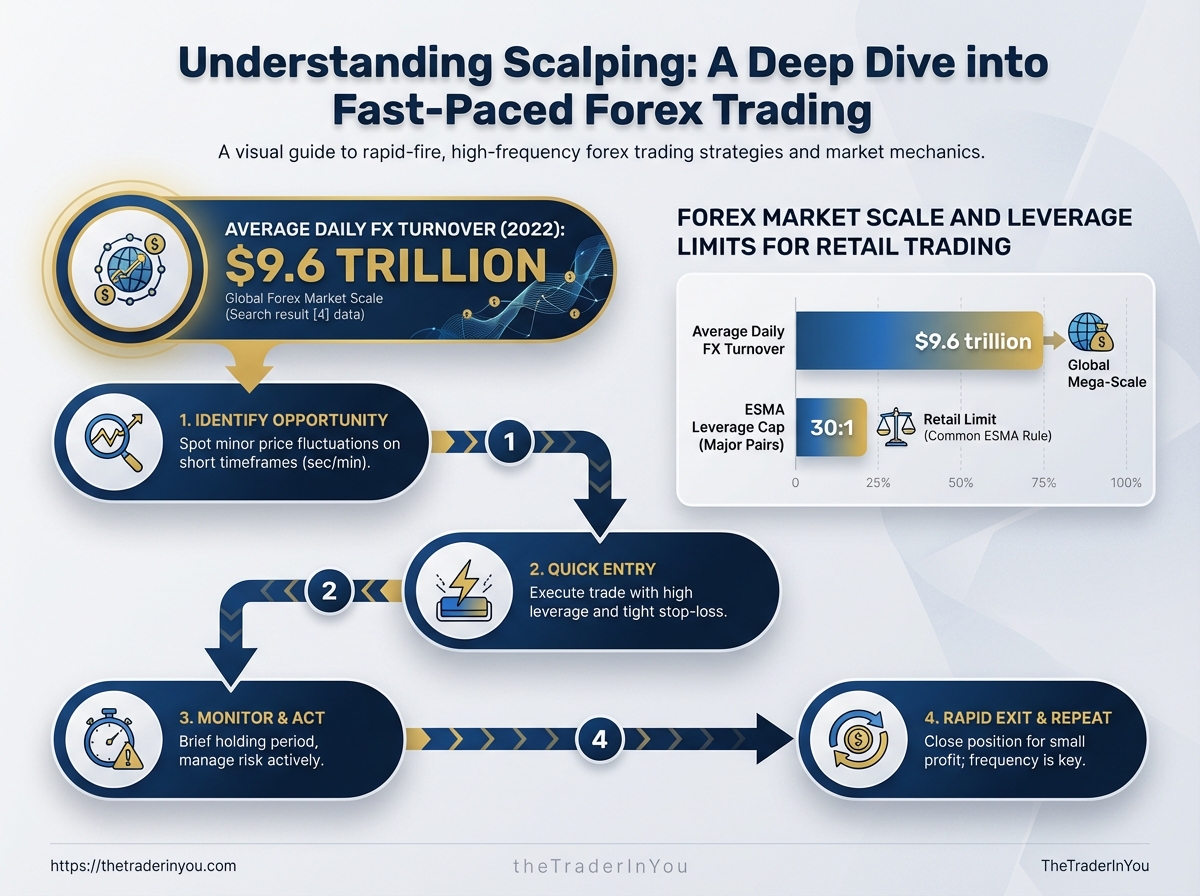
The BIS reported about US$7.5 trillion in average daily turnover in its 2022 survey, and that scale is exactly why fast-paced trading can feel so seductive and so unforgiving at the same time.
With scalping strategies, the target is not a big trend.
It is a small move, taken quickly, over and over again, while costs stay painfully low.
That makes the bid-ask spread, slippage, and fill quality more important than a flashy entry signal.
A setup can be right and still fail if the spread widens at the wrong moment or the order lands late.
That is why many traders study Forex scalping techniques with a hard eye on execution, not just indicators.
The pressure rises fast when leverage enters the picture.
ESMA’s 30:1 cap on major currency pairs shows how seriously retail risk is treated, because a strategy built for seconds leaves very little room for error.
What Scalping Means in Forex Trading
Why do some forex traders chase just a few pips and then get out? Because scalping is built around repetition, not big predictions.
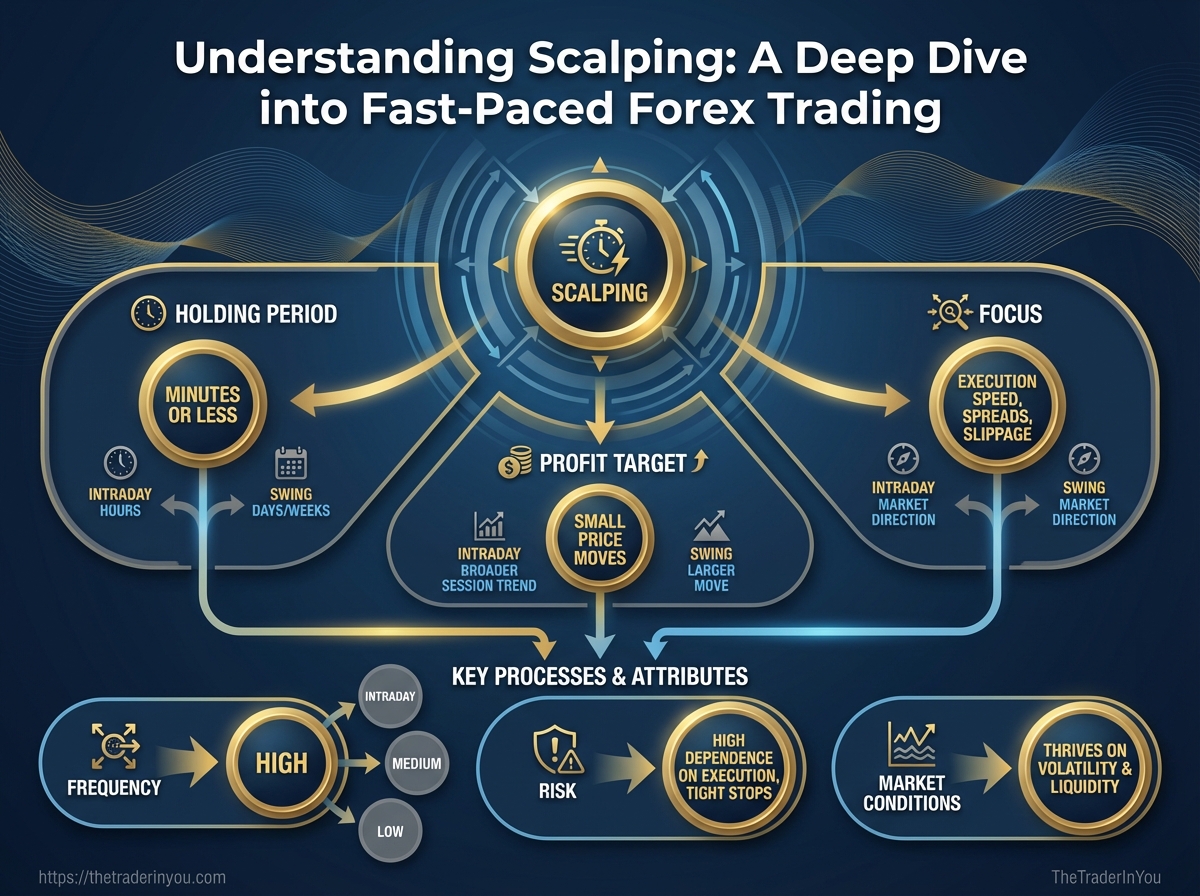
In forex, scalping means opening and closing trades over very short holding periods, often minutes or less, to collect small price moves many times a day.
The logic is simple: if the market keeps offering tiny inefficiencies, a trader tries to capture them before they disappear.
That style fits the scale of the market.
The BIS Triennial Central Bank Survey reported US$7.5 trillion in average daily FX turnover in 2022, which shows how deep and active the market is.
In a market that large, price changes can happen fast enough for fast-paced trading to matter, but only if execution is clean.
Scalping is very different from intraday or swing trading.
An intraday trader may hold positions for hours and still care about a broader session trend.
A swing trader may hold for days or weeks and focus on a larger move.
A scalper lives much closer to the tape, where the spread, slippage, and fill speed can matter more than the signal itself.
A few conditions make this style more workable:
- Tight spreads: A wide spread can wipe out the small profit a scalper is targeting.
- High liquidity: Major pairs during active sessions usually give cleaner fills and less drag.
- Stable execution: Low latency and fewer re-quotes help when trades are measured in seconds or minutes.
- Controlled costs: Commission-based accounts can suit scalping strategies if the total round-trip cost stays low.
- Clear micro-moves: Short bursts of momentum, order-flow shifts, and tight range breaks often suit Forex scalping techniques better than slow, drifting markets.
This is also why platform choice matters.
Tools like MetaTrader 5 and cTrader are popular with active traders because they support fast order handling and automation features.
On venues such as EBS, execution characteristics become especially important when the trade horizon is tiny.
The risk side is just as important.
ESMA’s 30:1 leverage cap for retail major currency pairs, in place since 2018, reflects how quickly leveraged positions can go wrong when trades are opened and closed rapidly.
Scalping is really a trade-off: fewer points per trade, more dependence on execution, and far less room for error.
That is why it rewards discipline more than excitement.
Core Scalping Strategies and Market Logic
Why do some traders obsess over the first few seconds of movement? Because in fast-paced trading, the edge often comes from reading the market’s current mood, not from predicting a big move.
That matters in a market this deep.
The BIS estimated average daily FX turnover at US$7.5 trillion in 2022, so the tape is always alive, but not always tradable.
Scalping strategies live or die on spread, slippage, and timing, because a small target can vanish fast.
Momentum-based scalping in active sessions
Momentum scalping works best when the market is already moving with purpose.
Think of the London open, the New York overlap, or a clean post-news burst where price keeps printing higher highs or lower lows.
The trader is not hunting a miracle reversal.
The job is to catch the next push, grab the small continuation, and get out before the pace cools.
- Trade with direction: Enter after the move starts, not before it wakes up.
- Use tight exits: A small win matters more than a perfect call.
- Favor liquid pairs: Fast fills matter when the tape moves quickly.
Range-bound scalping when price stalls
A stalled market can be just as useful as a trending one.
When price keeps bouncing between support and resistance, the logic shifts from chasing momentum to fading edges.
The chart should show a narrow channel with repeated reactions at the same price zones.
That picture helps make the idea concrete: buy near support, sell near resistance, and avoid trades in the dead middle where the odds get messy.
The trick is patience.
In a range, the best setups usually come after repeated rejection, not on the first touch.
Breakout scalping around key news or session opens
Breakout scalping is the most impatient of the three.
It tries to catch the first clean expansion when price escapes a tight range, especially around session opens or scheduled news.
That said, breakouts are noisy.
A real move usually shows follow-through, while fake breaks snap back hard and punish late entries.
A practical way to think about it:
- Watch compression: Tight candles and shrinking range often come before expansion.
- Wait for confirmation: A break with real volume or momentum is better than a hopeful poke.
- Respect the stop: Breakout failures move fast in the wrong direction.
Retail traders also need to remember that leverage rules matter.
ESMA’s 30:1 cap on major currency pairs is a reminder that even small mistakes can snowball quickly.
These scalping strategies are really just different ways of answering the same question: is price moving, pausing, or breaking? Read that correctly, and the market starts looking a lot less random.
Execution Factors That Make or Break Scalping
A scalper can be right on direction and still lose money.
That happens when the trade target is so small that spread, slippage, and commission eat the edge before the move ever pays.
That is why many Forex scalping techniques live or die on execution quality, not signal quality.
The BIS estimated average daily FX turnover at US$7.5 trillion in 2022, and that depth helps only when your order lands in a liquid pocket, not when the market is thin or jumpy.
The practical question is simple: does the trade still work after all costs are counted?
A one-pip target on a major pair leaves very little room for error.
Add a wide spread, a half-pip of slippage, and a round-trip commission, and a decent entry can become a losing one.
That is also why fast-paced trading needs stable routing, clean fills, and a broker setup that does not fight back with delays or frequent re-quotes.
Execution costs at a glance
| Cost factor | What it affects | Typical effect on scalping | Why it matters |
|---|---|---|---|
| Spread | Entry and exit price gap | Cuts into every trade, even winners | Small targets can vanish once the spread is paid |
| Commission | Round-trip trading cost | Reduces net profit on frequent trades | Fixed fees hit scalpers harder than swing traders |
| Slippage | Actual fill price | Can turn a planned gain into a break-even or loss | Fast markets often move before the order lands |
| Execution speed | Order timing and fill quality | A slow fill can miss the intended price | Minutes matter when the target is only a few pips |
| Requotes | Order acceptance at the requested price | Forces a new price or missed entry | Requotes are brutal when momentum is moving fast |
London and New York overlap usually gives tighter pricing and smoother fills, while thinner Asian hours can widen spreads and make short bursts less reliable.
Around major news, execution can get messy fast, even on platforms like cTrader or MetaTrader 5, where order handling is strong but market conditions still rule.
ESMA’s 30:1 leverage cap for retail major pairs, still in place in 2026, reduces blow-up risk, but it does nothing to rescue a bad fill.
The real edge comes from matching the right session, the right routing, and a cost structure that leaves room for the trade to breathe.
Risk Management for High-Frequency Decision Making
Fast-paced trading punishes loose thinking.
In Forex scalping techniques, the market is not the main enemy; the trader’s own hesitation, oversizing, and revenge trades usually are.
That matters even more in a market that moved about US$7.5 trillion a day in 2022, according to the BIS Triennial Central Bank Survey.
Huge liquidity does not protect a small account from bad sizing.
It just makes mistakes happen faster.
The cleanest rule is simple: keep risk fixed, then let the stop define the size of the trade.
If the stop is tight, the position must shrink.
A common way to think about it is position size = account risk / stop distance / pip value, which keeps one trade from turning into a damage event.
A trader with a $10,000 account who risks 0.5% per trade is risking $50.
If the stop is 5 pips on EUR/USD, that size is very different from a 15-pip stop, even if the setup looks similar on the chart.
Tight stops demand smaller size, or the account takes unnecessary heat.
Stop placement deserves the same discipline.
A stop should sit where the idea is wrong, not where the pain feels smallest.
That usually means beyond a real short-term level, not a random round number that gets clipped by noise.
Exit discipline is the part most traders ignore after a few wins.
In scalping strategies, it is easy to keep clicking because the chart still looks active.
Overtrading turns small, controlled decisions into a string of fees, stress, and sloppy entries.
A daily loss limit acts like a circuit breaker.
ESMA’s retail leverage cap of 30:1 on major currency pairs, introduced in 2018 and still in force through 2026, reflects the same idea: when leverage is high, protection has to be strict.
Many active traders cap daily losses at 1% to 2% of equity and stop trading once they hit that line.
That rule sounds boring.
It saves accounts.
A practical routine helps:
- Risk a fixed fraction on every trade, not a fixed lot size.
- Place stops at invalidation points, not at convenient numbers.
- Stop after the daily loss limit, even if the next setup looks perfect.
- Avoid “one more trade” thinking when the setup quality drops.
Used well, risk management is not a constraint.
It is what keeps fast decisions from becoming expensive ones.
Choosing a Broker and Platform for Forex Scalping
A scalper can have the right read and still get buried by the wrong broker.
When the target is only a few pips, the broker and platform become part of the strategy, not just the plumbing.
That matters even more in a market this large.
The BIS estimated average daily FX turnover at US$7.5 trillion in 2022, so the market is deep, but your access point still decides how cleanly you can trade.
The real test is simple: can the setup keep pace with fast-paced trading without adding noise, delay, or hidden cost?
Broker features that matter most to scalpers
| Feature | Why it matters | Ideal scalping setup | Common warning signs |
|---|---|---|---|
| Tight spreads | The spread is a direct cost on every entry and exit. | Consistently narrow spreads on major pairs during active sessions. | Spreads that jump sharply around ordinary market activity. |
| Fast execution | Small targets leave little room for delay. | Orders fill quickly, with minimal re-quotes or rejects. | Frequent “price changed” messages or obvious lag. |
| Low-latency routing | Faster order transmission helps preserve trade quality. | Stable servers, good regional routing, and reliable connectivity. | Slower fills at busy times or inconsistent order timing. |
| Transparent commission model | Scalpers need to know total round-trip cost before entering. | Clear commission per lot, plus posted spread policy. | Confusing fee tiers or unclear all-in pricing. |
| Reliable order handling | Partial fills and failed exits can distort short-horizon trades. | Clean stop-loss and take-profit handling, even in active bursts. | Missed exits, delayed modifications, or repeated order errors. |
| One-click trading | Fast-paced trading often depends on quick manual control. | Simple order entry from the chart or trade ticket. | Multi-step order windows that slow decisions down. |
| Platform stability | A frozen screen during active movement is expensive. | Stable desktop and mobile access with few disconnects. | Crashes, freezes, or sync issues between devices. |
| Depth of market tools | Helps judge liquidity around short-term price changes. | Clear order book or liquidity view on active pairs. | No depth information when fast entries matter. |
| Algorithmic support | Many scalping strategies benefit from rules-based execution. | Built-in backtesting and automation, like in MT5 or cTrader. | No testing tools, or clumsy add-ons for automation. |
| Account structure | Some setups fit scalping better than others. | Account types built for active trading, with clear terms. | Restrictions on short holding periods or frequent trading. |
Tools like MetaTrader 5 and cTrader are popular for a reason: they support quick order handling, testing, and automation that fit short-horizon trading better than clunky all-purpose platforms.
Questions worth asking before funding an account
The first question is whether the broker actually welcomes scalping.
Some firms say they do, then bury the account in limits, slow routing, or tricky fee rules.
A cleaner approach is to ask direct, practical questions before depositing a cent.
- Are scalping strategies allowed? Check the account terms, not the marketing page.
- What is the real all-in cost? Ask for spread, commission, and any extra fees on active accounts.
- How are orders handled during volatility? Find out whether the broker uses re-quotes, partial fills, or execution delays.
- Which platform fits the workflow best? Test whether the interface supports one-click trading, chart trading, and fast order edits.
- Can the setup be tested first? A demo account or small live test can reveal friction that sales pages never mention.
ESMA’s 30:1 leverage cap for major currency pairs is another useful reminder that broker choice is not just about speed.
It is also about whether the account structure matches the way you actually trade.
A good scalping setup feels almost boring when it works.
The order goes in, the order comes out, and nothing gets in the way.
Common Scalping Mistakes and How Experienced Traders Avoid Them
Miss the first burst and feel that urge to jump in anyway? That instinct ruins more scalps than bad indicators do.
In fast-paced trading, the market punishes impatience fast, especially when the move you wanted is already half-finished.
Experienced traders treat a missed entry as information, not an emergency.
They know the setup either resets or it does not, and forcing a trade usually turns a clean idea into a messy one.
The same problem shows up when traders focus on being right instead of being consistent.
A string of tiny wins can disappear quickly if the rules change every ten minutes.
With Forex scalping techniques, consistency matters more than excitement.
> The FX market is enormous, with average daily turnover estimated at US$7.5 trillion in 2022 by the BIS Triennial Central Bank Survey. In a market that deep, forcing weak entries is less about finding opportunity and more about donating to noise.
- Chasing after the move: Experienced scalpers wait for a fresh setup, not a late emotional entry. If price has already extended, they let it go and look for a pullback, a retest, or a new microstructure shift.
- Ignoring trading costs: Too many small trades can turn a decent strategy into a losing one. Traders who last model the full round-trip cost and cut out low-quality attempts early.
- Using weak setups: A vague “it looks good” trade is usually a trap. Strong scalpers define a repeatable trigger, a clear invalidation point, and a reason the setup should work in the current tape.
- Changing rules mid-session: Some traders abandon their plan after one bad trade. Experienced traders keep the same criteria for the session and review the process later, away from the screen.
A simple filter helps here.
Before entering, ask whether the setup still matches your rules, whether the move is fresh enough to matter, and whether the trade still pays after costs.
If any answer feels fuzzy, that is usually the trade speaking for itself.
That discipline is especially important under rules like ESMA’s 30:1 leverage cap for major currency pairs, because retail traders do not get much room for sloppy decisions.
Clean execution and repeatable criteria beat nervous clicking almost every time.
Good scalping is not about catching everything.
It is about catching the right thing, at the right moment, with no drama attached.
Building a Repeatable Scalping Process
How do you keep a scalping plan from turning into random clicks?
By treating each trade like a small routine, not a fresh decision from scratch.
In fast-paced trading, the trader who survives longest is usually the one who can repeat the same checks under pressure.
That matters even more in Forex scalping techniques, where tiny errors can erase a good read.
A repeatable process also protects you from mood swings.
The market can be noisy, but your steps should not be.
When the global FX market is moving roughly US$7.5 trillion a day as reported in the BIS Triennial Central Bank Survey for 2022, even a small edge can get buried by inconsistency.
A process keeps the edge visible.
Pre-trade checklist for fast decisions
| Checkpoint | Pass/Fail | Notes |
|---|---|---|
| Session volatility is adequate | Pass | Trade only when price is active enough to reach the target without dead, choppy movement. |
| Spread is within plan | Pass | Skip setups when spread is wider than the strategy can absorb. |
| Entry level is defined | Pass | Know the exact trigger before clicking, not after price moves. |
| Stop-loss is placed | Pass | The exit for failure should be fixed before entry. |
| Risk per trade is set | Pass | Keep exposure consistent so one bad burst does not distort the day. |
| Exit target is realistic | Pass | The target should match the pair’s current pace, not wishful thinking. |
It also forces the trader to notice when conditions have changed, which is where many scalpers get careless.
Reviewing results without fooling yourself
The best review is blunt and short.
After a session, compare each trade with the checklist, then ask whether the setup or the execution was weak.
A simple journal works well here, especially when paired with replay tools in platforms like MetaTrader 5.
You are looking for patterns such as late entries, repeated trades in poor conditions, or targets that were too tight for the pair’s actual movement.
- Record the setup type: Note whether the trade came from momentum, range behavior, or a microstructure cue.
- Log the cost: Include spread, commission, and any slippage you noticed.
- Mark the reason: Write why the trade was taken, not just whether it won.
- Tag the mistake: Separate bad market conditions from bad discipline.
Knowing when to pause
Scalping needs a clear stop point.
If spreads widen, price gets erratic, or the market starts reacting to news instead of structure, stepping back is smarter than forcing another trade.
ESMA’s 30:1 retail leverage cap on major currency pairs is a reminder that this style of trading is already operating with limited room for error.
That makes market quality, not just direction, the real filter.
Pause when the setup quality drops.
Reassess when the market stops behaving the way your plan expects.
That habit keeps the process repeatable, and repeatability is what turns scalping from guesswork into something more durable.
The Edge Lives in the Friction
What separates a clean scalp from an expensive one? Usually it is not the chart pattern.
It is whether spread, latency, and slippage leave enough room for the trade to breathe.
That is why scalping strategies work only when execution is tight and repeatable.
A textbook breakout can still fail if the broker widens spreads, the platform lags, or the exit gets hit a few seconds too late.
In fast-paced trading, those tiny costs are not noise; they are the whole game.
The best Forex scalping techniques are built around that reality.
Treat every setup like a small business decision, not a guess, and the math starts to matter more than the adrenaline. Check one recent trade today and add up spread, commission, and slippage before you decide whether the setup was actually worth taking.
If you want more structure around that process, resources like thetraderinyou.com can be a useful place to compare ideas and sharpen your routine.

Follow Joshua for daily forex tips on X: @thetraderinyou or connect with him on LinkedIn: Joshua Okapes.
- Common Mistakes Beginners Make in Forex Trading and How to Avoid Them - April 15, 2026
- The Benefits of Algorithmic Trading in Advanced Forex Strategies - April 15, 2026
- Understanding Scalping: A Deep Dive into Fast-Paced Forex Trading - April 13, 2026