Nothing exposes a forex trader faster than a fast market and a nervous hand on the mouse.
A setup that looked clean at 8:00 can fall apart at 8:01, when spreads widen and hesitation creeps in.
That is where algorithmic trading starts to matter.
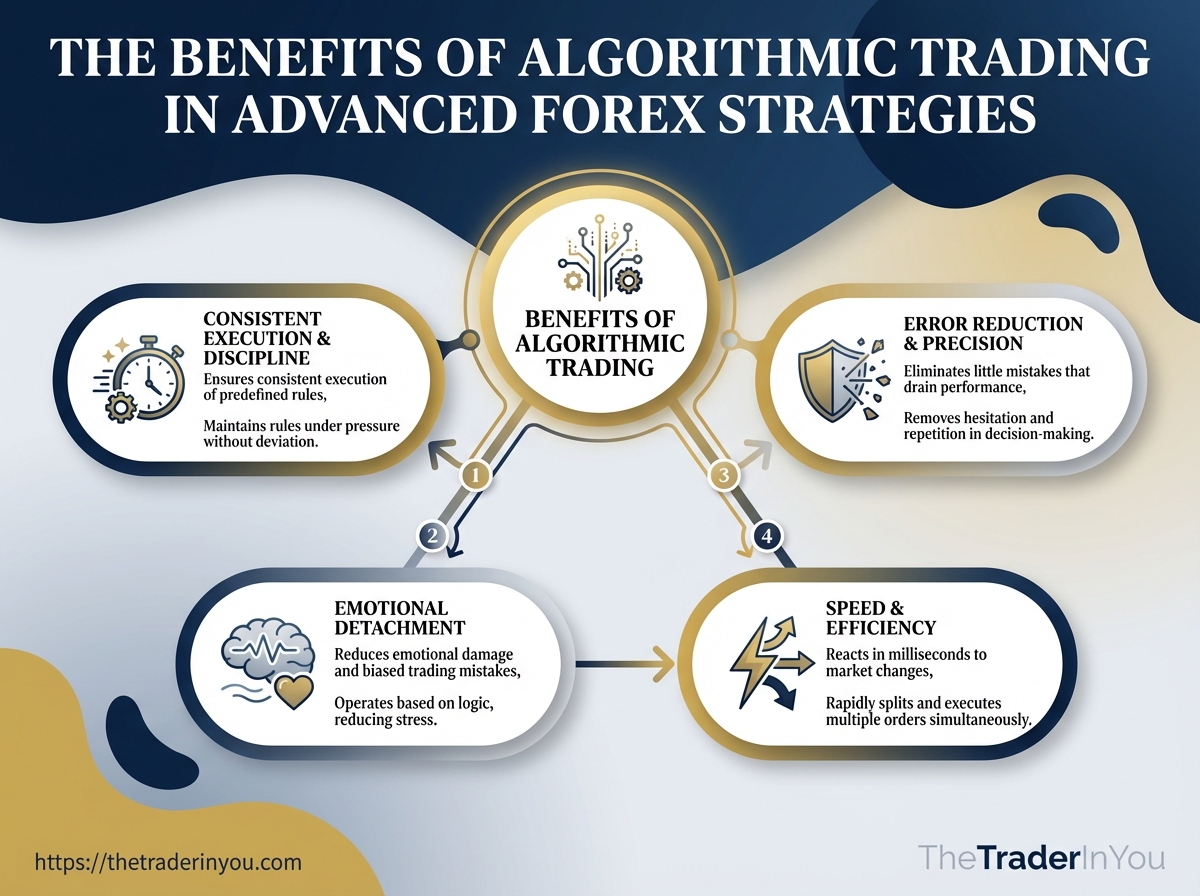
The best automated trading systems do not remove judgment; they remove hesitation, repetition, and the little mistakes that quietly drain performance.
For traders using Forex algorithm strategies, that means the rules stay intact when the pressure rises.
Speed matters, but discipline matters more.
Algorithms can react in milliseconds, split orders, and keep execution consistent when manual entries drift or stall.
One of the clearest algorithmic trading benefits is simple: less emotional damage, cleaner execution, and a process that behaves the same on a calm day and a chaotic one.
None of this makes forex easy.
It does make it more manageable, especially when the strategy is tested, the risk is defined, and the trading rules are not left to mood.
Algorithmic trading improves advanced Forex strategies by executing a rules-based setup consistently even when markets move fast, preventing hesitation and inconsistent sizing that can turn identical EUR/USD signals into different outcomes. Automated systems can react in milliseconds and enforce predefined risk limits, while also targeting best execution with lower slippage as a core advantage. The edge depends on testing and clear strategy logic, because automation only standardizes execution—not market understanding.
What Algorithmic Trading Changes in Advanced Forex Strategy
Why do two traders see the same EUR/USD setup and end up with very different results? The answer usually sits between speed, discipline, and repeatability.
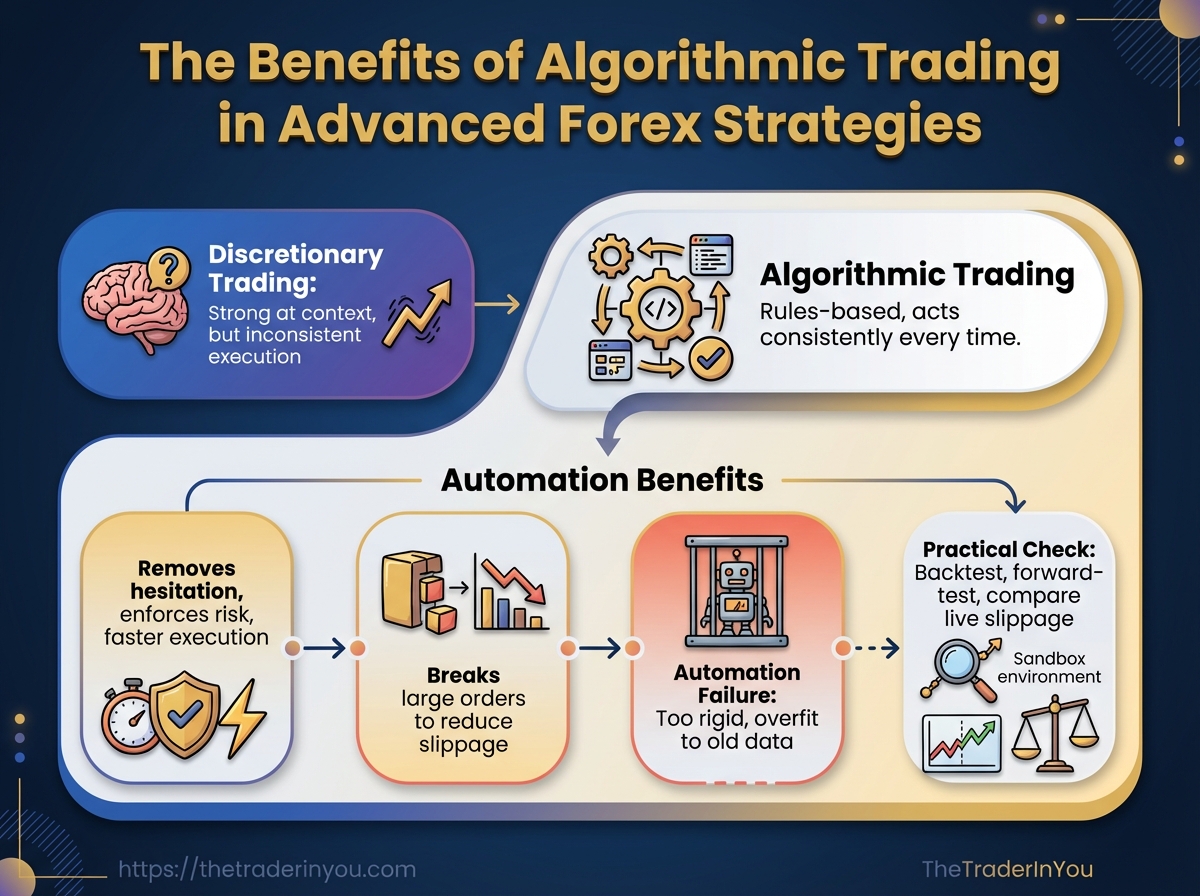
Discretionary trading is strong at reading context.
It can spot a central bank tone shift, a messy range, or a fake breakout that a model might miss.
But it also tends to miss the same pattern when it appears three times in a month, because human judgment changes with fatigue, mood, and market noise.
Why repeatable opportunities slip through
A clean setup is only valuable if it is treated the same way every time.
In practice, traders often hesitate on one signal, chase another, and size positions differently depending on the day.
That inconsistency makes it hard to see whether the edge is real.
A rules-based system turns market logic into action.
If trend strength, volatility, and session timing line up, the system acts the same way every time.
That is why FOREX.com’s guide to algorithmic trading stresses best execution and lower slippage as core advantages of automated trading systems, not side benefits.
Where automation helps, and where it gets ugly
Automation shines when the strategy already has a clear edge.
It can remove hesitation, enforce risk limits, and handle execution faster than a person can click.
ThinkMarkets’ 2026 guide to automated trading also notes that banks use execution algorithms to break large orders into smaller pieces and control market impact.
> Large orders are often split into smaller child orders to reduce slippage and avoid pushing price around. That logic matters just as much in retail forex as it does in institutional execution.
Automation becomes a problem when the model is too rigid.
A mean-reversion system built for calm conditions can get shredded during a news spike.
The same happens when a strategy is overfit to old data and cannot adapt to a fresh regime.
- Best use case: repetitive entries, strict exits, and clear risk rules.
- Best execution: fast markets where delay hurts fills.
- Bad fit: fuzzy setups that depend on gut feel.
- Common failure: assuming past behavior will stay stable.
- Practical check: backtest, forward-test, then compare live slippage.
The real shift is not that machines trade better than people.
It is that they make the rules visible, testable, and brutally honest.
That alone changes how advanced Forex strategies get built, judged, and trusted.
Among the clearest algorithmic trading benefits is execution consistency—especially when the market gets fast and messy.
In forex, spread variability, momentary price jumps, and order-handling delays can turn a correct idea into a mediocre outcome. Automated systems help because they respond to the same inputs every time, and they can apply your rules with less hesitation than manual trading.
Manual vs algorithmic execution in practice
| Trading factor | Manual approach | Algorithmic approach | Practical benefit |
|---|---|---|---|
| Entry timing | Depends on attention and reaction time | Triggers on predefined conditions | Fewer missed entries |
| Exit discipline | Often affected by hesitation or hope | Closes trades at set rules | Cleaner risk control |
| Reaction to volatility | Prone to second-guessing | Responds instantly to market conditions | Less emotional drift |
| Consistency across sessions | Varies with fatigue and focus | Applies the same logic every time | More repeatable results |
| Strategy testing speed | Slow, trade-by-trade review | Fast backtests across pairs and periods | Quicker refinement |
Algorithms shine when precision matters more than instinct—because they can follow your defined stop logic, enforce limits, and keep the strategy’s behavior stable from calm hours to volatile sessions.
Importantly, this isn’t about removing risk. It’s about reducing the avoidable variability that comes from clicks, delays, and shifting intent—so the edge (if it exists) is easier to measure, compare, and improve.
How Automated Trading Systems Support Advanced Strategy Design
What happens when a strategy stops being a chart pattern and becomes a set of rules? That is where automated trading systems start doing their best work.
They turn vague ideas like “ride the trend” or “fade the move” into testable logic that behaves the same way every time.
Trend-following, breakout, and mean reversion systems all need different logic, but they share the same backbone: clear entry rules, exit rules, and risk limits.
In practice, that means a trend system might enter after price closes above a moving average and a breakout system might wait for a range high to give way, while a mean reversion model looks for exhaustion near an extreme and then demands confirmation before acting.
Sources such as ThinkMarkets’ 2026 guide to automated trading strategies and New York City Servers’ overview of forex algorithmic trading strategies both point to these families as core building blocks in modern Forex algorithm strategies.
The real edge comes from encoding the boring parts properly.
Entries need a precise trigger, exits need a price-based or time-based rule, and position sizing needs to reflect account risk rather than gut feel.
That is why many professionals treat prediction as the least interesting part of the job; the structure around the trade matters more.
Interactive Brokers’ piece on AI-driven algorithmic trading also highlights how precision improves when rules stay consistent instead of drifting with mood or noise.
A simple model might risk 1% of equity per trade, cut the trade if price closes back inside the breakout zone, and reduce size after a volatile session.
A mean reversion setup might do the opposite: smaller size, tighter invalidation, and a faster exit if the rebound stalls.
That kind of discipline is what keeps a clever idea from becoming an expensive habit.
- Trend following: Hold until the trend fails, not until it feels “long enough.”
- Breakout systems: Enter only after confirmation, then define the invalidation level first.
- Mean reversion systems: Fade extremes carefully, because bad timing gets punished fast.
- Position sizing: Match size to risk, not confidence.
- Parameter discipline: Keep inputs stable unless market structure truly changes.
Research on algo trading also emphasizes how structured rules reduce emotional decision-making and make backtesting meaningful, which is why Zelleducation’s 2026 overview of algo trading still matters here.
The sharpest systems are usually not the fanciest ones.
They are the ones that stay honest when the market gets messy.
Broker and Platform Requirements That Shape Results
Why do two traders run the same Forex algorithm strategies and get different fills? The broker and platform are often the quiet difference.
One setup gets clean execution, while the other bleeds on spread, delay, and bad order handling.
That matters more than most people think.
Execution quality, spreads, and latency shape whether automated trading systems behave like disciplined machines or like frustrated guesswork.
In 2026, execution still comes down to pricing quality and speed, and brokers openly frame that around best execution and low latency, not just access to charts; Forex.com’s algorithmic trading guide makes that point clearly, and ThinkMarkets’ 2026 guide to automated trading emphasizes the same execution reality.
A practical broker check starts with the boring stuff.
If the platform cannot handle your order types, store reliable history, or connect cleanly through API or scripting, the strategy may look great in testing and wobble in live trading.
That is why execution details matter just as much as algorithmic trading benefits themselves.
Platform features that matter for automated Forex trading
| Feature | Why it matters | What to look for | Risk if missing |
|---|---|---|---|
| Low-latency execution | Faster fills reduce slippage on fast-moving pairs. | Stable execution times, nearby servers, direct routing, and clear execution policy. | Missed entries, worse exits, and weaker fill quality. |
| API or scripting support | Automation needs a way to place, modify, and cancel orders programmatically. | MT4/MT5 support, REST or FIX access, Python or cTrader scripting, and sandbox access. | Manual work replaces automation, and rules break under pressure. |
| Historical data quality | Backtests are only as good as the price feed behind them. | Tick-level data, clean timestamps, enough history, and no obvious gaps. | False confidence from unrealistic backtest results. |
| Backtesting tools | Strategy logic should be tested before real capital is exposed. | Walk-forward testing, spread assumptions, and realistic commission settings. | Overfit systems that look strong on paper and fail live. |
| Order type support | Different Forex algorithm strategies need different order controls. |
Market, limit, stop, trailing stop, OCO, and partial fills. | Strategies cannot express their rules properly. |
It keeps spreads stable, routes orders predictably, and gives the platform enough control to follow the script.
That mix supports the algorithmic trading benefits people actually want: cleaner execution, fewer emotional errors, and more repeatable results.
The best test is simple.
Run a small live sample, compare fill quality against your backtest assumptions, and check whether the platform behaves the same during quiet hours and active sessions.
When those numbers stay close, the broker is probably doing its job.
Risk Control, Validation, and Real-World Failure Points
A strategy can look brilliant on a backtest and still fall apart the first week it meets live prices.
That gap is where most automated trading systems get humbled, because historical data is tidy and the market is not.
Backtesting still matters.
It helps separate a real edge from lucky noise, and it shows how a set of Forex algorithm strategies behaves across different conditions.
The trap is overfitting: the more a system is tuned to one dataset, the more it starts memorizing the past instead of trading the future.
That is why serious validation goes beyond one neat equity curve.
Walk-forward checks, forward testing, and live monitoring force the logic to prove itself again and again under changing spreads, volatility, and execution quality.
As ThinkMarkets notes on algorithmic trading strategies, execution algorithms are often designed to control risk without disturbing the market, which is exactly the kind of discipline a live system needs.
Validation that actually means something
A clean process usually starts with backtesting on one data set, then walk-forward testing across several slices of time.
After that comes forward testing in a demo or small live account, where the system faces real quotes and real timing.
A good check is simple: if performance collapses when you slightly change parameters, the edge was probably fragile.
Research and trading guides from Forex.com on algorithmic trading and STP Trading on forex trading costs and execution quality both point to the same practical problem—slippage, spreads, and delay can erase a strategy that looked fine on paper.
Where automated systems usually break
- Bad data: Missing candles, bad ticks, or bad session filters can distort entries and exits.
- Overfit rules: Too many parameters often mean the model learned noise, not structure.
- Execution drift: Slippage, widening spreads, and delayed fills can change the trade math fast.
- Live environment mismatch: A demo feed, a broker feed, and a real account rarely behave the same way.
- Operational faults: VPS crashes, API hiccups, and symbol mapping errors can stop a system cold.
- No monitoring discipline: Without alerts, drawdown limits, and trade logs, small issues become expensive ones.
The cleanest automated trading systems are not the cleverest.
They are the ones that survive friction, adapt when conditions shift, and fail in obvious ways before the account takes the hit.
Building a Practical Framework for Using Algorithmic Trading
A strategy should not be automated just because it can be automated.
Trend-following, mean-reversion, and rule-heavy breakout systems usually fit automated trading systems well because the logic is repeatable and the inputs are clean.
Discretionary setups are different.
If the edge depends on reading headlines, judging tone, or reacting to a messy price sweep, full automation often turns a good idea into a clumsy one.
That is why many Forex algorithm strategies work best in layers: the machine handles entries, exits, or order routing, while the trader keeps control over the parts that still need judgment.
Sources like ThinkMarkets’ 2026 guide to automated forex trading strategies and Forex.com’s algorithmic trading overview both point to the same practical idea: execution-heavy tasks are the easiest place to start.
Once the system is live, the job changes.
The real work becomes monitoring execution quality, not chasing every chart move.
Spreads, slippage, delays, and error logs tell you far more about performance than a single winning day ever will, and STP Trading’s 2026 forex overview makes that point clearly.
A simple readiness checklist for automation
| Check item | Pass criteria | Why it matters |
|---|---|---|
| Defined entry and exit rules | Rules are written clearly enough that two people would code the same logic | Prevents guesswork and keeps the system consistent |
| Verified historical data | Data has enough depth, clean timestamps, and no obvious gaps | Bad data produces false confidence |
| Acceptable drawdown profile | The strategy can survive its worst realistic losing stretch | Stops traders from over-sizing a fragile system |
| Broker and platform compatibility | Orders, symbols, lot sizes, and order types are supported without workarounds | Reduces execution errors and rejected trades |
| Live monitoring plan | Spreads, slippage, latency, and trade logs are reviewed on a set schedule | Catches drift before it becomes expensive |
If the strategy is rule-based, the checklist passes, and the live metrics stay clean, automation usually adds the most value where humans are weakest: consistency, patience, and execution discipline.
That is where the algorithmic trading benefits show up in a way traders can actually feel.
The Edge Lives in the Rules
When a fast market hits, the trader with the cleanest rules usually keeps the clearest head.
That is the real promise behind algorithmic trading benefits in Forex: not magic returns, but fewer emotional guesses when timing matters most.
The value shows up when a proven setup can be repeated, measured, and improved instead of being reinvented on every trade.
The strongest Forex algorithm strategies do not try to predict everything.
They focus on one repeatable edge, then let automated trading systems handle the parts humans tend to mishandle: hesitation, overtrading, and inconsistency.
That is why the framework matters so much; a weak rule set becomes a weak algorithm, no matter how elegant the code looks.
The next move is simple: pick one recurring setup, write the entry and exit rules in plain English, and test them on a demo account before risking real capital.
If you want structure around that process, our trading courses can help turn a rough idea into something measurable and disciplined.
A trader who can define the rules today is already ahead of the trader still hoping instinct will save the trade tomorrow.

Follow Joshua for daily forex tips on X: @thetraderinyou or connect with him on LinkedIn: Joshua Okapes.
- What to Look for in a Forex Trading Mentor: Key Considerations - April 17, 2026
- Common Mistakes Beginners Make in Forex Trading and How to Avoid Them - April 15, 2026
- The Benefits of Algorithmic Trading in Advanced Forex Strategies - April 15, 2026