A setup can look brilliant on a chart and still fall apart the moment real spreads, slippage, and timing enter the picture.
That is why backtesting forex is not a fancy extra; it is the first honest check on whether a strategy has any edge at all.
The trap is simple.
A trader sees a clean entry, a tidy take-profit, and a string of wins in hindsight, then assumes the same pattern will hold in live conditions.
It rarely does, because testing trading strategies on historical data exposes the ugly parts that charts tend to hide.
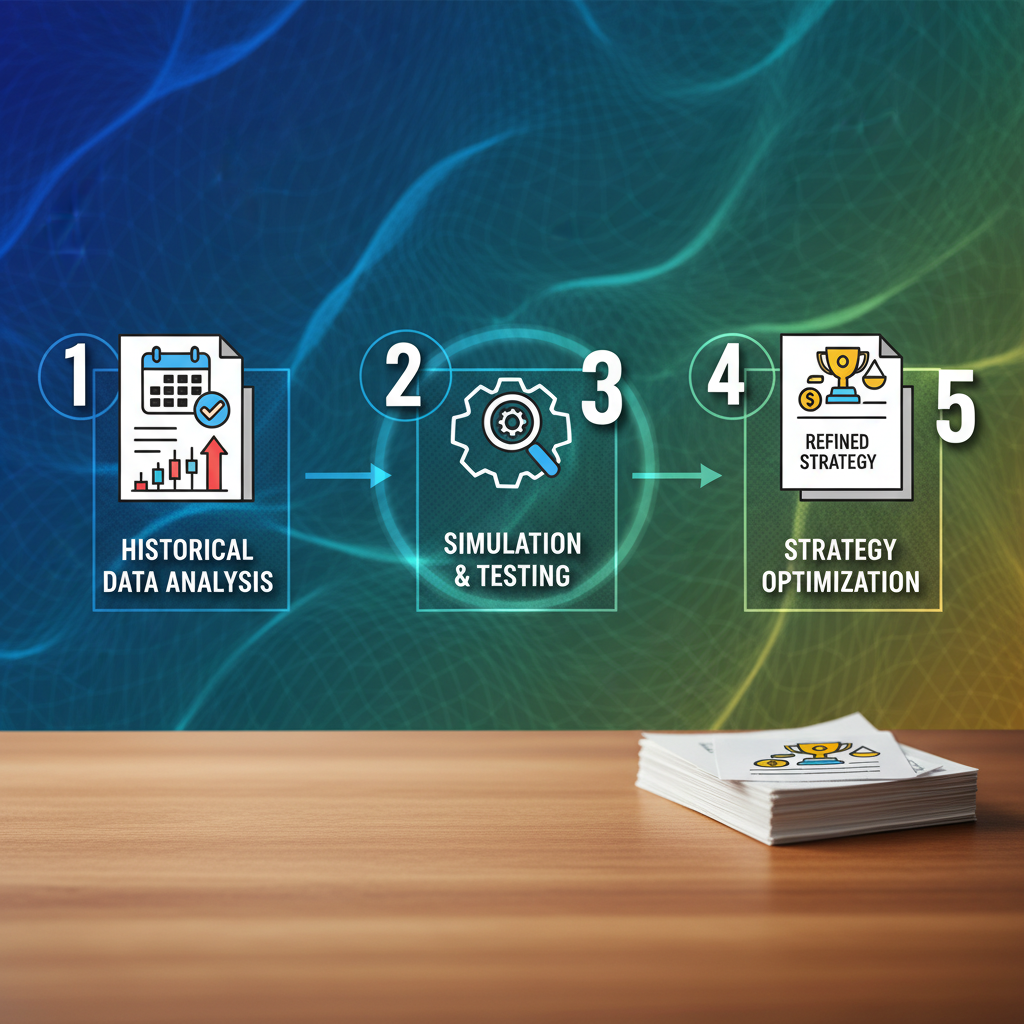
That is where forex trading simulations earn their keep.
They turn opinion into evidence by showing how a method behaves across different sessions, volatility spikes, and losing streaks.
A strategy that survives a large sample tells a very different story from one that only looks good on a handful of perfect trades.
The real value is not just spotting winners.
It is learning how a strategy handles drawdowns, how often it fails, and whether the numbers still make sense once execution costs are included.
That kind of clarity saves traders from the most expensive mistake in forex: believing a pattern works simply because it worked once.
Quick Answer: Backtesting forex is how we test whether a strategy’s rules survive realistic execution and market variation—before we trust the edge with real capital. Our workflow is simple: (1) simulate with execution-aware assumptions, (2) validate on out-of-sample data to reduce overfitting/look-ahead bias, and (3) measure risk behavior (not just returns) so the results remain tradable once conditions change.
Introduction: Why Backtesting Matters in Forex
Backtesting in forex is not about proving a strategy is “smart.” It’s about stress-testing whether the strategy’s rules remain workable once execution details and changing conditions enter the picture.
Crucially, different forex strategies need different levels of realism. A fast breakout system or anything sensitive to order fills will demand a more execution-aware simulation than a broad, slow-moving swing idea.
If the test is built around the wrong assumptions or the wrong data granularity, the result can mislead you—even when the strategy looks clean on a chart.
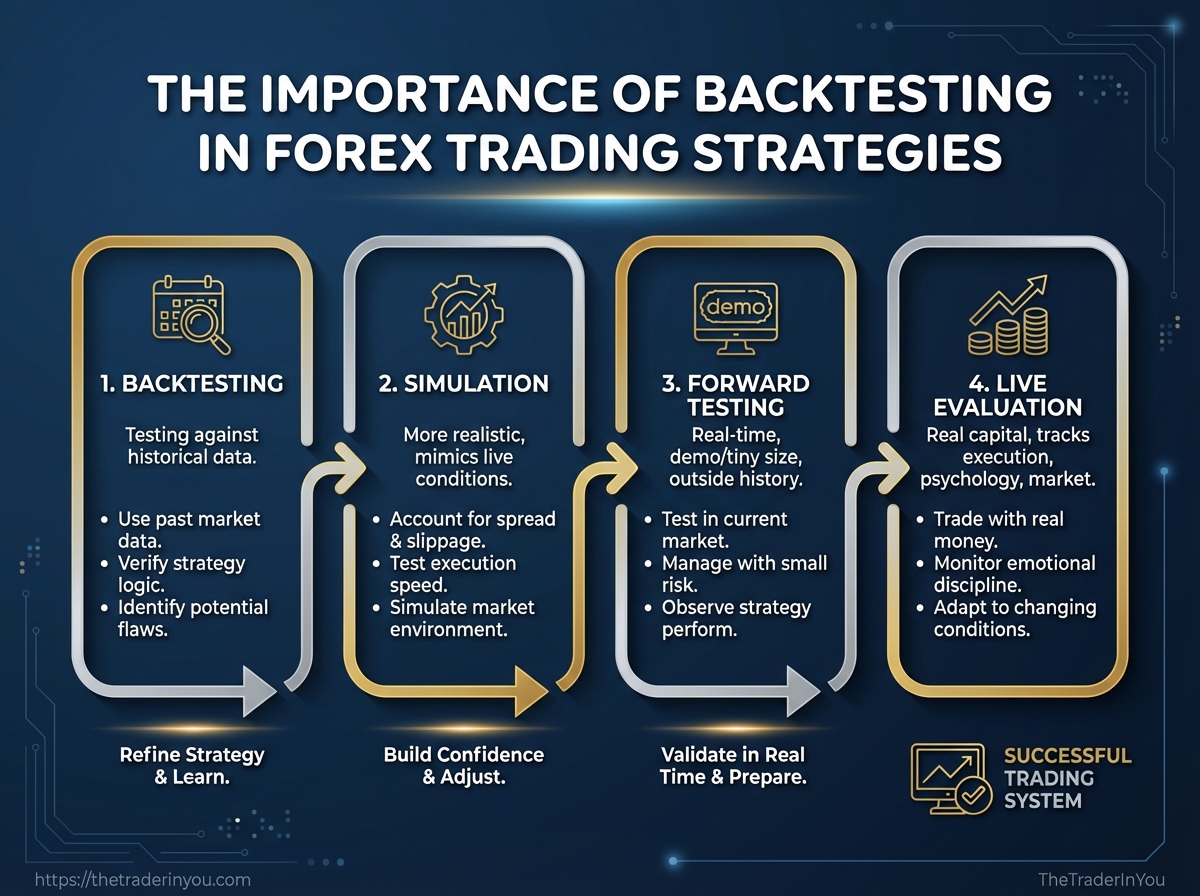
Backtesting: Testing a trading rule against historical market data to estimate how it might have performed.
Simulation: A more execution-aware test that attempts to mimic live conditions (bid/ask spread, order fills, stops, and slippage).
Forward testing: Running the strategy in real time (typically demo or small size) to check whether results persist outside the historical period.
Live evaluation: Trading with real capital and tracking whether real execution quality and behavior still support the expected edge.
When backtesting helps most, it clarifies what you can expect under realistic constraints. When it misleads, it usually comes from optimistic fill assumptions, mismatched data granularity, or validating the past while failing to validate the future.
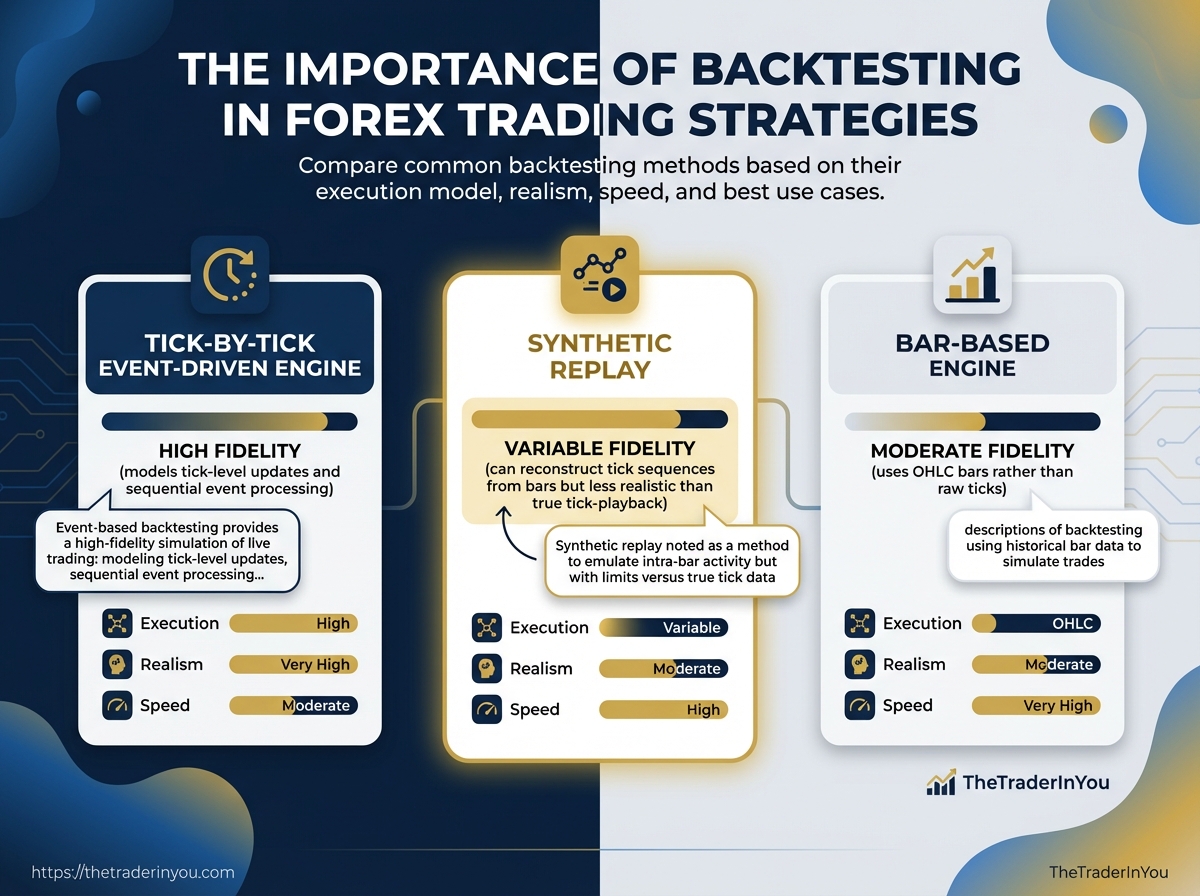
Why do two backtests of the same EUR/USD setup sometimes disagree so badly? The culprit is rarely the strategy idea—it’s usually the mechanics: the engine logic, the data granularity, and the fill model.
A bar-based test can make a strategy look neat and predictable.
A tick-driven replay can expose spread spikes, stop-outs, and awkward fills that never show up in candle-only work.
At The Trader In You, we treat backtesting as part of a repeatable workflow that connects analysis to execution, not as a side quest.
That matters in backtesting forex, because the method you choose shapes the story your data tells.
Synthetic replay sits in the middle.
Platforms such as FX Replay’s replay mode and order simulation tools try to reconstruct fills, stops, and slippage more realistically than simple candle tests, which makes them useful for execution-sensitive forex trading simulations.
Comparing the main methods
| Method/Engine | Execution Model | Realism (fills, slippage) | Speed | Best use case |
|---|---|---|---|---|
| Tick-by-tick event-driven engine | Processes each market event in order | Highest realism; can model spread changes, stop fills, and slippage closely | Slowest | News scalps, breakout systems, and any strategy that depends on exact execution |
| Bar-by-bar simulation | Uses OHLC candles as the decision frame | Moderate to low; intrabar path is hidden | Fast | Early screening of swing ideas and higher-timeframe systems |
| Vectorized/backtest libraries, such as pandas-based tools | Calculates signals across arrays or data frames | Low to moderate unless custom fill logic is added | Fastest | Large parameter sweeps and research-heavy testing strategies |
| Broker or platform built-in backtester | Runs inside the charting or broker environment | Moderate; usually practical, but still rule-based | Fast to moderate | Retail testing where convenience and repeatability matter |
| Hybrid or sampled-tick approach | Mixes bars with selected ticks or reconstructed events | Better than bars, less exact than full tick data | Balanced | Execution-sensitive systems when full tick data is unavailable |
The same guide notes that vectorbt can test thousands of parameter combinations quickly, which is why vectorized tools shine when the job is broad research rather than precise execution modeling.
For forex systems that depend on fills, the detail matters.
Goat Funded Trader’s 2026 backtesting guide pushes out-of-sample validation and realistic slippage modeling for exactly that reason.
The practical rule is simple: bars are fine for first-pass filtering, replay tools are better for execution realism, and tick-level engines are for strategies where the candle body is not enough.
Pick the engine that matches the trade, not the one that makes the curve look prettiest.
If your backtest and live trading results diverge—different fills, different drawdowns, different “winning” trades—the reason is usually straightforward: price isn’t the whole market.
Forex outcomes are shaped by ticks, spread, liquidity, and execution, and each one bends results in its own direction.
When the data is sloppy, the backtest becomes a story instead of a test.
That is why realistic forex trading simulations need bid/ask structure, not just a neat candle series.
Platforms such as FX Replay’s backtesting and simulation features emphasize bid/ask fills, stops, slippage, and journaling for exactly that reason.
What clean FX data actually contains
A tick is the smallest market update you can observe.
A spread is the cost sitting between bid and ask.
Liquidity snapshots and fills tell you whether your order would have been absorbed cleanly or slipped into a worse price.
A backtest that ignores those pieces is usually too optimistic.
Even a strong strategy can look weaker once spread widens around news or liquidity thins in the London-New York overlap.
- Ticks: show price movement at the most granular level.
- Spreads: reveal the true entry and exit cost.
- Liquidity snapshots: hint at whether orders could realistically get filled.
- Fills: show the price your trade would likely receive, not the price you wish for.
What to ask a data provider
A clean-looking price feed is not enough.
Ask whether the historical FX data includes bid and ask, whether spreads are fixed or time-varying, and whether commissions and slippage are modeled.
A 2026 guide from Goat Funded Trader on backtesting strategies warns that over 70 percent of traders underestimate slippage and commissions, which is exactly how paper winners become live disappointments.
> A 2026 guide from Goat Funded Trader says over 70 percent of traders underestimate slippage and commissions.
- Source format: confirm tick-level or bar-only data.
- Spread history: check whether spreads are archived by session.
- Corporate actions: less relevant in FX, but feed adjustments still matter.
- Time stamps: verify timezone handling and DST shifts.
Make the environment reproducible
Infrastructure matters because a brilliant backtest is useless if you cannot recreate it later.
TradingView’s Strategy Tester and Bar Replay, plus Python tools such as Backtrader, Zipline, and vectorbt, are useful partly because they support repeatable rule sets and exportable results.
The real discipline is logging everything: data version, broker settings, order logic, and execution notes.
The Trader In You’s own workflow ties backtesting to risk management for the same reason—clean analysis only matters when it survives the live handoff.
- Frozen settings: keep symbol, timeframe, and session rules unchanged.
- Execution logs: record entries, exits, rejection notes, and slippage.
- Environment parity: match the same data source in every rerun.
That combination turns testing trading strategies into something you can trust, not just admire.
And in forex, trust is earned one fill at a time.
A strategy can be solid and still produce inconsistent results if the testing workflow isn’t controlled.
A repeatable process fixes that. It turns backtesting forex into a disciplined, comparable experiment—so your results are closer to evidence than opinion.
TradeZella’s 2026 backtesting guide frames the bar pretty clearly: a strategy needs positive expectancy over 200+ backtested trades before the numbers start meaning much, while Goat Funded Trader’s 2026 guide on out-of-sample testing pushes traders to separate in-sample and out-of-sample data to avoid overfitting.
Execution details matter just as much.
FX Replay’s 2026 backtesting feature guide highlights bid/ask fills, stops, slippage, and journaling for a reason: a clean equity curve means little if the fills are fantasy.
That same discipline sits inside The Trader In You’s forex market analysis workflow, where backtesting and risk management belong in the same process.
- Write exact rules. Define the entry trigger, stop, target, and risk per trade in plain language. If two people can read it differently, the test is already contaminated.
- Model execution honestly. Add spread, commission, and slippage assumptions before trusting the results. Realistic forex trading simulations are supposed to be awkward, not flattering.
- Lock the testing universe. Keep the same pairs, timeframe, session window, and data format every run. Changing symbols or dates midstream hides the real edge.
- Validate out of sample. Hold back recent data, then run walk-forward tests and cross-validation on fresh periods. That is how you catch look-ahead bias before it quietly wrecks the stats.
- Automate and version everything. Save parameter files, logs, trade IDs, and test dates so the same run can be reproduced later. Python tools like Backtrader, Zipline, and vectorbt are useful here, especially when parameter sweeps get large.
A solid process makes testing trading strategies feel less glamorous and far more useful.
That is usually where the real edge starts showing up.
Key Metrics, Statistical Tests and Common Pitfalls
A backtest can look beautiful and still be useless.
That is why our forex analysis workflow at The Trader In You treats backtesting as part of risk control, not a side quest.
The numbers that matter most are not the flashiest ones. CAGR tells you how fast equity grew, Sharpe shows how much return came per unit of volatility, and MAR ratio puts long-term growth next to worst drawdown, which is exactly where many strategies quietly fall apart.
Drawdown profiles deserve equal attention.
A strategy with decent returns but ugly, clustered drawdowns can still be a nightmare to trade live, especially in backtesting forex setups that rely on tight execution and stable spreads.
> TradeZella’s 2026 guide on backtesting metrics says profit factor above 1.5 is solid, and it recommends 100+ trades before treating win rate as meaningful. TradeZella’s 2026 backtesting guide
- CAGR: Best for comparing growth over time, especially when you want a clean annualized view.
- Sharpe ratio: Useful when two strategies earn similar returns but one swings far less.
- MAR ratio: Strong when drawdown matters more than vanity returns.
- Drawdown profile: Look at depth, duration, and clustering, not just the worst dip.
Statistical checks keep testing trading strategies honest.
A low p-value can help, but it does not rescue a bad setup that was tested across too many variations.
That is where multiple hypothesis correction and Monte Carlo tests earn their keep, because they expose how often a “winner” appears by luck alone.
- Overfitting: A model that fits history too neatly often dies fast out of sample.
- Look-ahead bias: Any use of future information makes the result fake, even if the spreadsheet looks polished.
- Data snooping: Testing dozens of tweaks and only showing the best one creates false confidence.
- Survivorship bias: Ignoring failed symbols or pairs makes the past look cleaner than it was.
Goat Funded Trader’s backtesting guide stresses out-of-sample testing because strategies can look strong in research and still fail in live conditions.
It also notes that many traders skip that step, which is usually where the trouble starts.
Goat Funded Trader’s guide on free backtesting strategies
When a model degrades out of sample, the warning signs are usually plain.
Expectancy drops, drawdowns arrive faster, the equity curve flattens, and the live trade distribution stops resembling the test period.
The cleanest defense is simple: test across enough trades, question every assumption, and treat good results as a starting point rather than proof.
Good research makes bad surprises show up early, while they are still cheap.
From Backtest to Live: Implementation, Monitoring and Continuous Improvement
A strategy that prints money in a notebook can still bleed out in live trading.
That gap usually has little to do with the idea itself.
It comes from spread changes, slippage, fill quality, and how the broker handles execution in fast, irregular conditions.
Platforms built for forex trading simulations help expose those weak spots before real capital is on the line—especially when the replay engine supports realistic bid/ask fills and order behavior (as FX Replay describes in its Replay Mode and journaling features).
The move from test to live works best when the live plan is boringly strict.
A strategy should clear a few gates first: positive expectancy over a meaningful sample, drawdown that fits the account, and execution assumptions that still hold after commissions and slippage (see Section 8 for the metric benchmarks we track).
> If the backtest math and the live execution story don’t match, monitoring becomes your early-warning system.
Before going live
A clean launch starts with a short checklist.
- Execution match: confirm the live broker’s spread and commission profile is close to the test assumptions.
- Risk cap: set per-trade risk, daily loss limits, and a hard stop for the pilot phase.
- Order rules: keep entries, exits, and partials identical to the tested version.
- Pilot window: trade small size first, then compare results against the backtest profile.
Monitoring for drift
Live monitoring is really about catching mismatch early.
Watch slippage, fill quality, win rate, average R-multiple, and consecutive losses.
If slippage widens for several trades in a row, or if the strategy’s average payoff starts shrinking, the edge may be leaking through execution rather than logic.
When to adjust, and when to stop
A strategy should be recalibrated when the problem is operational, not conceptual.
Maybe the broker changed, spreads widened, or a session filter is too loose.
Retire it when the edge disappears across a new sample—especially after forward testing.
That’s why a repeatable workflow matters: backtesting and risk control aren’t separate hobbies, they’re one continuous validation loop.
The best live trading plans stay humble.
They survive by measuring, adapting, and walking away when the numbers stop talking.
How far back should I backtest a forex trading strategy?
Backtest far enough to cover multiple market regimes and validate results with out-of-sample periods (walk-forward/holdout). Always include realistic execution costs—spreads, slippage, commissions, and fill assumptions—so the historical test reflects how orders actually behave.What metrics matter most in forex backtesting (profit factor, drawdown, expectancy, or win rate)?
We prioritize return and risk: maximum drawdown (and the drawdown profile), plus expectancy (or profit factor) to confirm gains outweigh worst losses under realistic execution. Win rate alone can be misleading—especially when losses are infrequent but large or when spreads/slippage erode edge.When a Strategy Survives the Messy Parts
Backtesting forex isn’t about proving a strategy is clever. It’s about stress-testing whether your specific rules still produce acceptable risk and outcomes once realistic trading frictions and timing constraints are included.
When a strategy only works on perfectly clean candles, it usually doesn’t survive contact with execution. The solution isn’t to abandon backtesting—it’s to make it more empirical and more verifiable.
Do one disciplined backtest today for a single pair:
- Include execution costs (spread/commission and a reasonable slippage assumption).
- Validate out of sample (walk-forward or a holdout period).
- Review not only returns, but risk behavior (drawdown profile, expectancy, and failure frequency).
- Log assumptions so you can rerun the test and compare results after changes.
If the results don’t hold under realistic constraints, revise the rule set before risking live capital. The habit you’re building—measuring, documenting, and verifying—matters more than any one strategy idea.

Follow Joshua for daily forex tips on X: @thetraderinyou or connect with him on LinkedIn: Joshua Okapes.
- The Importance of Backtesting in Forex Trading Strategies - April 20, 2026
- What to Look for in a Forex Trading Mentor: Key Considerations - April 17, 2026
- Common Mistakes Beginners Make in Forex Trading and How to Avoid Them - April 15, 2026