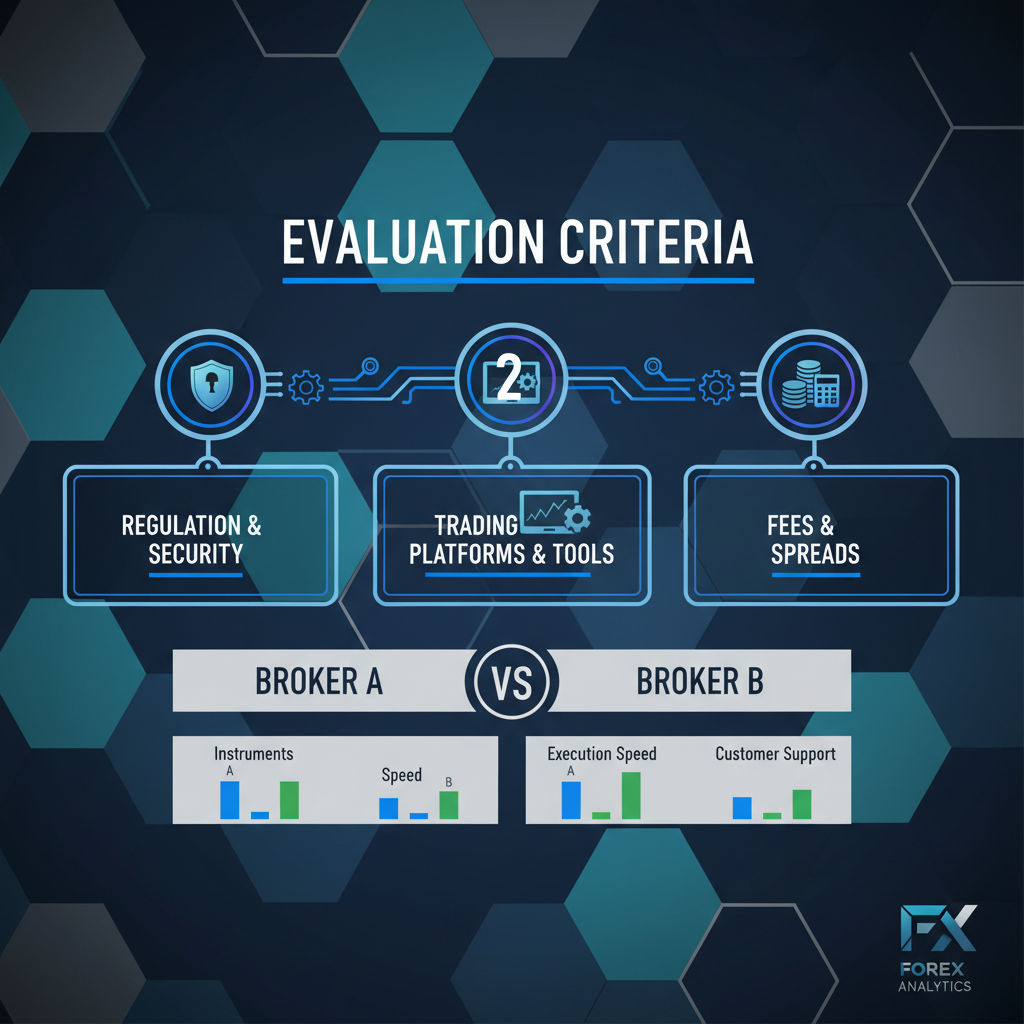
What if the broker with the tightest spread turns out to be the most expensive mistake? A polished website can hide slow withdrawals, weak oversight, or execution that slips at the worst moment.
That is why a serious Forex broker comparison starts with what happens after the ads stop talking.
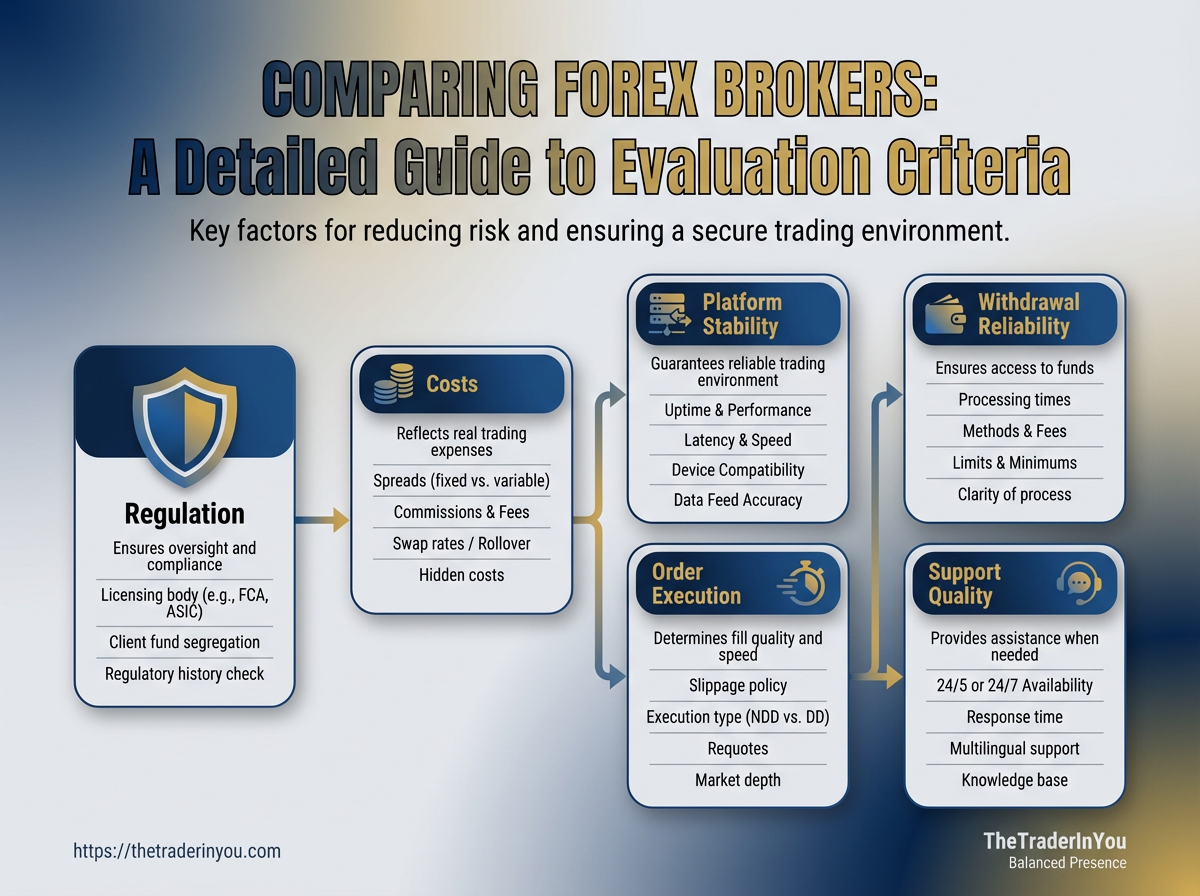
The real evaluation criteria for brokers go beyond price. Regulation, costs, platform stability, and order execution tell you whether a broker is built for real trading or just good marketing.
In 2026, the difference often shows up in small details that beginners miss and experienced traders watch closely.
One trader may care most about low spreads on EUR/USD, while another needs dependable withdrawals and clear margin rules.
Learning how to compare Forex brokers means looking at the full trading experience, not one shiny feature that looks good on a homepage.
The best comparison feels almost boring.
It strips out the noise and leaves a clear view of safety, pricing, and usability, so the choice rests on facts instead of promises.
Quick Answer: Pick the broker that matches your specific trading style—not the one with the flashiest marketing—by comparing regulation, real trading costs, execution quality (spread stability and slippage), and practical factors like withdrawal reliability and margin rules. For example, U.S. brokers operate under NFA rules with leverage limits and investor safeguards, while tier-one regulators like ASIC and FCA impose conduct standards, but the “right” broker still depends on how you trade. A mismatch shows up quickly in your trade log as wider spreads, worse fills, or slow execution.
What if the best-looking broker is not the best broker for your trading style?
A polished broker site can hide a bad fit.
The logo is clean, the platform screenshots look fast, and the bonus offer sounds generous—but none of that tells you whether the broker matches your trading rhythm.
That mismatch matters because marketing sells emotion, while trading needs mechanics.
A scalper cares about spread stability and execution speed.
A swing trader may care more about swap costs and order handling.
When you compare brokers properly, you stop guessing and start matching the broker to the way you actually trade.
Regulation is part of that comparison too. U.S. brokers operate under NFA rules with leverage limits and investor safeguards, while tier-one regulators like ASIC and FCA also set strict conduct standards, according to Investopedia’s overview of U.S. forex broker regulations and Liquidity Finder’s 2026 global financial regulators directory.
That does not make every regulated broker a good fit.
It just means the field starts on firmer ground.
A bad match shows up fast in the trade log.
Wider spreads raise entry cost.
Slippage turns a clean setup into a worse fill.
Slow execution can wreck short-term strategies, especially when price moves during news or thin liquidity.
Here’s a simple way to think about it:
- Spread quality: A broker can advertise “tight spreads,” yet still widen them during active sessions.
- Slippage behavior: Fast markets punish brokers with weak execution more than flashy branding.
- Order model: Market maker, STP, and ECN-style setups can affect fill quality in very different ways.
- Platform fit: A crowded platform may be fine for long holds, but painful for fast entries.
- Regulatory strength: Strong oversight reduces some risks, but it does not replace good execution testing.
Imagine a day trader who opens ten trades around major news.
A broker with decent branding but poor execution can turn small gains into flat results.
Over dozens of trades, that gap becomes real money.
That is why a proper Forex broker comparison beats a glossy promise every time.
Strong evaluation criteria for brokers make the difference visible, and knowing how to compare Forex brokers keeps the focus on fills, costs, and control instead of sales copy.
Build a broker evaluation framework before you compare platforms
A clean Forex broker comparison starts with your own trading profile, not a broker’s homepage.
A EUR/USD scalper, a swing trader holding positions overnight, and someone trading indices or gold all care about different things.
That is why a scorecard beats guesswork.
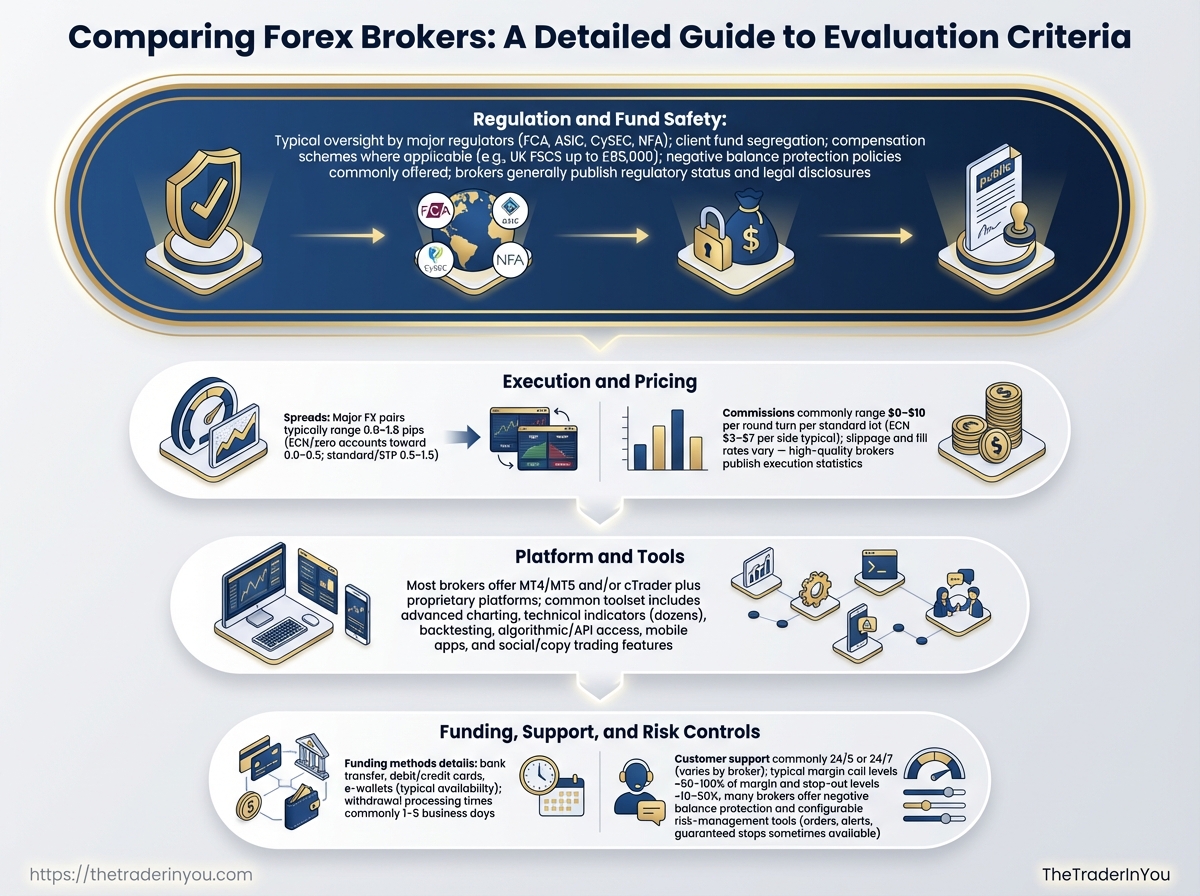
Regulation, pricing, execution, platform fit, funding, support, and risk controls should each earn a weight before any platform gets a look.
A simple split works well: 30% regulation and fund safety, 30% execution and pricing, 20% platform and tools, and 20% funding, support, and risk controls.
That keeps flashy extras from crowding out the parts that actually affect fills and cash access.
Regulation deserves early attention because the rules are not identical across jurisdictions.
The latest regulator directory and U.S. broker rules guide show how oversight differs across the FCA, ASIC, and NFA/CFTC frameworks, while broker roundups such as the 2026 NFA and ASIC lists make the licensing differences easy to spot Global Financial Regulators Directory 2026, U.S. Forex Broker Regulations Explained, Best NFA Regulated Forex Brokers for 2026, Best 9 ASIC Regulated Forex Brokers in 2026.
Broker shortlisting checklist
| Criterion | Why it matters | What to look for | Red flags |
|---|---|---|---|
| Regulation and licensing | Sets the baseline for client protection and complaint handling | Legal entity name, regulator, license number, and a match on the official register | Vague “regulated” claims, offshore-only setup, no license number |
| Pricing structure | Trading costs shape every entry and exit | Published spreads, commissions, swaps, inactivity fees, and withdrawal charges | “From” pricing with missing commissions or hidden conversion fees |
| Execution quality | Poor fills can turn a good setup into a bad trade | Execution policy, order types, slippage policy, and trading-hour conditions | Requotes, unexplained slippage, no execution policy |
| Platform and tools | The platform must fit the way you trade | Charting, alerts, hotkeys, mobile stability, depth of market, VPS support | Missing order types, weak mobile app, clunky risk controls |
| Funding and withdrawals | Fast cash access matters as much as deposits | Supported methods, timelines, fees, base currencies, and withdrawal rules | Slow withdrawals, unclear cutoffs, extra admin charges |
| Customer support | Problems rarely happen at a convenient time | Live chat, phone, email, response times, and weekend coverage | Chat-only support, scripted replies, no escalation path |
| Risk controls | Helps limit damage when markets jump | Negative balance protection, margin call levels, stop-loss options, position limits | Hidden liquidation rules, unclear margin policy, no protection details |
If two brokers look close on price, execution policy and withdrawal rules usually break the tie.
A trader who treats this like a checklist, not a vibe test, ends up with fewer surprises and cleaner comparisons.
That is usually where a serious broker shortlist starts to feel real.
Assess regulation, legal structure, and client fund protections
Brand legitimacy isn’t enough—what matters is the legal entity behind your account and the protections tied to it.
The first check is painfully simple and still skipped all the time.
Find the broker’s exact company name and license number, then match both against the regulator’s own register, not the broker’s homepage.
In U.S. markets, for example, retail forex brokers fall under NFA and CFTC rules that shape leverage, conduct, and investor safeguards, as laid out in Investopedia’s guide to U.S. forex broker regulations.
A broader scan of major regulators is easy to start with through LiquidityFinder’s global financial regulators directory for 2026.
Entity structure matters just as much.
Many broker groups run several subsidiaries, and your account may sit with a different legal entity depending on where you live.
That is not automatically bad, but it changes the rules that apply to you, which is why evaluation criteria for brokers should always include the exact jurisdiction, not just the brand name.
Client money protection is the next layer.
A serious broker should state whether funds are segregated from company money, whether a compensation scheme applies, and whether negative balance protection covers your account type.
Brokers regulated by the NFA are widely associated with stronger transparency and financial standards, according to TopBrokers’ 2026 NFA-regulated Forex broker list, while ASIC-regulated firms are often used as a benchmark for tighter oversight in RationalFX’s 2026 ASIC broker roundup.
A quick check usually looks like this:
- License match: Confirm the exact company name, not just the trading brand.
- Jurisdiction match: Make sure the entity you sign with is the one the regulator lists.
- Fund rules: Check segregation language, compensation coverage, and whether negative balance protection applies to your account.
- Account region: Confirm that your country does not push you into a weaker offshore subsidiary.
A broker that passes these checks feels less exciting on the surface and far safer underneath.
That is the kind of boring traders learn to love.
Compare trading costs in a way that reflects real market use
Headline spreads can look great—until you price a trade the way you actually trade.
That’s when “cheap” gets padded by commission, swap/overnight financing, and smaller account terms that only show up after money moves.
The cleanest Forex broker comparison totals the full cost of an instrument for realistic holding times, not just the advertised spread.
Instead of debating labels, focus on the disclosures and fee mechanics that determine your all-in bill.
How to estimate all-in trading cost for your average position size
Pick one position size you truly use, then price it under a holding period that matches your strategy.
If you trade one standard lot of EUR/USD, a 1-pip move is roughly USD 10, so an 0.8-pip spread costs about USD 8 before commission.
Then add commission, then add expected overnight financing if you hold beyond rollover.
> All-in cost = spread cost + commission + swap + account fees spread across your trading volume
- One-day scalp (spread + commission matter most)
- Two-night swing trade (swap can dominate)
- Dormant month (inactivity and withdrawal terms matter)
Once you do this math, “cheap” and “expensive” stop being vague marketing words.
The broker that looks best on paper is not always the one that leaves the smallest dent in your real fills.
What matters is whether the broker turns your order into a fill you can trust. Even if pricing looks attractive, execution can break the trade through delayed fills, unexpected routing, or order handling that doesn’t match what you assumed.
Execution model matters because it shapes how your order meets the market. A dealing desk often internalizes flow, which can mean faster quoting in calm conditions—but can also increase conflicts or friction when volatility spikes. STP and ECN-style routing aim to pass orders to external liquidity; the label is less important than what happens in real fills during the sessions you actually trade.
Broker regulation won’t guarantee perfect execution, but it does affect how much disclosure and oversight you should expect. U.S. firms regulated under the NFA operate under stricter conduct rules, while firms in other tier-one jurisdictions such as ASIC and the FCA also face tighter standards than lightly supervised offshore entities, according to Investopedia’s explanation of U.S. forex broker regulation and the 2026 global financial regulators directory.
That’s why serious brokers usually publish more detail about execution policy, order handling, and liquidity access.
Ask for the numbers that reveal the truth
Before funding an account, request the broker’s execution policy and recent execution statistics.If they hesitate, that hesitation usually tells you more than their marketing does.
- Average fill time: Look for platform-to-fill timing during normal and fast markets.
- Slippage breakdown: Ask for average positive and negative slippage separately.
- Requote and reject rates: Higher rates often point to weaker routing or insufficient liquidity access.
- Order handling rules: Check how market, stop, limit, and partial fills are processed.
A broker can say “fast execution” all day. Real data is where the story changes.
Read the live-trading clues
A clean fill on a quiet Tuesday means very little.The harder test arrives during news releases, thin Asian sessions, and fast reversals—when latency and liquidity depth start showing their limits.
According to TopBrokers’ 2026 guide to NFA-regulated forex brokers and RationalFX’s 2026 ASIC-regulated broker review, stronger regulation often correlates with clearer trading conditions and more transparent broker practices.
For your broker comparison, this is the real point: execution quality is an evaluation criterion because it shows up directly in your PnL.
If the broker can’t explain how orders are routed, what you should expect during slippage, and where rejections come from, keep moving.
Good execution leaves a paper trail—and the best brokers usually don’t mind showing it.
Compare platforms, tools, and market access
Even when two brokers look identical on paper, the platform experience can feel worlds apart.
For active traders, that difference shows up fast.
Order speed, screen layout, and chart depth shape the whole experience.
A strong Forex broker comparison does not stop at spreads and regulation.
It also checks whether the platform fits the way you actually trade, because the wrong interface turns simple decisions into annoying little delays.
That is especially true when you move between desktop, web, and mobile.
A trader who scalps on a laptop needs different tools from someone who checks positions on a phone during the commute.
Check the platform stack
Desktop still matters most for serious chart work.
Multi-monitor support, hotkeys, detachable windows, and deeper indicator control make a real difference when you are watching several pairs at once.
Web platforms are best when you need fast access without installing software.
They should keep watchlists, templates, and drawing tools clean and easy to reach.
Mobile is where many brokers cut corners.
The better apps keep order entry simple, alerts reliable, and charts readable without burying basic controls under taps and menus.
- Charting depth: Look for multiple timeframes, custom indicators, and enough drawing tools to mark structure clearly.
- Order types: Market, limit, stop, trailing stop, and linked orders matter when entries need precision.
- Workspace control: Saved layouts, synced watchlists, and one-click switching save time during busy sessions.
- Mobile speed: Fast ticket entry and solid alerts matter more than fancy screens on a small display.
- Specialty tools: Depth-of-market, alarms, and strategy testing can separate a serious platform from a basic one.
Match access to your trading style
Market access is where many traders get surprised.
A broker may offer plenty of pairs, but still limit the instruments, account types, or platform features available in your region.
According to Investopedia’s guide to U.S. forex broker regulations, NFA rules shape what U.S. brokers can offer, including stricter leverage conditions.
Liquidity Finder’s global financial regulators directory 2026 also shows how access changes across major regulators like FCA, ASIC, CFTC, MAS, and ESMA.
For traders building a Forex broker comparison, that means platform choice and market access belong in the same review.
A clean app is nice, but a platform that matches your order style and your region is worth far more.
The best fit usually feels boring in the best way.
Everything is where it should be, and the trade ticket does not fight back.
Test account funding, withdrawals, and support reliability
Funding is usually fast—withdrawals are where reliability is proven.
That’s why funding, withdrawals, and support deserve the same scrutiny as spreads and charting tools.
If you only test one thing, test the boring part: how smoothly the money actually moves.
Start small:
- make a modest deposit,
- request a modest withdrawal,
- and track each step (timelines, documents requested, and any rule changes).
Run the real-world test
Support quality tells its own story—especially when you’re not asking about trading conditions, but about process.
A quick chat response is nice, but the real test is whether someone can explain withdrawal rules, document checks, and timeline changes without vague reassurance.
Use the same checklist logic every time:
- Deposit methods: Confirm which methods are supported (wire/card/e-wallet), plus the fees and limits shown before you fund.
- Processing speed: Cards and wallets are often quickest; wires can take longer. The key is consistency with stated timelines.
- Withdrawal rules: Check minimum amounts, cutoff times, and whether withdrawals must return to the original payment method.
- Support channels: Live chat, email, and phone are table stakes. Ticket history matters because it creates a record if delays happen.
- Response quality: Good support answers clearly, cites the policy, and gives a next step. Weak support hides behind “we’re reviewing” with no specifics.
- Operational friction: First withdrawals often trigger extra KYC/address verification or source-of-funds questions. That’s normal—repeated unexplained delays are not.
A simple habit separates decent brokers from frustrating ones: test the money path before you commit serious capital.
In a real Forex broker comparison, this is where the wheels either keep turning—or where friction shows up fast.
A broker that handles money and support cleanly is usually easier to live with over the long term.
The client agreement is where broker promises either hold up—or quietly change meaning.
You already validated the license/entity against the regulator’s record in the regulation step. Now the due-diligence question becomes more practical: what do the contract clauses do to your trading costs, execution expectations, and ability to withdraw?
That’s where the damage (or the protection) usually shows up—often in fee appendices, execution policy, bonus rules, and regional restrictions.
An inactivity fee, a less favorable stop-out level, or a clause that limits specific order types can matter more than an attractive homepage.
The disciplined due-diligence process (what to extract and score)
Use a consistent checklist so you don’t “feel” your way into a decision.- Read the trading terms line by line (only the clauses that change outcomes).
- fee appendices (spreads/commissions/financing/other charges)
- execution policy language and order handling/priority rules
- margin closeout/stop-out mechanics, weekend holding, and hedging/strategy restrictions
- bonus and eligibility restrictions (especially withdrawal conditions)
- Verify what the documents actually say will happen under stress.
- Score consistently against your shortlist.
Broker comparison scorecard template for final selection
| Category | Weight | Broker A score | Broker B score | Notes |
|---|---|---|---|---|
| Regulation | 30% | 9 | 6 | Use the regulation/entity verification you completed earlier; here score transparency + protections stated in disclosures. |
| Pricing | 20% | 7 | 8 | Include spreads/commissions/swaps and any non-trading fees that can hit your workflow. |
| Execution | 20% | 8 | 7 | Score based on execution policy clarity and your fill/latency/slippage tests. |
| Platform tools | 10% | 7 | 9 | Score charting/order-entry tools plus whether risk controls work as stated. |
| Funding and withdrawals | 10% | 8 | 6 | Score processing timelines, withdrawal rules, and documented friction (KYC triggers, cutoffs, return-to-source rules). |
| Support | 10% | 9 | 5 | Score based on response quality and whether answers match written policy. |
The goal isn’t perfection—it’s alignment: do the contract terms, public records, and your real tests point to the same trading experience?
The brokers that look best on paper are not always the ones that hold up when real money is on the line.
A practical Forex broker comparison starts with your priorities: regulation, total trading cost, execution quality, platform fit, and how reliably money moves in and out.
That’s the part most traders skip—and it’s usually the part that costs them.
The strongest takeaway from this article is to use broker evaluation criteria that match how you actually trade, not how a marketing page wants you to trade.
A scalper cares about execution and slippage; a swing trader may care more about financing costs and platform stability.
And even brokers with attractive pricing can fail the real-world test if withdrawals drag or order handling degrades during the specific situations you trade.
Start by applying the same checklist to your shortlist, using one concrete test window that matches your strategy (for example, a multi-day hold that crosses rollover, or a thin-liquidity session you typically trade). Document what each broker actually delivers—not what their homepage claims.
If you want a more structured way to build that habit, your next step is turning these notes into a repeatable comparison workflow.

Follow Joshua for daily forex tips on X: @thetraderinyou or connect with him on LinkedIn: Joshua Okapes.
- Comparing Forex Brokers: A Detailed Guide to Evaluation Criteria - April 24, 2026
- The Impact of Global Economic Indicators on Forex Trading Decisions - April 22, 2026
- The Importance of Backtesting in Forex Trading Strategies - April 20, 2026
