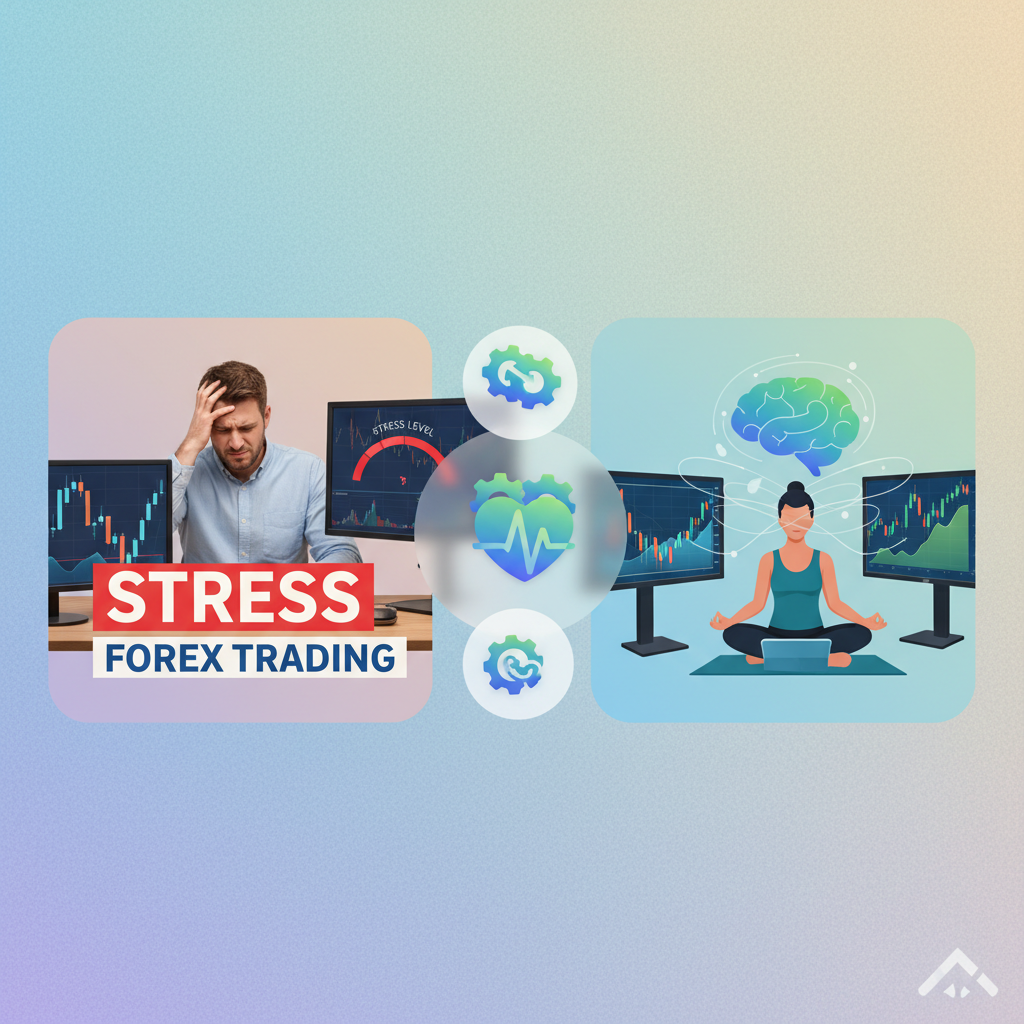
You follow perfect setups and still watch winning trades turn into losses.
The gap isn’t the charts—it’s the person clicking the button.
A 2025 study found 70% of traders attribute their success to psychological factors rather than technical analysis.
That statistic explains why strong systems collapse when fear or greed takes hold.
Two cognitive traps dominate: loss aversion, which makes traders hold losers, and overconfidence bias, which inflates risk.
Both quietly blow up accounts long before market swings do.
Impulsivity and stress aren’t personality quirks; they’re performance risks that change execution and risk management.
Modern platforms like MetaTrader 5 and educational brokers such as OANDA now include tools and resources that help address those mental pitfalls.
Trading great systems without mental discipline is like driving a race car with a blindfold.
Begin by noticing how decisions feel under pressure; that observation is where consistent improvement starts.
Why trader psychology matters in forex
In the context of trading, understanding the psychological frameworks is essential.
Numerous studies emphasize that the decisions traders make are heavily influenced by their mental state.
It is widely acknowledged in the trading community that emotions can overshadow technical analysis, causing traders to falter when actual stakes are on the line.
This insight directs traders to focus on the mental frameworks that govern their decisions rather than purely on market signals.
Cognitive biases that derail forex decisions
Cognitive biases turn clean price charts into convincing stories.
A single bias can make an obviously neutral range look like a breakout or an inevitable trend continuation.
Traders interpret candles through personal filters.
That means the same price action will prompt different trades depending on which bias is active.
Recognizing those filters stops avoidable mistakes before they become losses.
The useful ones to watch are confirmation bias, recency bias, and overconfidence, plus anchoring and loss aversion — each distorts how signals are read and how risk is sized.
How those biases show up in price action interpretation
Confirmation shows up when a trader highlights the few candles that support their view and ignores opposing signals.
A trader might see a series of small wicks as proof of buying strength while dismissing volume divergence.
Recency makes traders overweight the latest swing.
After a sharp move, the immediate bars dominate decisions, so pullbacks are interpreted as trend resumption rather than consolidation.
Overconfidence shortens stop distances and increases position size after a string of wins.
That behavior often follows a period of correct calls, even if those wins were luck or small sample noise.
Anchoring fixes attention on an earlier price level — a prior high or entry price — causing delayed exits or missed entries.
Loss aversion leads to holding losers too long and cutting winners too early, which skews the realized P/L.
Bias detection checklist for live trading
Bias detection checklist for live trading
| Cognitive bias | Typical trading symptom | Immediate corrective step | Metric to track |
|—|—:|—|—:|
| Confirmation bias | Cherry-picking candles or indicators that support current thesis | Force opposing-evidence search for 2 minutes before trade | % of trades where opposing evidence existed |
| Recency bias | Overreacting to last swing; frequent intraday re-entries | Wait one higher timeframe candle before acting | Average time between signal and execution |
| Overconfidence | Increasing position size after streaks; tighter stops | Cap size to fixed % of equity; revert to baseline size for 5 trades | Position size as % of equity (trend) |
| Anchoring | Fixating on entry or past swing for exits | Use rule-based exit tied to price structure, not past price | Average hold time vs. planned horizon |
| Loss aversion | Letting losers run; cutting winners early | Implement pre-commit stop and target; enforce automatic exit on stop hit | Win rate vs. average win/loss ratio |
This checklist maps bias to a quick fix and a measurable metric.
Use it during live sessions to turn subjective feelings into objective checks.
Track metrics weekly and adjust rules when patterns repeat.
Practical drills to reduce bias
Start each session with a two-minute calm-down to slow the decision loop.
Deep breaths and a short visualization reduce impulsivity and interrupt automatic reactions.
Before placing a trade, answer these pre-trade questions out loud:
What specific price structure justifies this trade?
What would invalidate it in the next 8 candles?
How large is this position by fixed-percentage rule?
After every trade, run a brief post-trade review.
Ask: did I seek opposing evidence? Did emotion change my stop or size? Record one behavioral change to test next session.
Tools like MetaTrader 5 can log trades and annotate decisions, and OANDA’s educational materials offer templates for psychological drills.
Those systems make bias detection repeatable and measurable.
Small rituals compound.
Consistent pre-trade checks and disciplined reviews turn bias-prone instincts into data that improves decisions over time.
Tracking simple metrics is what separates guesswork from disciplined trading.
Emotional regulation for consistent execution
A trader’s body and routine shape how trades are executed as much as the plan does.
Arousal, sleep debt, and acute stress shift risk appetite, speed of thought, and willingness to hold positions.
When those physiological levers move, so does consistency.
This section gives clear, repeatable tactics to arrest impulsivity in-session and build daily habits that stabilize emotion away from the screen.
The goal is not to eliminate feelings — it’s to create predictable responses to them, so execution follows the plan more often than not.
Physiology and performance: how arousal, sleep, and stress alter risk tolerance
Physical state changes decision thresholds.
Moderate arousal can sharpen responses, while very low or very high arousal narrows focus or fuels panic-driven risk-taking.
Sleep loss compresses patience and increases preference for immediate rewards, which raises the chance of chasing moves.
Simple metrics help track this.
Use resting heart rate or HRV trends as early warning signs of elevated stress.
When those markers move outside your baseline, reduce position size or widen stop criteria until recovery.
HRV: Heart rate variability; lower values often signal stress or poor recovery.
Decision timeout: A pre-set pause after an emotional trigger before any new trade action.
In-session emotional interventions (breathing, micro-breaks, decision timeouts)
Recognize a trigger and apply a short, clear intervention before acting.
Micro-interventions change the physiological state fast enough to restore control.
The flowchart maps a simple path: notice the trigger, assess intensity, choose an intervention, then either execute the plan or exit to cool down.
Use it as an on-screen checklist during live sessions.
Notice the trigger (price spike, unexpected fill, personal distraction).
Run the two-question assess: “Am I reacting or deciding?” and “Is this plan-compliant?”
Apply an intervention: breathing, 60–90s screen-away micro-break, or a
Decision timeout.Reassess and either execute the original plan or step out for a longer break.
Breathing:
4-4-4-4box breathing for one minute calms sympathetic arousal.Micro-break: Look away for 60–90 seconds, walk two flights of stairs, reset posture.
Timeout rule: No new entries for 5–10 minutes after a high-emotion trigger.
Daily habits outside the screen that stabilize emotion
Consistency builds on routines.
Sleep, movement, food, and social support are the foundation that keeps in-session interventions effective.
Sleep: Prioritize 7–9 hours; keep fixed wake/sleep windows.
Exercise: Three weekly sessions of moderate cardio or strength maintain stress resilience.
Nutrition: Favor steady proteins and low-glycemic carbs to avoid energy crashes.
Social support: Debrief with a peer or community to process big losses and wins.
OANDA’s educational resources and platforms like MetaTrader 5 can help integrate psychological tracking into your routine, but the habit work happens off-screen.
Small rituals matter: a 15-minute pre-market breathing and checklist routine plus a 10-minute end-of-day journal reduces emotional carryover into the next session.
Consistent execution depends more on inner rhythms than perfect signals.
Tightening physiological control and rehearsing short interventions yields measurable improvements in discipline and trade quality.
Designing a high-performance trading routine
What separates an inconsistent trader from a high performer is not a better indicator.
It’s a repeatable structure that makes good decisions automatic under pressure.
A high-performance routine turns plan into habit.
It defines what you do before the market opens, exactly how you enter and size trades, and how you close the day and recover.
That structure removes guesswork and reduces drift after losses.
Routines also create measurable checkpoints.
When every session follows the same steps, the journal becomes a diagnostic tool rather than a moral ledger.
Pre-session checklist: focus, market structure, and limits
Start the session with two short paragraphs that set context and purpose.
A clean market scan takes five minutes when it’s focused.
Identify active pairs, session overlap liquidity, and any scheduled macro releases that could widen spreads or gap price.
Market scan: review top 3 pairs by volatility and volume.
Liquidity window: confirm session overlaps (e.g., London/New York).
Macro filter: mark high-impact events on the calendar.
Risk budget check: confirm maximum capital at risk today and open trades.
Mind-state meter: rate alertness 1–5; postpone if below 3.
Risk budget: The dollar or percent cap you’ll risk across all trades this session.
Mind-state meter: One-line self-check of sleep, stress, and focus to decide whether to trade.
Execution protocol: rules that stop second-guessing
Good entries and exits are procedural.
Treat them like a small operations manual.
Define entry trigger: break of structure, confluence of
S/R + moving average, or a pattern confirmed on the 5–15 minute timeframes.Determine stop using market structure or
ATR × factorand calculate position size withRisk $ / stop distancein base currency.Use tiered targets: take 50% at first realistic swing and trail remaining with a
1:1ATR-based trailing stop.Enforce a cadence: maximum 3 concurrent trades, one new trade per instrument per session.
Entry discipline: wait for full trigger candle close.
Sizing rule: cap position to pre-set session risk percentage.
Exit protocol: predefined stop, partial profit, and trailing method.
End-of-day and weekly rituals for reflection and recovery
End the day with short facts, not feelings.
Log outcomes immediately: entry, size, stop, emotion note, and what changed from plan.
Spend 10 minutes editing trades in your journal or platform (MetaTrader 5 works well for exporting trade lists).
Weekly, review patterns: win-rate by setup, average hold time, and a single improvement target for next week.
Use one recovery ritual—walk, short nap, or 20 minutes of offline activity—to reset cognitive bandwidth.
A reliable routine turns skill into consistent results; small habits compound faster than sporadic brilliance.
Decision frameworks and rules that reduce cognitive load
Imagine trading with a short checklist that does the hard thinking for you.
Good frameworks turn slippery judgment calls into predictable, repeatable actions.
That frees mental bandwidth for what actually matters: monitoring, learning, and dealing with exceptions.
A decision framework is not a straightjacket.
It’s a set of conditional templates that handle the routine work — entries, exits, position-sizing, and defined exceptions.
When built right, these templates cut hesitation, stop overtrading, and make discretionary moves deliberate instead of reactive.
Start with a compact rule set and expand only when it measurably improves outcomes.
Use automation to run checks and flag exceptions so discretionary judgment is used sparingly and with a clear rationale.
Pre-filter: Define market states where you will trade and where you will not — keeps noise out of the decision loop.
Entry template: Specify the exact conditions that must exist to enter a trade, including
indicator,price action, andtimeconstraints.Exit template: Set profit targets, stop rules, and time-based exits so you never guess when to leave.
Size and risk checks: Hard rules for
position_size,max_drawdown, anddaily_trade_limitprevent creeping risk.Exception criteria: Explicit signals and a short checklist for permitted discretionary overrides.
Review triggers: Rules that force post-trade review after specific outcomes (e.g., 3 consecutive losses).
Rule-based template: A condensed conditional pattern you can copy and paste onto charts.
Discretionary gate: Conditions under which judgment is allowed without voiding the plan.
Automation checkpoint: A programmatic test that returns pass or fail before an order is placed.
Identify the friction points in your trading day — where you hesitate or second-guess.
Translate each friction point into a binary condition:
TRUE(trade) /FALSE(no trade).Encode the conditions as simple
IFstatements:IF trend = up AND pullback <= 0.5*ATR THEN enter long.Automate pre-trade checks in your platform (e.g., MetaTrader 5) or with broker APIs (OANDA offers risk tools).
Define an exception workflow: require a written rationale and a fixed review window after discretionary trades.
A small, enforced rulebook plus lightweight automation keeps the brain out of routine decisions.
Use discretion only when pre-defined gates are passed and document every exception for learning.
Forex Trading Psychology ChecklistMeasuring performance: metrics that reflect psychological health
A 2025 study found that 70% of traders credit psychological factors for their success, which makes measurable mental metrics essential alongside P&L.
Tracking behavior gives early warning of creeping problems like compulsive overtrading or creeping risk tolerance before they show up in account equity.
Performance measurement should include process and psychological KPIs: not just how much was made, but how reliably rules were followed, how losses were handled, and how quickly a trader recovers mentally after a drawdown.
Those signals are actionable — they point to habits to reinforce or correct.
Practical metrics create a feedback loop.
When a journal, platform export, or tool captures both trade outcomes and emotional/contextual data, improvements become systematic rather than accidental.
Consistency: hit strategy entry/exit conditions over time.
Adherence: percent of trades executed per plan (no deviations).
Drawdown behavior: frequency and depth of equity drawdown vs. recovery time.
Decision latency: time between signal and execution, highlights hesitation or impulsivity.
Position-size variance: deviation from target sizing shows risk-drift.
Emotional score: pre/post-trade self-rating (1–10) to track mood patterns.
Suggested KPI comparison table for traders
| KPI | How to calculate | Psychological signal | Target/benchmark |
|---|---|---:|---|
| Win rate | Wins ÷ Total trades | Risk aversion vs. selective entry | 30%–60% (strategy dependent) |
| Average win/loss ratio | Avg win ÷ Avg loss | Letting winners run vs. cutting losses | >1.5 for discretionary traders |
| Expectancy per trade | Expectancy = (Win%AvgWin) - (Loss%AvgLoss) | Overall edge and discipline | Positive (>0); professionals target meaningful positive expectancy |
| Max drawdown | Peak equity − trough equity | Risk control and panic behavior | <20% for many retail strategies; lower for institutional |
| Adherence to plan (%) | Trades following documented rules ÷ Total trades | Rule discipline vs. impulsivity | >85% for disciplined traders |
| Trade frequency | Total trades per week/month | Overtrading or avoidance | Varies by system; unexpected spikes indicate emotion-driven trading |
| Reward:Risk ratio | Avg potential reward ÷ Avg risk | Profit-target discipline | ≥1.5 common; depends on win rate |
| Position-size consistency (%) | Std dev of position size ÷ mean size | Risk-drift and confidence swings | <20% variation preferred |
| Slippage / execution delay | Avg ms or pips slipped per trade | Hesitation, speed under stress | Low and stable; spikes need investigation |
| Emotional deviation score | SD of pre/post-trade emotion ratings | Emotional volatility affecting decisions | Lower SD indicates steadier psychology |
This table maps behavior to numbers traders can monitor daily or weekly.
Use broker statements, exported logs from platforms like MetaTrader 5, and a disciplined journal to populate these fields.
Start the journal with structure, not prose.
Track signals, decisions, and mental state in every entry.
Trade ID: Unique reference for cross-checking with platform logs.
Date / Time: Timestamp of signal, entry, and exit.
Setup: Brief description of the trade trigger and timeframe.
Planned R:R: Risk-to-reward targeted before entry.
Position size: Size and rationale for that size.
Adherence: Yes/No — did you follow your plan? If no, explain.
Emotion (pre): 1–10 rating and brief note (e.g., rushed, calm).
Emotion (post): 1–10 rating and reaction (relief, regret).
Deviation reason: Concrete cause (news, fear, boredom).
Recovery action: Steps taken to reset (walk, breathwork, stop-trading).
Sample entry: Trade 20260301-17 — EUR/USD breakout on 15m after consolidation.
Planned R:R 2:1, size 0.5% account.
Adherence: Yes.
Emotion pre 6 (slightly impatient).
Outcome: +1.8R.
Post emotion 7 (confident).
Note: Held to plan; excellent execution.
Sample entry: Trade 20260302-09 — GBP/USD scalp.
Planned R:R 1:1, size 1%.
Adherence: No (added after partial loss).
Emotion pre 8 (anxious).
Outcome: −0.9R.
Post emotion 4 (frustrated).
Recovery: 30-minute break, reviewed rules.
Recording these fields turns vague feelings into patterns you can fix.
Platforms such as MetaTrader 5 or resources from OANDA can export trade logs and offer psychology-focused tools to automate parts of this tracking.
Measuring mental health in trading isn't soft — it's measurable and repairable.
Track behavior, not just dollars, and the edge becomes sustainable.
Training pathways: coaching, simulation, and behavioral practice
Good training is less about memorizing setups and more about creating trained responses when markets get noisy.
Coaching, simulation, and behavioral drills each target a different learning mechanism: cognitive framing, procedural fluency, and stress-conditioned response.
When combined intentionally, they accelerate reliable decision-making under pressure.
A structured pathway uses three principles that produce durable change: spaced practice to prevent skill decay, deliberate repetition focused on specific errors, and exposure to stressed scenarios so learned responses survive emotional load.
Each principle maps to practical activities: weekly coached reviews for spacing, focused replay drills for repetition, and timed, high-volatility sims for stress exposure.
Platforms and providers matter because tools shape the training loop.
For example, MetaTrader 5 offers simulation and psychological monitoring features that support repeated drills, while OANDA supplies educational modules that pair well with coached curricula.
Choosing a pathway means matching instructional design to the trader’s current failure modes and available time.
Structured training models
Spaced practice is scheduling learning sessions with growing intervals.
It prevents forgetting and builds context-specific cues.
Spaced practice: Short, repeated review sessions spaced over days and weeks to solidify memory and pattern recognition.
Deliberate repetition is targeted practice on micro-skills until performance stabilizes.
Focus on one bias or execution error at a time.
Deliberate repetition: Isolated drills on precise behaviors, with immediate feedback and incremental difficulty.
Exposure to stressed scenarios conditions calm responses under pressure.
Simulate losing streaks, fast markets, and margin events.
Exposure to stressed scenarios: Controlled stress tests that pair physiological regulation techniques with trading tasks.
Comparing coaching and self-directed programs for professionals
Below is a practical comparison to help decide which format fits time, learning speed, and budget.
Coaching vs self-directed programs — feature comparison
| Program type | Typical features | Best for | Time commitment | Cost range |
|---|---:|---|---:|---:|
| One-on-one coaching | Personalized plan, live review, accountability | Traders needing bespoke behavior change | 3–12 months | $2,000–$20,000 |
| Performance psychologist coaching | Clinical techniques, biofeedback, stress work | Traders with severe emotional barriers | 3–9 months | $1,500–$15,000 |
| Group coaching | Weekly calls, peer accountability, shared drills | Cost-conscious pros seeking structure | 8–24 weeks | $300–$2,500 |
| Simulation bootcamps | High-frequency sims, instructor feedback, scenarios | Rapid skill acquisition for short windows | 1–6 weeks | $500–$5,000 |
| Live trading room subscription | Real-time commentary, copy-trade options | Ongoing market exposure and routine | Ongoing (monthly) | $50–$500/month |
| Peer review groups | Trade log sharing, structured critique | Experienced traders wanting peer accountability | Ongoing | $0–$300/year |
| Mentorship / apprenticeship | Shadow trading, gradual independence | Traders transitioning to professional roles | 3–12 months | $500–$5,000 |
| Self-study courses | Video lessons, exercises, quizzes | Self-motivated learners on a budget | Self-paced | $50–$1,000 |
| Algorithmic / backtesting course | Code, backtests, edge validation | Quant-minded traders building systems | 4–12 weeks | $200–$2,000 |
| Hybrid programs (course + coaching) | Course content + periodic coaching check-ins | Balanced learners wanting guided autonomy | 3–9 months | $500–$6,000 |
This table reflects typical market offerings and timeframes.
Use it as a starting checklist when matching your calendar, learning style, and seriousness about behavior change.
How to assess a coach or program
Choosing a coach is as much about evidence as it is about chemistry.
Start by verifying curriculum structure and measurable outcomes.
Credible curriculum: Look for documented training cycles, explicit practice schedules, and performance metrics.
Track record: Prefer programs with verifiable alumni outcomes or transparent case studies.
Assessment tools: Programs that use replay, tagged trade logs, and physiological or psychological measures provide better feedback loops.
Practical feedback: Hands-on error correction and homework beats motivational talk.
Watch for red flags and positive indicators before committing.
Red flag: Vague promises of guaranteed profits — programs that promise quick riches are rarely honest.
Red flag: No assessment or baseline measurement — no way to tell if training moves the needle.
Positive indicator: Regular, objective performance metrics (win-rate, expectancy, adherence to rules).
Positive indicator: Structured escalation: skill checkpoints, progressive scenario difficulty, and maintenance plans.
Choosing the right mix of coaching, simulation, and behavioral practice turns intentions into habits.
Training design matters more than flashy tools, and the best programs prove that with measurable improvement and repeatable practice.
Technology and tools that support psychological control
Markets punish hesitation.
The smartest traders use tools that give honest, immediate feedback when emotions start steering decisions.
Modern trading tech does more than show prices.
It enforces limits, surfaces behavioral signals, and records session-level psychology so patterns become obvious instead of invisible.
Platforms and broker tools can nudge better choices in real time with alerts, hard risk caps, and session analytics that track how closely a trader sticks to rules.
When chosen and configured correctly, these tools act like a coach sitting next to you during a session—quiet, objective, and relentless about the facts.
Real-time feedback: alerts, risk caps, session analytics
Real-time feedback reduces the gap between feeling and action.
Alerts interrupt automatic reactions.
Risk caps stop compounding mistakes.
Session analytics turn noisy behavior into comparable metrics.
Price and behavior alerts: Configurable triggers that send a discrete notification when trade size, frequency, or deviation from plan exceeds thresholds.
Hard risk caps: Platform-enforced limits that block new orders above a set percent exposure or maximum loss for the session.
Session analytics: Post-session summaries that show adherence, average reaction time, and behavioral drift across sessions.
Micro-break reminders: Timed prompts to pause after a streak of losses or rapid trades to reset arousal and reduce impulsivity.
MetaTrader 5 includes built-in features and plugins that can support many of these real-time controls, while brokers such as OANDA pair platform tools with educational resources to help traders interpret session analytics.
The dashboard mockup illustrates a live session display: running P&L, an adherence score shown as a gauge, a heatmap of trade clusters, and a stress indicator derived from trade frequency and size swings.
This view makes it easy to spot when behavior diverges from plan and to act before losses compound.
Adherence score: A composite metric showing how closely executed trades match the predefined trading plan.
Trade heatmap: Visual map of trade density by time and instrument, highlighting impulsive bursts.
Stress indicator: A normalized flag based on trade cadence, size volatility, and rule violations.
Session P&L: Real-time profitability with session-level peak-to-trough drawdown.
Integration: APIs, logging, and trade tagging
Connect tools so psychology data becomes usable.
Automated logging and tags let analytics answer "why" rather than just "what."
Configure platform APIs to stream execution and order metadata into a central log.
Add
trade_tagfields at order entry to capture intent (e.g.,plan,recovery,impulse).Build session-level analytics that compute adherence, reaction time, and risk-on-off measures.
Automate alerts from the analytics engine back to the trading platform or mobile device.
Combining automated enforcement (risk caps), live nudges (alerts), and rigorous logging creates a feedback loop that reduces impulsivity and improves discipline over time.
Psychology-friendly tech doesn't replace judgment — it sharpens it by turning subjective feelings into objective signals the trader can act on.
Real-world case studies and applied examples
Traders recover from psychological breakdowns the same way athletes rebuild after injury: deliberate routines, objective feedback, and phased exposure back into competition.
The examples below show how targeted interventions — not new indicators — repaired decision-making, restored confidence, and created measurable behavior change.
These are illustrative, practice-focused case studies drawn from common patterns seen in coaching and platform analytics.
Each case lists specific interventions, the metrics that tracked progress, and practical steps you can copy into a trading plan.
Expect clear, replicable actions rather than theory.
The 2025 finding that 70% of traders credit psychological factors for their success shows why these applied fixes matter in live accounts.
Case study 1: recovering from a drawdown — interventions and measurable recovery
Consider a discretionary EUR/USD day trader who faced a prolonged losing streak and a deep account drawdown.
The recovery plan focused on three pillars: stop-rule enforcement, scaled re-entry, and behavioral feedback loops.
Implemented a strict
max-daily-lossrule and a phased position-sizing ladder to prevent emotional chasing.Used MetaTrader 5 session logs and trade-by-trade timestamps to correlate mistakes with time-of-day fatigue and news noise.
Added a daily micro-journal capturing pre-trade arousal (0–5), intent, and post-trade rationale to force reflection.
Measured progress tracked: adherence to stop rules, frequency of violated rules, and trade plan compliance.
Over time the trader moved from reactive exits to rule-driven exits and regained consistent position sizing.
Recovery metrics explained:
Max drawdown: A running measure of peak-to-trough loss used to set immediate behavior limits.
Trade adherence rate: Percentage of trades that matched pre-trade plan; used as the primary behavioral KPI.
Average holding time variance: Tracks impulsive exits or additions by seeing dispersion around target hold times.
Case study 2: improving consistency through a rule-based overhaul
A swing trader struggled with inconsistent entries and frequent exceptions to the plan.
The overhaul replaced discretionary thresholds with crisp rules and an escalation path for exceptions.
Key rule changes:
Entry filter: two-confirmation rule (signal + momentum)
Size control: fixed risk per trade tied to ATR
Exception protocol: mandatory post-trade coach review before any rule override
Built an exceptions log and required coach sign-off for three consecutive exceptions.
Ran a 30-trade simulation using OANDA educational modules to rehearse rule-following under stress.
Converted wake-of-market decisions into checklist items to reduce on-the-fly rationalization.
The result was steady improvement in trade-to-plan alignment and fewer ad-hoc trades.
The concrete artifacts — checklists, exceptions log, and coach notes — made behavioral change auditable and repeatable.
This short video walks through a trader’s full week: time-stamped journal excerpts, key decision points, and coach feedback clips.
Watch for the coach’s language patterns that redirect emotion-driven choices into procedural actions.
These applied examples show how specific behavioral tools make psychological improvements measurable and repeatable.
Use the same artifacts — journals, rule logs, and platform timestamps — to turn subjective change into objective progress.
Common implementation pitfalls and how to avoid them
Most implementation failures have nothing to do with technique and everything to do with process.
Plans that look perfect on paper often fail because traders adopt them partially, make them too complex, or leave accountability gaps.
That combination turns promising methods into inconsistent habits.
Fixing this requires three parallel moves: simplify what gets used, build social and automated accountability, and design organizational rules that survive personnel changes.
When these pieces align, a psychology-driven routine becomes a reproducible system rather than a hope.
What follows is practical guidance on the typical traps and exact steps to prevent them.
The examples point to tools and team practices that scale from solo retail traders to prop desks.
Why good intentions fail: partial adoption, complexity, and accountability gaps
Partial adoption: Traders pick a few attractive tasks and ignore the rest.
The result is broken feedback loops and misleading learning signals.
Excessive complexity: Over-engineered rules and long
checklistscreate friction.Complexity reduces adherence, especially in fast markets.
Accountability gaps: No one tracks follow-through.
Without social or automated checks, good intentions erode under stress.
In 2025, a study found that 70% of traders attribute their success to psychological factors rather than technical analysis.
Steps to build adoption: accountability partners, incremental goals, and automated reminders
Start small and make compliance visible.
Create a one-item adoption rule. Require doing one clear behavioral action per trading day (for example,
pre-session checklist).Pair for accountability. Assign an accountability partner or group who reviews the
trade journalweekly and flags deviations.Set incremental goals. Break targets into 7-day, 30-day, and 90-day checkpoints to make progress measurable.
Automate reminders and tracking. Use platform alerts, calendar invites, or platform features in MetaTrader 5 to log compliance automatically.
Use lightweight consequences. Public reporting or modest financial stakes increases follow-through more than verbal promises.
Organizational considerations for prop and institutional traders
Governance: Define who owns behavioral rules and how they are enforced.
Onboarding: Train new traders on psychological processes as a core competency, not an optional module.
Reporting: Integrate behavioral metrics into regular P&L review cycles so psychological data isn’t siloed.
Tools integration: Link trading platforms and compliance systems — for example, feed execution summaries from MetaTrader 5 or OANDA into the team’s review workflow.
Adoption is policy plus habit.
Make it simple, visible, and repeatable, and the likelihood of long-term change rises dramatically.
Curated resources and next-level learning
Most traders fail to get traction because their learning mix is random: a podcast here, a YouTube video there, and no way to turn new ideas into repeatable behavior.
This section points at the highest-value books, papers, courses, downloadables, and communities that professional forex traders actually use to move from theory to habit.
Each recommendation is chosen for immediate applicability: something you can read, apply, and measure within a week.
Practical next steps live in three buckets — structured study, reusable templates, and ongoing peer feedback.
Treat them as a single system: read a focused chapter, apply a template for the next five trades, then get feedback from a community.
Books, papers, and courses with high practical value
Pick resources that pair mental models with concrete drills and measurable outcomes.
Short, focused readings that map to a behavioral exercise are more useful than sprawling tomes.
Trading in the Zone — Mark Douglas: A compact manual on decision rules and removing emotion from execution; best read with a concurrent journaling drill.
The Daily Trading Coach — Brett Steenbarger: Practical daily exercises to build psychological habits and micro-routines for trading days.
Thinking, Fast and Slow — Daniel Kahneman: Not a trading book, but essential for understanding cognitive biases that affect position sizing and exit decisions.
OANDA educational courses: Company-led modules that mix market mechanics with psychology-focused lessons (useful for structured curricula and practice exercises).
MetaTrader 5 documentation and built-in tools: Platform-level features and analytics that support psychological tracking and automated feedback loops.
Templates and downloadable assets (ready to use)
Put repeatability into your process with well-structured templates.
Use them for at least 30 consecutive trades to see signal in the noise.
Trade journal (
trade_journal.csv): Columns: date, pair, entry, exit, size, setup, emotion_score, postmortem (one line per trade).Pre-trade checklist (
pre-trade-checklist.md): Items: thesis, horizon, risk per trade, stop placement, exit plan, emotion check.KPI tracker (
kpi-tracker.xlsx): Sheets: expectancy, avg win/loss, max drawdown, psychological metrics (sleep, stress).Behavioral exposure plan (
30-day_behavior_plan.pdf): Format: daily micro-goals and graded exposure to higher-stress setups.
Trading Journal: A dated, structured record of every trade and the mental state that accompanied it.
Use it to spot patterns you can't see in P&L alone.
Pre-trade Checklist: A short, fixed sequence of prompts to run before any order.
It prevents impulsive entries and clarifies intent.
KPI Tracker: A simple dashboard that combines financial and psychological KPIs so performance reviews include mental health signals.
Communities and ongoing support channels for serious forex pros
Sustained improvement comes from feedback loops with better peers.
Choose communities that enforce evidence-based critique over hot takes.
Peer accountability groups: Format: small cohorts that share weekly journals and give structured feedback.
Specialized Discord servers: Benefit: real-time trade review and emotional support during live sessions.
r/Forex (focused threads): Use-case: crowd-sourced edge-checks and link-sharing; vet advice carefully.
Platforms like https://thetraderinyou.com: Offerings: course-driven communities and real-time market insights that pair education with accountability.
Reserve one channel for immediate trade feedback and another for deeper weekly review.
That separation reduces reactivity and improves learning.
A few targeted books, a strict set of templates, and two disciplined communities will raise your psychology practice faster than consuming more random content.
Keep learning lean and measurable.
Conclusion
Keep the trader, not the chart, in focus
The single most useful insight from this guide is simple: the losing edge usually lives in the person pressing the button, not in the setup.
That’s why the sections on decision frameworks, measurable psychological metrics, and the case studies mattered more than entry candles — they show how rules and hard data stop emotion from hijacking good trades.
A concrete example from earlier: when a trader removed discretionary overrides and tracked "time-of-day exits" and "consecutive-loss reactions," win-rate improved even though the setups never changed.
Reinforcing behavior with simulation and coached replay converts insight into habit faster than theory alone, and tools like The Trader In You can help structure that practice.
Start small and be brutal with one variable today. Begin a 14-day behavior experiment: pick one emotional failure mode (for example, revenge sizing), write a single execution rule to prevent it, and log every trade against that rule. Will two weeks of disciplined measurement change how you trade when the charts get noisy?

Follow Joshua for daily forex tips on X: @thetraderinyou or connect with him on LinkedIn: Joshua Okapes.
- Top 5 Features to Consider When Choosing a Forex Broker - May 1, 2026
- Ultimate Resource on the Psychology of Trading for Forex Success - May 1, 2026
- Understanding Regulation: Why Broker Compliance Matters - April 29, 2026