A trader can have a solid chart setup and still feel invisible.
The market rewards discipline, but it also rewards the people who know where to find sharp eyes, honest feedback, and timely context.
That is where trader networking matters.
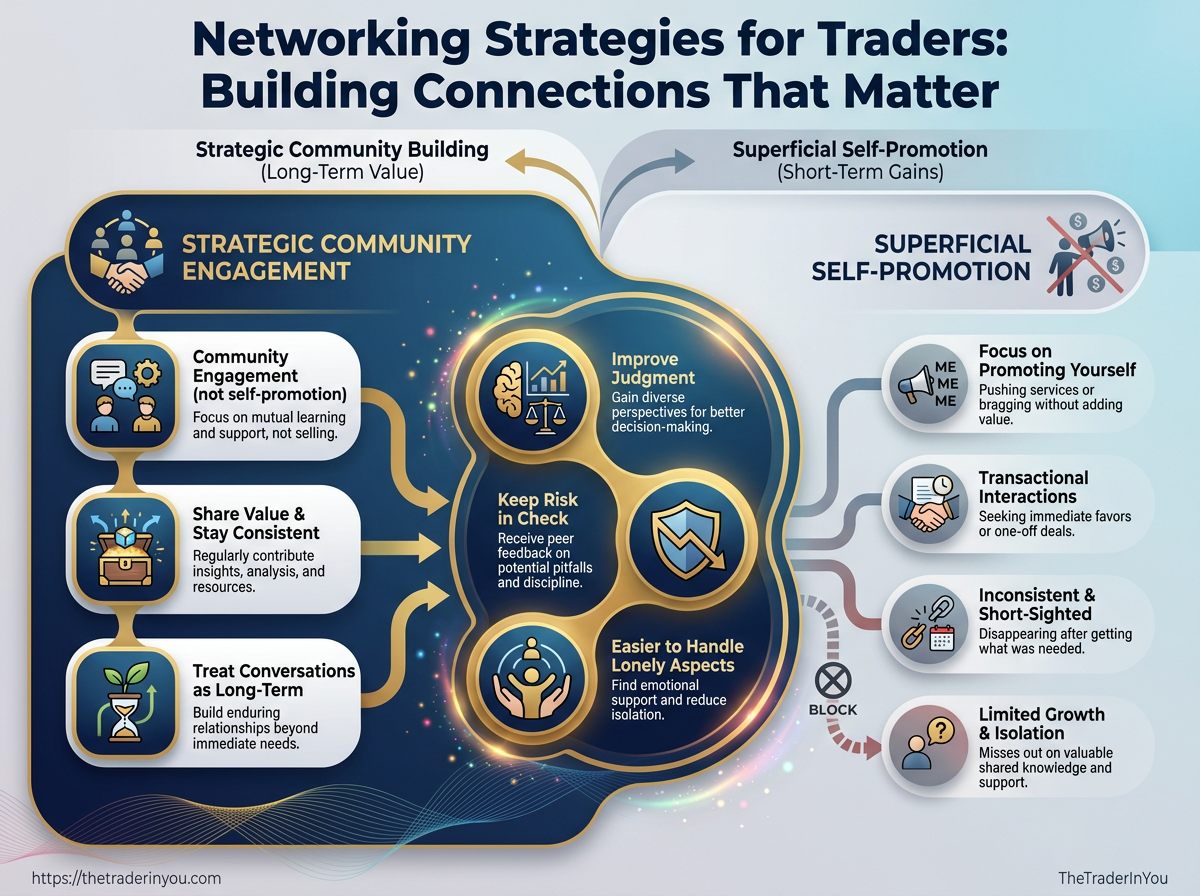
It is not about collecting contacts or filling a chat room with noise; it is about building trading relationships that actually improve judgment, keep risk in check, and make the lonely parts of the job easier to handle.
The strongest connections usually grow from community engagement, not self-promotion.
A trader who shares a clean chart read, asks a good question, or admits a bad exit often earns more respect than someone always trying to sound certain.
This is especially true when markets get messy.
A useful network can spot shifts faster, challenge weak assumptions, and keep bad habits from getting comfortable.
The hard part is that most traders approach networking like a sales pitch.
The better approach is slower and far more practical: show up with value, stay consistent, and treat every conversation as part of a long game.
Quick Answer: Trader networking matters because it turns community talk into faster, higher-quality decision support. Use it as a system: choose credible spaces, start discussions around setup logic, and keep the loop going with brief, relevant follow-ups—so you learn sooner and avoid expensive noise. (Use the screening checklist in Section 6 and the conversation templates in Section 8.)
Why Networking Matters in Trading
Opportunity arrives early to traders who have a reliable information circuit—not because they’re luckier, but because their conversations bring relevant context sooner.
It is often trader networking: a steady flow of trading relationships, shared market context, and honest feedback that helps people see what matters before the crowd catches up.
A strong network does not replace research or execution.
It gives those things better inputs.
Serious traders already know this.
Process matters more than hype, which is why behavior-based goals and disciplined routines are emphasized in BabyPips’ guide to setting trading goals for 2026, while CFA Institute’s 2026 reading on trade strategy and execution keeps the focus on decision quality, not noise.
A good community sharpens that edge.
A weak one muddies it.
Bad networks do damage fast.
They recycle stale ideas, push low-quality setups, and reward the loudest voice in the room.
That leads to missed entries, sloppy risk, and the classic mistake of copying someone else’s trade without understanding the thesis.
It gets expensive in quieter ways too.
You miss the trader who flagged a change in liquidity.
You miss the warning that a broker has poor execution on fast markets.
You miss the small shift in sentiment that could have saved you from forcing a setup.
- Idea validation: A serious community helps test a thesis before money is on the line.
- Risk awareness: Good peers talk about drawdown, slippage, and execution quality, not just wins.
- Broker screening: Experienced traders notice platform issues, spreads, and order handling early.
- Long-term growth: The best groups share process, not performance theater.
That is the real business value of trading relationships.
They improve judgment, save time, and reduce blind spots.
If a group only celebrates screenshots, it is entertainment.
If it trades in clear thinking, accountability, and clean feedback, it becomes an edge.
Where Traders Build High-Value Connections
A trader forum full of chatter is not the same thing as a useful network.
The best trading relationships tend to form in places where people trade the same markets, use similar tools, and care about execution details.
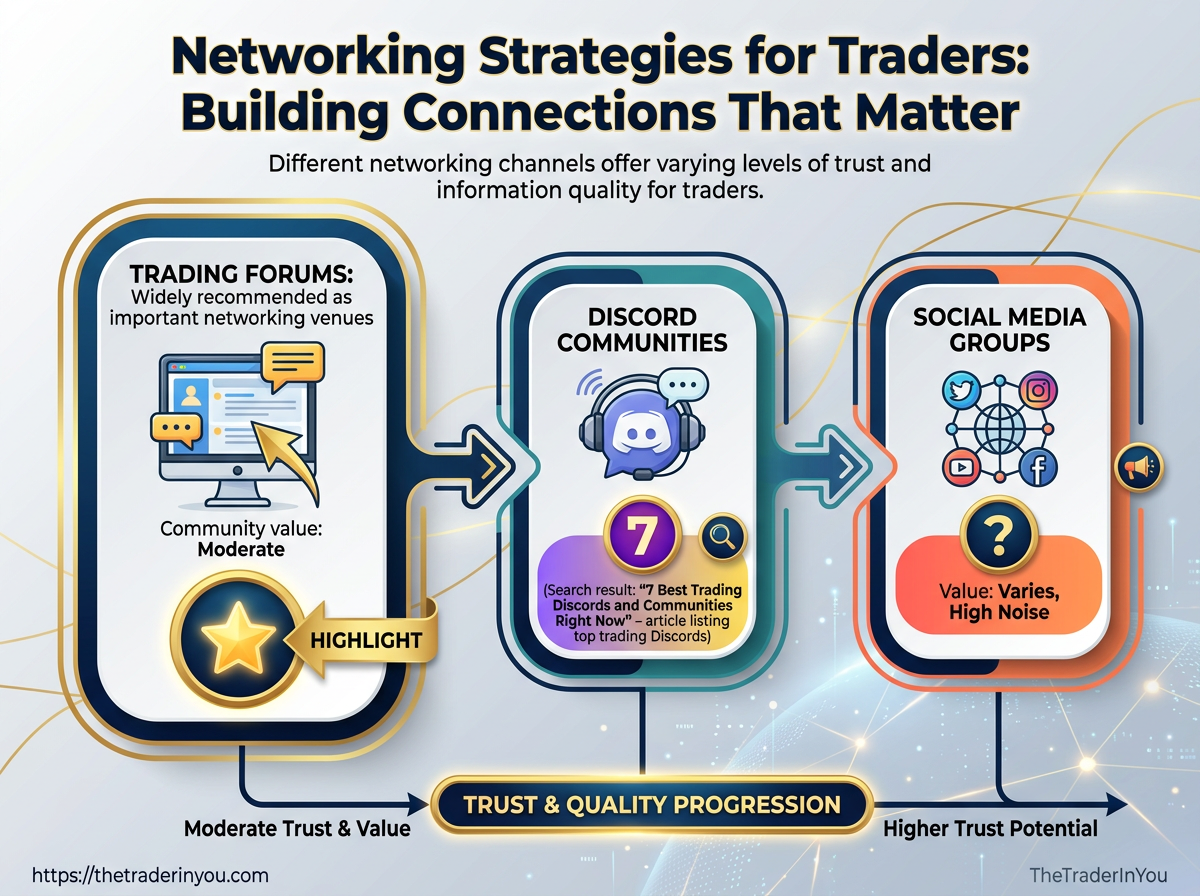
That usually means three spots: active forums and Discord groups, live education sessions, and the communities built around brokers and trading platforms.
Each one behaves differently, and the good connections come from matching the room to the kind of conversation you want.
Broker-hosted education spaces often attract traders who are serious about process, not just hot tips.
That lines up with the more disciplined approach to trade planning and execution discussed by the CFA Institute reading on trade strategy and execution, where process matters as much as the trade itself.
It also fits the behavior-first mindset in BabyPips’ guide to setting trading goals for 2026, which is exactly the sort of thinking that keeps community engagement useful instead of noisy.
Comparing the main networking channels
| Channel | Typical Audience | Trust Level | Information Quality | Best Use Case |
|---|---|---|---|---|
| Trading forums | Self-directed retail traders, swing traders, researchers | Medium | Mixed, but searchable and persistent | Comparing setups, asking historical questions, tracking long-form threads |
| Discord communities | Active day traders, scalpers, crypto and forex groups | Medium | Fast, uneven, often real-time | Quick feedback, live trade discussion, market watch sharing |
| Webinars | Beginners, intermediate traders, strategy learners | High | Usually structured and curated | Learning a framework, asking direct questions, meeting instructors |
| Live events | Serious retail traders, brokers, educators, prop-firm audiences | High | Strong when speakers are credible | Building face-to-face trading relationships and finding mentors |
| Broker communities | Clients of a specific broker, platform users | Medium-high | Practical and platform-specific | Learning order flow, platform quirks, margin rules, and execution tools |
| Platform user groups | Traders using the same charting or execution platform | Medium-high | Very practical | Solving technical issues and sharing platform-specific workflows |
Forums are slower, yet they often produce better long-term trader networking because threads stay searchable and people can revisit a good argument months later.
Webinars and live events carry more trust when the host shows actual process, not just marketing polish.
A trader who asks clean questions in those rooms usually gets more value than someone hunting for a secret signal.
The best trading relationships usually start in the most boring places: a platform group, a broker Q&A, or a webinar chat where someone asks the question everyone else was thinking.
That is where community engagement turns into something useful, and useful tends to last.
How to Judge Whether a Trading Community Is Worth Your Time
The fastest way to spot a low-quality trading community is to look at what happens when someone tries to explain a trade and gets challenged.
A solid trading community does not feel loud.
It feels clear.
The best ones show credible moderation, specific market discussion, and members who can explain their process without hiding behind buzzwords.
The CFA Institute’s 2026 reading on trade strategy and execution reflects that same discipline: good trading starts with rules, execution quality, and a reasoned process, not theater.
The easiest way to judge a group is to watch how it handles disagreement.
Healthy communities correct sloppy claims, separate opinion from fact, and keep hype from taking over.
That lines up well with the process-first thinking in BabyPips’ 2026 guide to trading goals, where behavior matters more than bragging about profits.
What credibility looks like
A useful group usually has a few quiet markers.
Moderators enforce rules, older threads stay readable, and members share losses as often as wins.
You will also see traders discussing context, not just entries.
- Clear moderation: Spam gets removed, self-promotion is limited, and debates stay on topic.
- Specific explanations: Members can explain setup, risk, and exit logic in plain language.
- Process talk: People discuss execution, sizing, and mistakes, not just P&L screenshots.
- Strategy fit: Discussions match real trading styles, whether that is swing, day, or position trading. That matters because different approaches need different rules, as shown in Benzinga’s 2026 trading strategies guide.
Warning signs that should make you pause
A community starts to smell off when every post sounds like a pitch.
If the chat is packed with “guaranteed” outcomes, secret signals, or urgency around paid access, walk away.
False authority usually leans on expensive-looking language and thin proof.
Watch for these red flags:
- Profit screenshots without context: No entries, no exits, no risk details.
- Paid promotion disguised as advice: Repeated mentions of the same broker, course, or signal service.
- Hero worship: One person is treated like a guru, and nobody can question them.
- No disagreement allowed: Real trading rooms can handle tough questions.
A quick screening checklist before joining
Spend ten minutes checking the group before you commit.
Read the rules, scan old threads, and look for a pattern of useful trader networking rather than pure noise.
- Check the moderation history for deleted spam and enforced rules.
- Read five older discussions and see whether members explain trade logic.
- Look for risk talk such as stops, sizing, and invalidation levels.
- Search for repeated promotions from the same people or brands.
- See whether members disagree politely and still stay useful.
- Ask one simple question and judge the quality of the answer, not the speed.
A good community should sharpen judgment, not feed ego.
If it improves your trading relationships and makes your decisions cleaner, it is earning its place.
How to Start Trading Conversations That Lead Somewhere Useful
A trading chat becomes useful when the first message is designed to extract decision logic—not to impress, not to sell, and not to guess.
Good trader networking starts with curiosity about the setup, not a loud opinion or a flex.
That same process-first mindset lines up with Babypips’ 2026 guide on setting behavior-based trading goals, which pushes traders to focus on habits instead of outcomes.
A useful question sounds specific.
Try asking, “What would make you pass on this setup?” or “Where does this trade fail?” Those questions invite judgment, not noise, and they make community engagement feel like a real exchange instead of a comment battle.
Sharing your own view works best the same way.
Frame it as a working idea: what you are watching, what confirms it, and what kills it.
That keeps the conversation honest, and it matches the broader execution mindset in the CFA Institute’s 2026 reading on trade strategy and execution, where strategy only matters when it connects cleanly to execution.
A simple pattern helps:
- Ask about the setup. Focus on entry, invalidation, or timing.
- State one view clearly. Say what you think, then add the reason.
- Name the risk trigger. Show where your idea stops making sense.
- Follow up after the move. Share what happened and what you learned.
The follow-up is where trading relationships start to deepen.
A short message after the idea plays out, even if it fails, says you were paying attention for the right reasons.
For example: “That breakdown lost strength once volume dried up above support” gives the other trader something useful to respond to.
This is also where a lot of people miss the mark.
They vanish after the initial chat, then reappear only when they want another take.
Consistent follow-up builds trust because it shows you are there to trade ideas, not collect attention.
When the conversation stays specific, calm, and accountable, people tend to open up.
That is the kind of trader networking that keeps getting more useful over time.
Networking Etiquette for Professional Traders
Ever notice how the traders people trust most rarely sound the loudest in the room? They do not chase every hot tip, and they do not turn every conversation into a pitch.
Good trader networking is mostly about respect for different methods.
A scalper, a swing trader, and a long-term position trader can all be serious without trading the same way.
That matters because community engagement gets messy fast when people treat their style as the only correct one.
Babypips’ 2026 guide on setting trading goals pushes behavior-based goals for a reason: trading improves faster when the focus stays on process, not ego.
The easiest mistake is signal-chasing.
Someone posts a setup, the room gets excited, and suddenly half the chat is asking for entries before asking whether the idea even fits their timeframe.
That is where trading relationships get damaged.
The better move is to ask what conditions made the trade valid, what invalidated it, and whether the setup still makes sense after the move has started.
> The CFA Institute’s 2026 reading on trade strategy and execution treats execution as a discipline, not a hunch. That mindset works just as well in trading circles.
A useful trader does not need to sound certain all the time.
They need to be clear about what they know, what they are testing, and what is still just a working idea.
- Respect timeframes. A day trader and a macro trader are solving different problems.
- Ask before giving a view. People trust answers more when they were invited.
- Name uncertainty plainly. “I have not tested this enough” builds more credibility than bluffing.
- Skip performative expertise. Fancy language is cheap; repeatable thinking is rare.
When someone shares an untested claim, the best response is calm and specific.
Ask what market conditions supported it, what data they used, and whether the idea failed in quieter markets too.
That kind of trading relationships work feels slower at first.
It also lasts longer, because people remember who was careful with their words and who was just hunting applause.
Using Digital Channels Without Losing Credibility
A credible digital presence is the opposite of marketing: it feels calm, specific, and a little understated.
It says what you trade, how you think, and what you leave out.
That matters because trader networking now happens in public.
Your profile, comments, and replies become part of your reputation, and community engagement can either build trading relationships or make people back away fast.
Profile signals that build trust
A strong profile works like a good handshake.
It is clear, brief, and not trying too hard.
Use a clean photo, a direct bio, and a consistent handle across platforms.
If you trade equities, futures, or forex, say so.
If your focus is process over prediction, that belongs in the bio too.
Post things that show judgment, not just excitement.
A note on why you skipped a setup, or a quick read on a major market event, tells people more than a victory lap ever will.
What to post, and what to leave out
The safest public content is educational and process-driven.
BabyPips’ 2026 guide on behavior-based trading goals makes the same point from another angle: better habits beat loud results.
> Aim for posts that reveal thinking, not account size.
- Post: trade plans, risk rules, watchlists, and lessons from mistakes.
- Comment: add one useful angle, ask a sharp question, and stay respectful.
- Avoid: P&L screenshots, oversized claims, hot tips, and anything that sounds like a sales pitch.
- Avoid: exact entries, full position size, and anything that maps your routine too neatly.
Protecting privacy and your edge
The moment people can infer your size, timing, or habit pattern, you have already given away too much.
Keep account details, broker names, and daily routines private.
If a post would help someone copy your trades faster than they could understand them, it probably belongs in a notebook, not on a feed.
The CFA Institute’s 2026 reading on trade strategy and execution is a good reminder that execution details matter.
The less of that process you expose, the better your edge survives public attention.
A credible online presence does not need noise.
It needs restraint, useful signals, and enough discipline that people trust the next post before they even read it.
How Strong Networks Support Better Trading Decisions
Strong networks surface the weak spots early—before the market punishes you.
Often, it is because someone else has already questioned the same idea from a different angle.
Strong trading relationships do not hand out magical signals.
They give you something better: a quick reality check against people who trade different time frames, different instruments, or different styles.
That kind of peer input matters because trading is full of clean-looking ideas that fall apart once slippage, spreads, news risk, or session timing enter the picture.
There is a reason process matters more than ego here. BabyPips’ guide to setting trading goals in 2026 leans hard on behavior-based goals, and that mindset fits network use perfectly.
A good contact does not exist to agree with you.
They help you test an idea against real market conditions.
A momentum trader may spot a breakout that a mean-reversion trader sees as late and vulnerable.
That tension is useful when it is honest, because it forces cleaner entries, tighter risk, and fewer fantasy trades.
Weekly habits that keep contacts useful
People who actually place trades notice the annoying details first: delayed fills, clunky order tickets, weak mobile syncing, or support that disappears when markets get busy.
That sort of field report is not a replacement for your own testing, but it often surfaces the questions worth checking before you fund an account.
The due diligence habit should stay practical.
The CFA Institute’s 2026 refresher on trade strategy and execution is a good reminder that execution quality is part of strategy, not an afterthought.
A community that talks honestly about order types, fill quality, and platform behavior gives you better inputs than a forum full of screenshot traders.
Recurring conversations are where community engagement becomes durable.
One-off chats fade fast; repeated ones build memory, trust, and context.
That is how a name becomes a contact, and a contact becomes someone you actually listen to when a trade setup gets messy.
Here at The Trader In You, we see that pattern constantly in our own learning circles: the traders who show up consistently tend to make cleaner decisions later.
The relationship itself is the asset, especially when the market gets loud.
Trading Relationships Beat Empty Noise
The point of trader networking isn’t to collect names—it’s to build a small circle that improves judgment.
When you consistently find credible people, ask decision-relevant questions, and follow up with accountability, your trading gets sharper inputs: better context, earlier risk warnings, and fewer blind spots.
Do one thing today: choose one channel (a community, broker group, or platform forum), audit it briefly for credibility, and start one conversation that’s about logic—not performance. After that, follow up once the trade idea plays out.
That simple loop is how connections become capability over time.

Follow Joshua for daily forex tips on X: @thetraderinyou or connect with him on LinkedIn: Joshua Okapes.