Why does a market feel calm one minute and violent the next? That swing is usually not random.
It often shows up first in market volatility, where prices start moving faster than your plan can absorb.
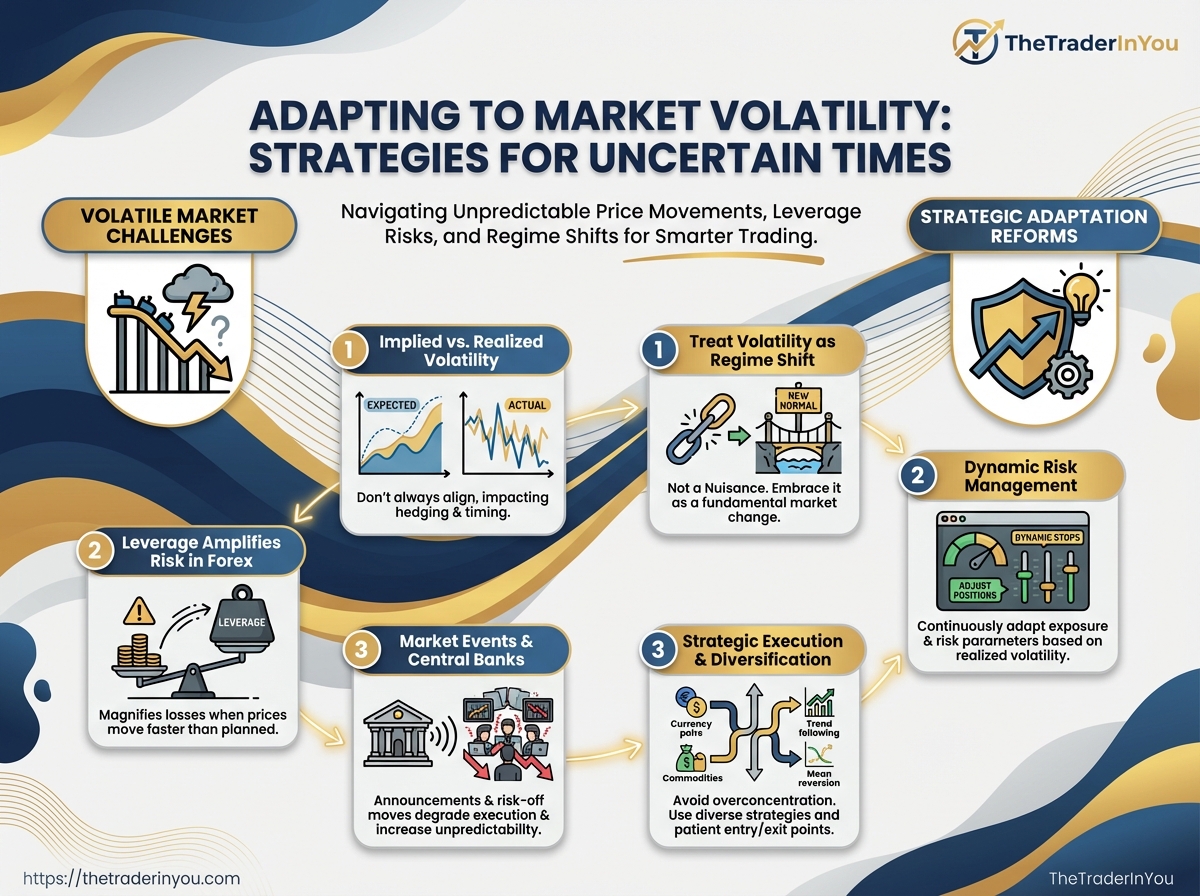
The hard part is that implied volatility and realized volatility do not always tell the same story.
Options pricing can stay nervous even after the chart looks quiet, which makes hedging more expensive and timing harder than it seems.
That gap catches a lot of traders off guard.
It matters even more in Forex trading during volatility, where leverage can turn a normal move into a margin problem fast.
The foreign exchange market averaged USD 7.5 trillion in daily turnover in April 2022, but depth does not mean safety when spreads widen and liquidity thins at the wrong moment.
Event windows, central bank announcements, and sudden risk-off moves can change execution quality in seconds.
That is why navigating market uncertainty is really about staying flexible, not predicting every twist.
Traders who treat volatility as a regime shift, not a nuisance, usually do better than the ones trying to force the same position size, the same stop distance, and the same assumptions onto a very different market.
Why volatility changes the trading playbook
Why do good setups start failing the moment the tape gets loud? The answer is usually not that the strategy broke.
It is that the market changed the rules around price movement, cost, and timing.
Volatility changes the job in front of you.
A clean entry on a quiet day can turn into a late fill, a wider spread, or a stop that gets clipped by noise instead of a real trend.
In FX, that matters even more because the market is enormous — the BIS reported USD 7.5 trillion in average daily turnover in April 2022, yet even that depth can thin fast around major events.
The first thing traders are really asking in erratic markets is simple: is this a trend, or just noise with better lighting? That question drives market volatility strategies, because the answer changes position size, stop placement, and whether a breakout is worth taking at all.
Implied volatility tools matter here too.
The VIX, published by Cboe Global Markets, reflects 30-day expected S&P 500 volatility from option prices, and CME Group lists VIX futures and options for traders who want direct volatility exposure.
When volatility rises, prices travel farther and faster, but not always cleaner.
Bid-ask spreads often widen, depth thins, and execution gets worse right when traders feel most urgent.
For Forex trading during volatility, that can mean higher slippage, tighter margin room, and less patience for leverage.
A lot of false signals show up in the same places.
Breakouts during thin liquidity windows, trades around central bank announcements, and fast reversals after sharp news all invite traps.
The chart below shows why those moments are so messy: intraday range expands, spread pressure rises, and late entries become expensive.
That’s the part many traders miss while navigating market uncertainty.
The signal may still be valid, but the market’s cost of proving it has gone up.
Practical read:
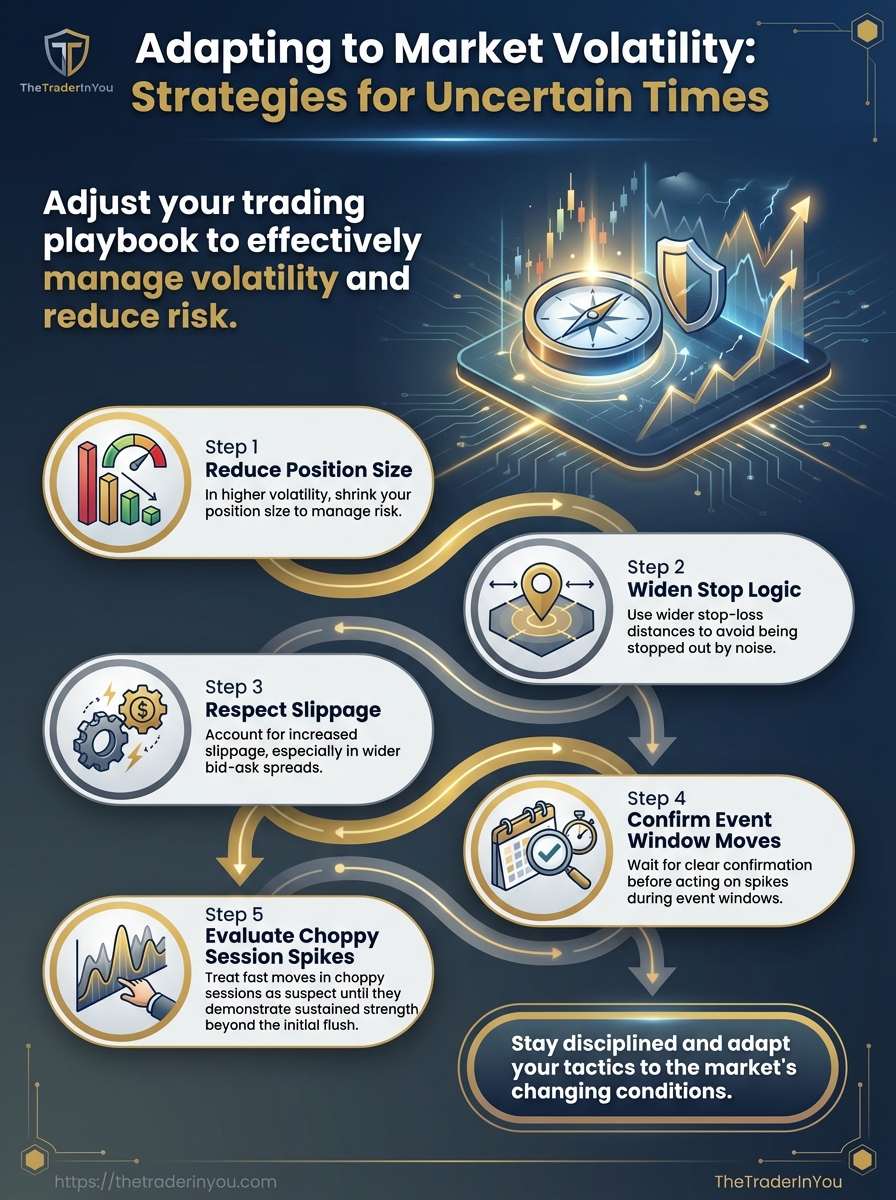
- Higher volatility: smaller size, wider stop logic, and more respect for slippage.
- Event windows: wait for confirmation instead of chasing the first spike.
- Choppy sessions: treat fast moves as suspect until they hold beyond the first flush.
In volatile conditions, the edge is often not in predicting the move.
It is in staying disciplined while the market tries to shake you out.
Core market volatility strategies that hold up under pressure
Why do solid setups start behaving like drunken clocks once volatility picks up? Because the trade is no longer just about direction.
It is about how much noise you can survive before the market proves you wrong.
The traders who stay standing usually do one boring thing well: they shrink size before they shrink conviction.
That keeps the idea alive while capping the damage when the tape starts whipping around.
Volatility-aware trading also means treating exits like moving targets, not fixed decorations.
A stop that makes sense in a calm session can be absurd during a fast swing, especially when spreads widen and fills slip.
That is where confirmation rules earn their keep.
In Forex trading during volatility, the market can look ready ten times before it actually is, and each fake entry drains capital and focus.
One useful anchor is the Cboe Volatility Index (VIX), which reflects near-term S&P 500 expectations from option prices.
For FX, the scale is even more unforgiving: the BIS reported USD 7.5 trillion in average daily foreign exchange turnover in April 2022, which helps explain how fast liquidity conditions can shift when stress hits.
Pre-trade checks that cut down impulse entries
| Check | Why It Matters | Pass/Fail Criteria | Action If Failed |
|---|---|---|---|
| Trend direction | Trades against a live move get clipped fast in volatile tape | Clear higher highs/lows or lower highs/lows on the chosen timeframe | Stand aside or trade smaller |
| Spread stability | Wider spreads raise entry cost and distort reward-to-risk | Spread stays near recent normal for that pair or instrument | Wait for spreads to normalize |
| News exposure | Event risk can turn a valid setup into a gap or spike | No major release, rate decision, or earnings window nearby | Delay entry until after the event |
| Liquidity level | Thin depth increases slippage and weakens stop execution | Order book and session time support steady fills | Reduce size or skip the trade |
| Stop distance | Too-tight stops get hunted by normal noise | Stop sits beyond recent swing noise, not inside it | Rework the setup or widen the stop |
| Risk per trade | Volatility can magnify losses faster than expected | Loss at stop stays inside the planed risk budget | Cut position size first |
Smaller size, wider stops, or no entry at all often beats a fast scratch-and-reenter cycle.
This approach works because it respects both price and execution.
It also fits volatility products like VIX futures and options listed by CME Group, where carry, roll, and term structure can change the cost of staying in the trade.
A good habit is to keep stop placement tied to current market noise, then let the profit target reflect the same reality.
If the session is jumpy, fixed pip targets often get hit too early or missed by a mile.
The traders who survive rough patches are usually the ones who slow the trigger finger first.
After that, the market still gets to speak, but it has to speak on cleaner terms.
Forex trading during volatility: execution habits that matter
Ever watched a clean setup turn into a bad fill in seconds? That is usually not a strategy problem.
It is an execution problem, and volatile FX markets punish sloppy execution faster than almost anything else.
As of 2022, the foreign exchange market averaged about USD 7.5 trillion in daily turnover.
That size creates depth, but it does not guarantee clean pricing when a news shock hits or spreads widen around a central bank announcement.
The habit that matters most is simple: stop thinking only about direction and start thinking about how the order gets filled.
In Forex trading during volatility, the entry price, order type, and exit plan often matter more than the setup itself.
- Use limit orders when the spread stretches. A market order can get filled far from the quote you expected, especially during event risk or thin sessions.
- Prefer
stop-limitover plain stops in fast bursts. A plain stop may trigger cleanly but still leave you with a poor fill if liquidity thins out right after.
- Scale in, do not chase. If the pair is moving hard, split the entry. One fill at a bad level can ruin a good idea.
- Tighten exits around known event windows. Central bank decisions, inflation releases, and surprise headlines can turn a manageable trade into a gap-shaped headache.
There is also a timing rule that saves money: when spreads jump and quotes flicker, wait.
Cleaner liquidity often returns a few minutes later, and the missed trade is usually cheaper than the forced one.
Broker and platform features matter just as much.
Fast markets reward systems that show real-time spreads, allow quick cancel and replace, support bracket orders, and keep a stable connection when price moves violently.
A platform like The Trader In You fits best when it helps traders review those execution habits alongside live market context, not when it turns trading into guesswork.
A good habit is to test the platform before the trade matters.
Check how quickly it updates prices, how it handles partial fills, and whether order tickets stay usable when volatility spikes.
When the tape gets noisy, your edge often comes from not forcing it.
Clean entries, cleaner exits, and the right order type keep you in the game longer, which is usually how market volatility strategies pay off in real life.
Navigating market uncertainty with a stronger risk framework
A volatile market does not just punish bad ideas.
It punishes loose risk limits, rushed decisions, and the habit of “feeling” your size instead of measuring it.
That matters even more in FX, where the market is huge and fast.
The BIS reported USD 7.5 trillion in average daily FX turnover in April 2022, which sounds almost too deep to move — until spreads widen and execution gets ugly during stress.
The cleanest framework starts with account equity, not emotion.
A position should fit the amount you can afford to lose on that trade, after volatility is accounted for, not the amount you wish you could make if the move works.
That also means separating high-quality setups from volatility-driven noise.
When the tape gets jumpy, plenty of candles look exciting.
Fewer of them are actually tradable.
- Set exposure from equity first: Define a fixed risk budget per trade, then size down as volatility rises so one bad move does not dominate the account.
- Treat implied and realized volatility differently: A VIX-style benchmark from Cboe shows what options traders expect next, while realized volatility shows what already happened. Those are not the same thing, and risk plans should not pretend they are.
- Filter out noise with a pre-trade rule: If a setup only looks good because the market is exploding around it, it is usually not a clean setup. Wait for structure, not excitement.
Major events deserve a routine, not improvisation.
Central bank decisions, payrolls, and surprise headlines often hit when spreads are already stretching, which means the first mistake is usually position size, not direction.
That clip walks through a simple pre-news and post-news checklist for Forex trading during volatility.
It is useful because the minutes before and after a release are where many otherwise decent trades get chewed up by slippage and bad timing.
- Before the event: Cut size, confirm margin buffer, and decide whether the trade still makes sense at wider spreads.
- At the release: Avoid guessing the first spike. Let price prove direction before risking fresh capital.
- After the move settles: Reassess the structure, then decide whether the original thesis still survives.
A stronger risk framework does not remove uncertainty.
It keeps uncertainty from running the account.
That is the real edge in navigating market uncertainty: staying disciplined enough to trade the next opportunity, not just the current headline.
How to evaluate whether your broker supports volatile conditions
A broker can look fine in calm markets and still fall apart when the tape gets loud.
That is why volatile-market checks matter so much.
For Forex trading during volatility, the real test is not a glossy claims page; it is whether fills, spreads, and platform behavior stay predictable when prices start jumping.
The scale of the FX market makes this even more important.
The BIS reported USD 7.5 trillion in average daily foreign exchange turnover in April 2022, but that depth does not mean every pair, session, or news window behaves the same.
Which execution and pricing issues can distort trading results
| Broker Factor | Why It Matters in Volatility | What to Check | Red Flags |
|---|---|---|---|
| Execution speed | Fast moves can turn a valid entry into a worse fill in seconds. | Average fill time, routing method, and whether market orders are priority-based. | Vague “fast execution” claims with no detail. |
| Spread behavior | Wide spreads quietly raise your cost before price even moves. | Typical spread during news windows and whether claims exclude volatile periods. | “From 0.0 pips” marketing that ignores stress conditions. |
| Slippage policy | Slippage can add real cost on every fast order. | How positive and negative slippage are handled, and whether requotes are possible. | Policies that only describe best-case fills. |
| Order rejection rate | Rejections break momentum entries and hedges. | Rejection rules for market, stop, and limit orders under fast markets. | Frequent rejections blamed on “market conditions” with no numbers. |
| Margin policy | Higher swings can trigger forced liquidations faster than expected. | Margin buffer rules, leverage cuts, and liquidation triggers during stress. | Sudden margin changes without advance notice. |
| Platform stability | A frozen chart at the wrong moment is expensive. | Uptime history, mobile failover, and order-ticket reliability during major events. | Crashes or login failures around news releases. |
The best disclosures explain when costs widen, how orders are handled, and what happens when liquidity thins.
Broker language can also be slippery. “Best execution” sounds reassuring, but the useful version includes routing logic, spread notes, slippage treatment, and margin rules that change under stress.
Platform tools that help traders stay in control
A clean order ticket matters more than flashy chart colors.
During navigating market uncertainty, the useful tools are the boring ones.
- Limit and stop controls: These keep entry and exit rules visible before the order hits the market.
- Spread and depth tools: These show when price quality is deteriorating, especially around event risk.
- Margin and exposure alerts: These warn you before leverage becomes a forced-close problem.
- Fill history and timestamps: These make it easier to spot whether a broker’s execution changes when volatility rises.
CME Group’s listed VIX futures and VIX options are a good reminder that volatility itself can be traded and hedged.
If a broker cannot support the instruments, tools, or disclosures needed for that kind of work, it is probably not the right place for fast markets.
A broker worth trusting does not promise calm.
It proves it can still function when the market refuses to be calm.
Trading the Storm Without Losing the Map
The real edge in volatile markets is not prediction.
It is discipline under pressure, especially when price starts moving faster than your plan can think.
The traders who hold up best are the ones who treat market volatility strategies as a ruleset, not a mood.
That matters most in Forex trading during volatility, where spreads widen, slippage shows up, and the clean setup you wanted can disappear in seconds.
The article’s broker example makes that plain: if execution falls apart when conditions get rough, your strategy was never getting the full picture.
Navigating market uncertainty starts with accepting that risk control is part of the trade, not an afterthought.
So the move today is simple: write down the one rule you will not break in a fast market.
It might be a maximum position size, a hard stop, or a no-trade filter when spreads stretch too far.
If you want more structure around that process, tools like thetraderinyou.com can be a useful place to keep building your edge.

Follow Joshua for daily forex tips on X: @thetraderinyou or connect with him on LinkedIn: Joshua Okapes.
- Adapting to Market Volatility: Strategies for Uncertain Times - April 8, 2026
- Using Technical Indicators to Enhance Your Forex Trading Strategy - April 6, 2026
- Cultivating Self-Discipline in Forex Trading: Tips for Long-Term Success - April 1, 2026