Staring at a losing trade and promising to “get it back” is a moment every Forex trader knows.
That reflex often comes from hidden mental shortcuts, not market rhythm.
Those are examples of cognitive biases that quietly shape trade decisions.
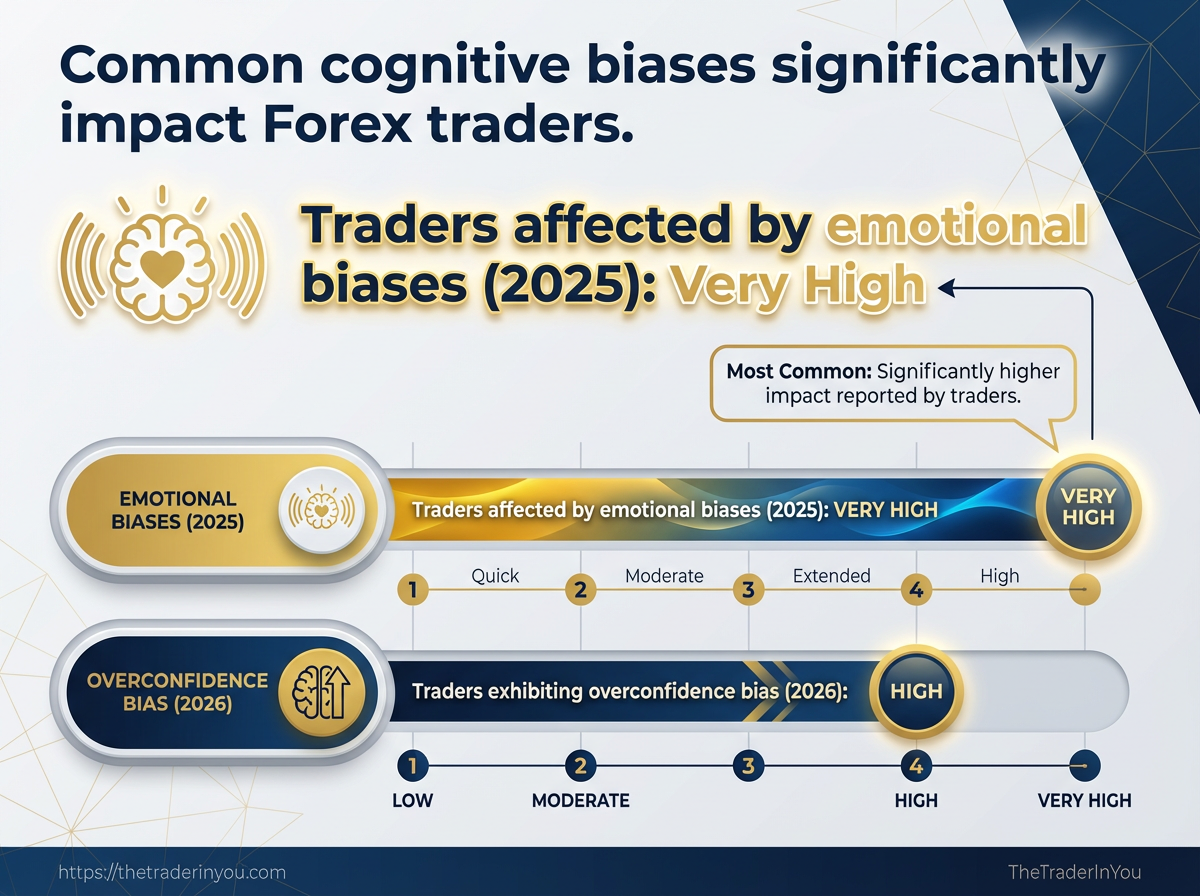
A 2025 study found 75% of Forex traders acknowledged emotional biases affected trading performance.
Research from January 2026 showed 60% exhibited overconfidence bias, increasing risky positions.
The usual suspects are overconfidence bias, loss aversion, and confirmation bias.
Each one reshapes how traders interpret signals, set stops, or admit mistakes.
These mental shortcuts turn probability into story, and stories into stubborn positions.
Understanding trader decision-making biases is part of the psychology of trading errors, and directly changes odds of consistent profitability.
Recognizing them is the single most practical step to stop repeating avoidable mistakes.
It begins with naming the error before blaming the market.
Diagnostic opening: Do your trades show predictable psychological errors?
What if a string of losses isn’t market noise but a pattern you can fix? Many traders assume bad luck.
The harder truth is that predictable mental errors often drive repeated mistakes.
Most Forex traders report emotional influence on decisions.
A 2025 study found that 75% of Forex traders said emotions affected their trades.
More recent research from January 2026 showed 60% of traders display overconfidence, which raises risk-taking and undermines position sizing.
This section gives a quick self-audit to spot whether your recent trades show those predictable biases.
It shows why the problem matters in Forex and offers clear steps, templates, and tracking ideas to begin changing behavior today.
The flowchart guides a five-question self-audit.
Each question narrows whether losses come from process errors (entry/exit rules) or from psychological slips like revenge trading or confirmation bias.
Use the results to pick one behavior to correct this week and track it in your journal or in MetaTrader 5 trade notes.
Why this matters in forex: speed, leverage, and asymmetric information
Forex amplifies small mistakes.
Trades execute quickly, so emotional reactions can become actions before the slow part of the brain recalibrates.
Leverage multiplies both gains and losses.
Overconfidence in position sizing can turn a single misjudged trade into a damaging drawdown.
Asymmetric information and crowded trades increase the chance you’ll chase narratives instead of facts.
The psychology of trading errors matters because cognitive biases distort how you interpret fast, noisy price moves.
Overconfidence Bias: Traders overestimate their forecast accuracy, often increasing size or frequency of trades beyond their edge.
Loss Aversion: Traders hold losers longer to avoid realizing a loss, which magnifies drawdowns and erodes capital.
Confirmation Bias: Traders selectively seek information that supports their view, ignoring signals that would suggest exiting.
Trading psychology research like Trading Psychology by Brett N.
Steenbarger and materials from platforms such as Forex.com are useful references when learning to recognize these patterns.
How to use this article: quick actions, templates, and tracking
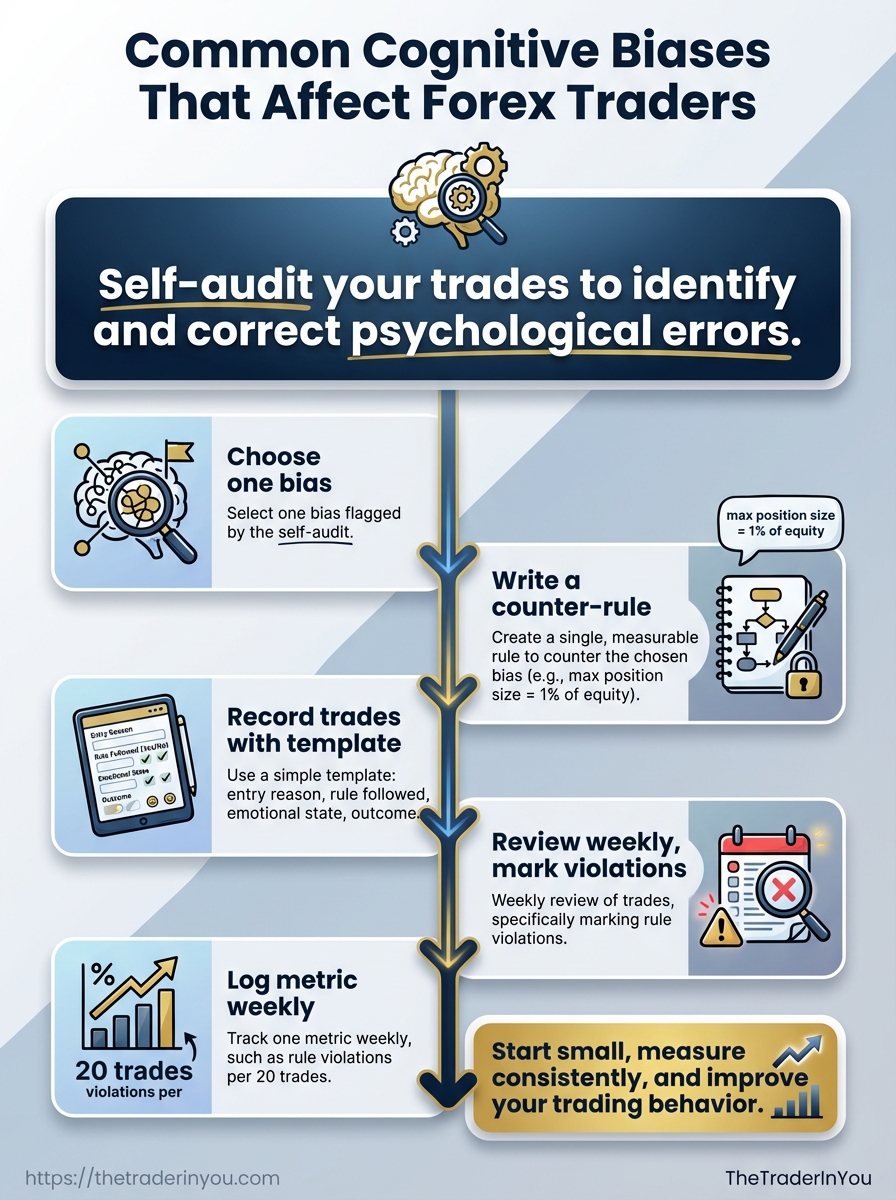
Start with a single, measurable change.
Focus narrows action and makes behavior easier to track.
- Choose one bias flagged by the self-audit and write a single rule to counter it (e.g., maximum position size = 1% of equity).
- Use a simple template to record trades: entry reason, rule followed, emotional state, outcome.
- Review trades weekly and mark violations.
- Template: One-line trade rationale + rule check (yes/no) — perfect for
MetaTrader 5notes. - Quick action: Set a pre-trade checklist with three items: rule, size, exit plan.
- Tracking: Log one metric weekly (rule violations per 20 trades).
Start small and measure.
Small, consistent fixes beat big, unfocused promises.
How cognitive biases show up in real forex trading
What if the reason a trade keeps failing has nothing to do with the chart and everything to do with your head? Traders toss around “market noise” while predictable mental patterns quietly worsen entries, exits and position size.
Psychological influences are not abstract.
A 2025 study found that 75% of Forex traders admitted emotional biases affected their decisions, and a January 2026 survey showed 60% displayed overconfidence that raised risk-taking.
Those numbers help explain why identical setups produce wildly different outcomes from one trader to the next.
Expect the biases below to appear as concrete behaviours: fixating on a specific entry price, hunting confirmatory indicators, refusing to cut a loser, increasing size after a streak, mistaking recent volatility for trend, and piling into crowded FX moves.
Each bias has a distinct pattern and a practical countermeasure.
Anchoring: Fixating on one price or reference point and letting it drive trade decisions
Confirmation bias: Selecting information that supports a pre-set view while ignoring contrary evidence
Loss aversion: Preferring avoidance of losses over the potential for equivalent gains, leading to asymmetric exits
Overconfidence: Overestimating skill or predictive power, causing oversized positions and too many trades
Recency bias: Treating recent price moves as more informative than longer-term evidence
Herd behavior: Following other traders into momentum moves, often into late-stage rallies or collapses
Anchoring in practice
Anchors often show up as stubborn order placement at round numbers or a prior swing high.For example, a trader might insist on entering at 1.2000 on MetaTrader 5 and miss better entries or force trades to hit that anchor.
Counter this by defining an entry band and using limit orders across the band rather than a single pinned price.
Confirmation bias and cherry-picking
A trader who wants EUR/USD to rally will scan for bullish indicators and ignore bearish volumes.Combat this by forcing a pre-trade checklist that requires at least one disconfirming signal before taking a position.
Loss aversion and skewed exits
Loss aversion makes traders hold losers and take small winners.Implement a fixed risk-reward rule and use OCO (one-cancels-other) orders so exits follow the plan, not emotion.
Overconfidence and frequency inflation
Overconfident traders increase size after wins and trade more often.Track your trade frequency and average position size monthly; treat spikes as red flags and scale back until performance stabilizes.
Recency bias and short-term noise
Recent spikes look like new trends.Compare recent move statistics to longer windows and prefer decisions backed by multiple timeframes.
Herd behavior and momentum traps
Crowded FX trades can flip quickly.Watch open interest and liquidity; when the impulse is mostly retail chatter, resist joining the crowd.
Practical quick wins:
- Daily checklist: write trade criteria and require a disconfirming signal.
- Pre-defined bands: use entry bands rather than single price anchors.
- Automated exits: place
stopandlimitorders at setup time. - Monthly audit: review position size and trade frequency trends.
These biases don’t disappear with experience, but they can be managed with rules, measurement and small automation steps that let the market, not emotion, dictate outcomes.
Deep-dive: less obvious biases that quietly erode performance
Most traders blame charts.
The quieter truth is that a handful of subtle thinking errors quietly shift risk profiles until performance drifts.
These are not the headline biases people quote in interviews; they live in position-sizing choices, platform nudges, and how recent news reshapes conviction.
This section focuses on four less obvious traps: the sunk-cost fallacy when rolling or averaging down, gambler’s fallacy in streak interpretation, availability-driven overreactions from news, and framing effects baked into broker reports and UIs.
Each one changes behavior slowly, so by the time a trader notices the impact, losses have already accumulated.
Expect practical checks you can apply immediately, plus short definitions and small process changes that stop these biases from compounding.
These fixes don’t need perfect discipline; they only need consistent application.
- Sunk-cost trap: rolling or averaging down because money is already invested.
- Gambler’s fallacy: treating unrelated price moves as compensating events.
- Availability bias: news or tweets overweight recent events in judgement.
- Framing effects: broker reports and UI cues skew how options look and feel.
Sunk-cost fallacy in rolling positions and averaging down
Traders often average down believing added size will “save” the original trade.
That’s the sunk-cost fallacy: past loss influences present decisions despite independent probabilities.
The danger is a slow escalation of position size until a margin call or catastrophic loss occurs.
- Define a hard stop-loss when the trade is opened and record it in
trade_journal. - If tempted to add, force a written rationale: what new information justifies a different probability, not emotion.
- Use a rule: never increase position size after a loss unless a pre-specified signal is triggered.
Example: a trader doubles down on EUR/USD after a losing leg because the prior entry “must be right.” That decision shifts portfolio risk without changing the trade’s odds.
Gambler’s fallacy and misinterpreting streaks
Price streaks are independent more often than traders assume.
Expecting a reversal because an instrument “has been down for five days” is classic gambler’s fallacy and a losing framing for risk control.
Actionable check: treat streaks as neutral data.
Backtest short-term mean reversion only, and require statistical evidence before changing edge assumptions.
Availability bias — news-driven overreactions and framing effects
Recent headlines dominate perceived risk.
Availability bias makes rare events feel common, prompting oversized reactions to news cycles and social media.
> 75% of Forex traders said their decisions were influenced by emotional biases in 2025, and a January 2026 study found 60% showed overconfidence that increased risk-taking.
Practical guard: schedule discrete windows for news-driven rebalancing.
If a story arrives outside that window, note it in the journal and revisit during the next review.
Framing and presentation effects from broker reports and platform UI
Colors, default order of assets, and suggested lot sizes nudge behavior.
MetaTrader 5 layouts or broker dashboards at Forex.com can make certain instruments feel “recommended,” subtly biasing allocation.
Term: Framing effect Presentation choices change perceived attractiveness without changing fundamentals.
Small fixes: customize UI to neutral colors, hide recommended size presets, and sort instruments by objective metrics you control.
these biases act like a slow leak in risk control; they’re easy to miss because they feel rational in the moment.
Catching them requires simple, repeatable rules and a trading journal that forces objective checks.
Quick reference: bias checklist and comparison
Biases often show up as the smallest decisions that compound into big P&L differences.
Treat this section as a practical cheat sheet you can use during post-session reviews to tag which mental errors appeared, what triggered them, and what to do immediately versus at the process level.
Trading behavior is measurable.
Use your trade-blotter, timestamps, and position-size history to match actions with triggers.
That makes cognitive biases visible and actionable instead of vague or shaming.
Two recent industry findings underline why this matters: a 2025 study found that 75% of Forex traders admitted emotions affected their decisions, and January 2026 research reported 60% of traders showed overconfidence bias, which raised risk-taking.
Those numbers aren’t abstract — they explain recurring leaks in typical trade records.
> 75% of Forex traders reported emotional influence on decisions (2025). > 60% of Forex traders exhibited overconfidence bias in a January 2026 study.
### Reference table: bias, trading trigger, observable behavior, immediate mitigation, long-term control
| Cognitive bias | Common triggers in FX | Observable trading behaviors | Short-term mitigation (during session) | Long-term control (process level) |
|---|---|---|---|---|
| Anchoring | Initial quote or analysis stuck in mind | Refusing to update entry/exit after new data | Pause; re-evaluate price against current levels for 5 minutes | Pre-define decision rules and use trade-blotter reviews |
| Confirmation | Biased news feed or selective indicators | Cherry-picking charts that match thesis | Actively search one opposing indicator before acting | Rotate analytical sources; regular hypothesis testing |
| Loss aversion | Recent loss or fear of regret | Holding losers too long; reducing size on winners | Set and respect stop-loss; move to demo on stress | Use automated stops and risk-per-trade caps |
| Overconfidence | String of wins, ego, trading without checklist | Increasing size; ignoring risk limits | Reduce size to baseline and force checklist pass | Monthly risk audits; accountability partner |
| Recency bias | Recent sharp move or news spike | Extrapolating recent trend indefinitely | Compare move to longer timeframes quickly | Use multi-timeframe rules in strategy design |
| Herd behavior | Market chatter, social media alerts | Jumping into crowded trades late | Wait one full candle or session before entry | Test strategies on out-of-sample data; trade plan discipline |
| Sunk-cost fallacy | Previous large position or losing streak | Averaging down to justify prior trades | Freeze further additions; close if rule breached | Ban discretionary averaging; document exceptions |
| Gambler’s fallacy | Streak thinking after wins/losses | Chasing to “even out” results | Stop trading after X consecutive losses/wins | Enforce session limits and cooldown periods |
| Availability bias | Recent news headlines or vivid examples | Overweighting high-profile events | Cross-check probabilities with historical frequency | Maintain a checklist of objective metrics for decisions |
| Framing effects | How risk/reward is presented | Choosing options based on wording | Re-frame the trade in absolute P&L terms | Standardize trade templates with neutral wording |
trade-blotter.
This turns vague frustration into targeted corrections.
Use the table like a fault tree: if a behavior repeats, move from short-term mitigation to process changes until the pattern breaks.
Cross-referencing with platform logs such as MetaTrader 5 speeds identification and lends evidence to behavioural claims.
How to use this checklist in a post-session review
Start each review with one clear question: which bias best explains my single worst trade? That narrows the search quickly and removes noise.
- Tag the trade: Mark the bias from the table that fits the observable behavior.
- Note the trigger: Record what news, chart, or emotional state preceded the action.
- Apply immediate mitigation: Write what short-term step would have stopped the loss if applied.
- Assign a process fix: Pick one rule to implement for the next week and track compliance.
Repeated tagging builds a pattern you can fix systematically.
Use this method weekly; the patterns become unmistakable.
Small changes in review habit reduce repeated psychological errors and restore control to trader decision-making.
Practical mitigation: processes, checks, and habit changes
What if a repeatable process could remove most of the guesswork from your entries and exits? Traders who add simple, rule-based checks to their routine find fewer impulsive trades and steadier risk profiles.
This section lays out concrete pre-trade rules, during-trade controls, a post-trade review framework, and short behavioral drills you can adopt tomorrow.
The advice focuses on processes that interrupt emotional reflexes and create measurable feedback loops.
The visual compresses the most defendable pre-trade criteria into a four-point checklist: trade thesis, stop placement, position sizing cap, and planned exit.
Pin it to your trading desk so the rules become muscle memory rather than an extra decision.
Pre-trade rules to prevent bias-driven entries
Start each trade with a brief written checklist and a two-step evidence test to force objective thinking.
- Two-source thesis: Note one technical reason and one fundamental or market-structure reason for the trade.
- Max risk cap:
Risk%per trade set before order (e.g., 0.5–1% of equity). - Stop-first rule: Place protective stop before any other order is executed.
- Planned exit: Record profit target and conditions that will cancel the trade (time, news, volatility).
- Intent tag: Label the trade as scalp, swing, or position to prevent scope creep.
These checks counter confirmation seeking and overconfidence before an entry.
During-trade controls: execution rules and automated alerts
Real-time friction stops emotional changes from becoming actions.
- Automated stop orders: Place
stop-lossorders in the platform before execution (MetaTrader 5 supports bracket orders). - Size locks: Use account-level rules that block increases above
max risk cap. - Alert thresholds: Set intraday alerts for volatility spikes or ATR doubling.
When alerts trigger, follow a pre-agreed checklist rather than reacting in the moment.
Post-trade review framework: metrics that reveal bias
Track a small, consistent set of metrics each day to spot patterns rather than justify outcomes.
- Bias flag: Note whether the entry matched your thesis or was emotional.
- Holding-time delta: Actual hold time vs. planned hold time.
- Stop-hit reason: Market-driven vs. self-adjusted.
- R:R drift: Recorded risk-to-reward vs. executed R:R.
- Repeat error count: How many trades repeated the same mistake that week.
Remember: 75% of Forex traders reported emotional influence on decisions in 2025, and a January 2026 study found overconfidence in 60% of traders.
Tracking these metrics creates accountability against those tendencies.
Behavioral drills: short exercises to reduce emotional reactivity
Small, repeatable drills build mental resistance to impulsive moves.
- Pause-and-write (60s): Before changing a live trade, write one sentence explaining the reason.
- Breath-count reset (30s): Three slow breaths to clear arousal before placing orders.
- Pre-market ritual: Review the day’s top three risks and set a single micro-goal.
Do these drills for two weeks and measure whether your repeat error count falls.
Adopting rules, alerts, and short drills turns reactive habits into predictable processes.
Start with one rule and one drill, then add the rest once they stick.
Designing systems and workflows to reduce bias exposure
Imagine building a trading routine that treats your mind like an unreliable sensor and designs around that fact.
Instead of relying on willpower, the goal is to make choices mechanically verifiable so emotions have less room to bend outcomes.
That means translating judgment calls into objective filters, constraining position size to counter overconfidence, and running experiments that hide identifying cues.
These steps lower the chance that the 75% of traders who reported emotional influence in 2025 or the 60% who showed overconfidence in January 2026 will undo otherwise sound strategy rules.
Practical systems do three things: capture signals in reproducible form, enforce conservative sizing when confidence is inflated, and test changes under blinded, randomized conditions.
Rules-based strategies and objective signal filters
Convert discretionary ideas into precise checks so a machine or checklist can agree with you.
Start with a written rule for entry and exit, then express it as a Boolean condition.
For example: enter_long if RSI < 30 AND close > open AND 20ema_slope > 0.
Use filters that remove ambiguous edge cases.
Avoid fuzzy language like “market looks strong”; replace it with quantified momentum (e.g., price > SMA(50)), volume thresholds, or volatility bands.
- Signal reproducibility: store raw inputs and exact indicator parameters for each trade.
- Objective vetoes: automatic prevents (e.g., no new trades during major economic releases).
- Audit trail: timestamped logs that link rule evaluation to the final decision.
This short demo shows converting a discretionary rule into an algorithmic check, then backtesting it to see statistical edge and failure modes.
Watch how tight definitions change win-rate and drawdown.
Position-sizing frameworks that counter overconfidence and loss aversion
Position sizing must act as a cognitive governor.
Fixed-fraction sizing and volatility-adjusted sizing remove hero risk-taking after wins.
Use a simple formula: risk_amount = account_balance risk_pct_per_trade and position_size = risk_amount / (stop_distance pip_value).
Bold rule example: Loss-aversion guard: after three consecutive losses, reduce risk_pct_per_trade by 25%.
Bold rule example: Win-streak cap: after two winners, cap next trade risk to prevent oversized bets.
Kelly caution: Kelly fraction can be informative, but scale it down (e.g., Kelly/4) to avoid overbetting when overconfidence inflates perceived edge.
Using blinding techniques and randomization in small-scale strategy tests
Blinding removes identity and sequence cues that bias judgment during evaluation.
Randomization prevents pattern-chasing across a small sample.
Term: Blinding Remove non-essential identifiers (e.g., timestamps, currency pair labels) so reviewers judge signals blind to context.
Term: Randomization Shuffle trade order or use bootstrapped samples when testing to reduce look-ahead pattern detection.
- Isolate 50–200 trades for a pilot strategy.
- Strip identifying metadata and randomize order.
- Evaluate performance metrics without knowing which trades came from which conditions.
- Reintroduce metadata only after statistical assessments are complete.
- Repeat with parameter variations.
These tests reveal whether an apparent edge survives neutral scrutiny or collapses under cognitive bias.
Trading psychology literature, including work by Brett N.
Steenbarger, supports blinded review as a way to reduce confirmation bias and overconfidence.
Design systems this way and bias becomes an engineering problem, not a moral failing.
Small structural changes like clear filters, conservative sizing rules, and blinded tests compound into steadier decision-making.
Case studies: short real-world FX examples
Imagine three short FX trades that go wrong for reasons a chart alone won’t reveal.
Each story is compact: entry reasoning, what the trader ignored, and one clear fix you can apply the next day.
Emotional and cognitive influences are common.
A 2025 study found that 75% of Forex traders said emotions affected their decisions, and research from January 2026 reported 60% showed overconfidence bias.
Those numbers show the problem, not the solution; the cases below show practical fixes you can replicate in your review process.
These examples draw on trade-log best practices and behavioral frameworks from Trading Psychology by Brett N.
Steenbarger, and on tools like MetaTrader 5 for replaying short sessions and trade execution records.
Each micro case ends with a concise lesson and one action to add to your checklist.
Micro case 1 — anchoring and a failed breakout
A trader anchors on a round resistance at 1.1200 after a multi-day range.
They place a breakout long when price punctures 1.1200 and hold through a quick rejection, expecting a retest.
The market snaps back; a stop-hunt takes them out with a larger-than-planned loss.
- Pre-trade: range seen, anchor set at 1.1200.
- Entry: breakout long on first 15m close above anchor.
- Outcome: false breakout, rapid rejection, stop executed.
- Root cause: Anchoring — treating a single level as decisive without context.
- Simple fix: Delay confirmation — wait for a 1-hour close or volume confirmation.
- Review action: Use
MetaTrader 5replay to compare breakout attempts across sessions and note false-break frequencies.
Micro case 2 — confirmation bias in news-driven FX trades
A trader reads several bullish headlines after an unexpected labor report and focuses only on sources that match that narrative.
They skip contrarian order-flow and enter aggressively.
Price initially spikes then reverses; the trader doubles down instead of reassessing.
- Trigger: bullish macro headline.
- Behavior: selective reading, aggressive position sizing.
- Result: reversal, outsized drawdown.
- Root cause: Confirmation bias — seeking supporting evidence and ignoring contrary signals.
- Simple fix: One-minute contrarian scan — force a checklist item to find at least one high-quality opposing data point before adding risk.
Micro case 3 — recency bias during high-volatility sessions
After three quick winners during London open, a trader assumes the same pattern will repeat and widens stops.
Volatility spikes for different reasons; loss increases and position becomes a significant outlier on the P&L.
- Pattern: recent wins create mental momentum.
- Action: looser risk controls and higher size.
- Outcome: single large loss during volatility expansion.
- Root cause: Recency bias — overweighting recent outcomes.
- Simple fix: Fixed risk rule — cap position size to a % of account and don’t change it based on prior trades.
Small, repeatable checks fix most of these failures.
Add the three one-step fixes above to your post-trade review and you’ll stop the same mistakes from repeating.
Measuring bias impact and building a monitoring routine
Imagine you could quantify how often your emotions cost you money and where they show up most.
That changes bias from a vague annoyance into a measurable performance problem you can fix.
Start by treating cognitive distortions as operational failures — the same way you’d measure latency or slippage.
A simple, repeatable set of behavioral KPIs turns gut feelings into numbers you can track over time, audit monthly, and feed back into your rules and checklists.
Those numbers matter.
Recent research found that 75% of Forex traders reported decisions influenced by emotional biases (2025), and a January 2026 study showed 60% exhibited overconfidence that raised risk-taking.
Use metrics to find whether you’re part of those groups and which bias costs you most.
Key behavioral KPIs and how to compute them
Below are practical metrics that map directly to trading psychology.
Each has a short formula and a one-line interpretation you can compute from your journal or platform logs (for example, export trades from MetaTrader 5).
- Bias Incident Rate:
bias_incidents / total_trades
- Average Position Hold Extension:
avg(time_closed - time_rule_exit)
- Win-Rate After Rule Break:
wins_after_breaks / breaks_count
- Overconfidence Exposure:
avg(leverage_used_when_confident) - avg(leverage_baseline)
- P&L Drift from Emotion Trades:
sum(P&L_emotion_trades) - sum(P&L_rule_trades)
- Confirmation Bias Index:
reversal_count_after_info_search / total_searches
Simple incident logging template
Keep the entry compact so logging actually happens.
Use a single-row per incident format in your journal or CSV.
Fields below are the minimum to capture repeat triggers.
- Date:
- Trade ID / Pair:
- Bias Type:
- Trigger:
- Rule Broken:
- Immediate Outcome (P&L):
- Reflection (2 lines):
Monthly bias audit: runbook
Run a short, structured review every month so patterns become obvious.
- Export trades from your platform (MetaTrader 5 recommended) and merge with journal rows.
- Recompute the KPIs above and flag metrics that moved >10% vs prior month.
- Sort incidents by frequency and P&L impact to prioritize fixes.
- Update or add one rule that directly addresses the top two triggers.
- Backtest the new rule on last 3 months of trades to check for unintended effects.
- Commit the change to your trading plan and set a 30-day check to confirm behavior change.
Measuring bias turns vague regrets into fixable problems.
Track the right KPIs, keep logging tight, and run the monthly audit to turn insight into disciplined habit.
Resources and tools to support ongoing bias control
What if staying unbiased was mostly about the setup, not constant self-policing? The most dependable traders make bias control a habit by combining evidence-based reading, platform features that enforce rules, and tight templates for every trade.
Start with reading that rewires how you interpret wins and losses.
Pair that with software features that force consistency — order templates, automated stop placement, and trade journaling.
Tracing decisions in a bias log turns vague feelings into measurable patterns you can correct.
The data shows why this matters. > A 2025 study found 75% of Forex traders admitted emotional biases influenced their decisions, hurting performance. > Research from January 2026 reported that 60% of Forex traders showed overconfidence bias, increasing risky positions.
Recommended reading and research summaries
Begin with Trading Psychology by Brett N.
Steenbarger: concise chapters that mix clinical insight with practical exercises for traders.
The book includes drills to reduce overconfidence and reframe loss aversion.
Research summaries: Short, focussed papers that examine trader behavior are essential.
Prioritize studies that measure outcomes (win/loss after interventions) and those that report prevalence of biases in FX markets, since 2025–2026 data shows high bias incidence.
Practical guides from brokers: Firms like Forex.com publish trader-behavior guides that pair market mechanics with psychology.
Use them for checklists and plain-language case studies.
Software tools and platform features that enforce rules
- Order templates in MetaTrader 5: set default
StopLoss,TakeProfit, andMaxRisk%before entry. This removes late-stage emotion from sizing decisions.
- Automated alerts and rule-based exits: alerts that trigger when price hits acceptance zones reduce the temptation to micromanage trades.
- Integrated trading journals: platforms or third-party apps that capture pre-entry notes, screenshots, and exact execution details make post-trade reviews objective.
- Broker educational resources: use trade replay tools and simulated accounts to test new anti-bias rules without P&L pressure.
Templates: pre-trade checklist, post-trade review sheet, bias log
1.
Pre-trade checklist Market context: trend, liquidity, event risk. Entry criteria: EntryCriteria (pattern, indicator, time). Risk controls: MaxRisk%, RR target, StopLoss level. Bias check: one-line note on emotional state or recent wins/losses.
2.
Post-trade review sheet Outcome: executed price, P&L, slippage. Decision audit: did the trade match checklist? If not, why? Improvement action: one fix to apply next time.
3.
Bias log Date / Trade ID: quick lookup fields. Bias observed: e.g., Overconfidence, Loss aversion, Confirmation bias. Trigger: what thought or event preceded the bias. Corrective step: concrete rule or habit to prevent recurrence.
Keeping a compact toolkit — a few focused books, platform rules, and tight templates — turns cognitive biases into trackable, fixable behavior rather than random mistakes.
Small, repeatable changes compound into steadier decision-making over time.
Turn bias awareness into better trades
What if the moment you promise to “get it back” became the single cue that stops a losing streak? Cognitive distortions in forex trading are not mysterious failures of will; they’re predictable mental shortcuts that show up in specific ways, like the revenge-scaling example from the case studies.
Treating those patterns as data rather than drama is the most valuable shift a trader can make.
Start with one practical habit today: begin a seven-day bias log where every trade gets a one-line trigger note and a one-line emotion note.
After the week, compare the notes to your P&L and the bias checklist from the article to see which trader decision-making biases appear most often.
For ongoing structure, tools like TheTraderInYou can provide templates and monitoring routines to keep the psychology of trading errors measurable and manageable.

Follow Joshua for daily forex tips on X: @thetraderinyou or connect with him on LinkedIn: Joshua Okapes.
- Cultivating Self-Discipline in Forex Trading: Tips for Long-Term Success - April 1, 2026
- Risk Management Techniques Every Forex Trader Should Master - March 24, 2026
- Understanding Different Forex Trading Strategies: A Comprehensive Overview - March 21, 2026