
The mornings when a currency pair gaps through your stop and the afternoon when an economic surprise flips every indicator — those are the moments that expose gaps in most traders’ education. Trading becomes survivable and repeatable only when Forex knowledge stops being a grab-bag of tips and instead becomes a coherent framework for decision-making, risk control, and trade evaluation.
Practical frameworks matter more than clever strategies that look good on a demo account, and learning the right broker quirks can shave months off the trial-and-error curve. Compare trading conditions side-by-side with Compare Forex Brokers, and read a deep breakdown of a widely used platform in Read our XM review.
This guide treats market structure, position sizing, and psychology as equal partners rather than optional extras, and it points to real broker options for testing ideas live, such as Exness, HFM, and XM. Expect clear, practical guidance that turns confusing market noise into repeatable processes you can trust.

Forex Fundamentals: Market Structure and Participants
The foreign exchange market is a decentralized, continuous market where currencies trade 24/5 through a web of banks, brokers, electronic networks and retail platforms. Price discovery happens not on a single exchange but across the interbank system — major banks quote prices to each other constantly, and those prices cascade down to brokers and retail platforms. That continuous quoting is why FX is liquid and fast-moving during overlapping market hours.
How the market works
- Price formation: Major banks and liquidity providers post bid/ask quotes continuously. Retail brokers aggregate those quotes and either pass them through or take the other side.
- Execution: Trades settle in the spot market (usually two business days), or traders use derivatives like forwards and futures to lock rates for future settlement.
- Participants: Global banks, hedge funds, corporations, central banks and retail traders — each with different time horizons and motivations.
Spot market: The market for immediate delivery (settlement usually two business days). Prices are driven by supply/demand and immediate liquidity needs.
Forwards: Customized OTC contracts to exchange currency at a set rate on a future date. Corporates use forwards to hedge specific cash flows.
Futures: Standardized, exchange-traded contracts to buy/sell currency at a future date. Futures reduce counterparty risk via clearinghouses.
Understanding the units
Pip: Smallest conventional price increment for most currency pairs; typically the fourth decimal place, e.g., a move from 1.2345 to 1.2346 is 1 pip.
Pipette: One-tenth of a pip; visible as an extra decimal place on many modern quotes (the fifth decimal for most pairs).
Lot: Standardized contract size. Standard lot = 100,000 units; mini lot = 10,000 units; micro lot = 1,000 units. Position sizing ties directly to lots and pip value.
Practical example: Buy 1 micro lot of EUR/USD at 1.2000. A 10-pip move to 1.2010 yields about $1.00 profit (10 pips × $0.10 per pip for a micro lot).
Market nuances traders should watch
- Spread behavior: Spreads widen in low liquidity or news events.
- Counterparty models: ECN/STP vs market-maker affects slippage and fills.
- Settlement conventions: Some exotic pairs have different spot settlement rules.
For live, interbank-like pricing and low-latency execution, many retail traders examine offerings from established brokers such as Exness. Understanding where prices originate and how those price increments translate to dollar outcomes makes position sizing and risk control far more practical.
Market Analysis Methods: Technical, Fundamental, and Sentiment
Traders typically combine three lenses to read markets: technical looks at price action and patterns, fundamental examines economic drivers and value, and sentiment measures how other participants are positioned. Each method answers different questions — where price might go next, why the move is happening, and whether the crowd is crowded — and pairing them makes signals more reliable.
Technical Analysis: Technical analysis: Uses price, volume, and derived indicators to find trends, reversal zones, and entries.
Fundamental Analysis: Fundamental analysis: Studies economic data, interest rates, corporate earnings, and macro events to assess intrinsic value and directional bias.
Sentiment Analysis: Sentiment analysis: Gauges market positioning and psychology using metrics like COT reports, retail positioning, and news flow.
Matching timeframe to method
- Choose the primary timeframe for your trade (e.g., 1H, 4H, daily).
- Align technical tools to that timeframe — use
EMA(20)on 1H for intraday,SMA(200)on daily for trend context. - Layer fundamental and sentiment context — check economic releases and positioning that could derail setups.
Side-by-side comparison of technical, fundamental, and sentiment analysis showing use-cases, key tools, best timeframes, and example indicators
| Analysis Type | Primary Use-case | Key Tools/Indicators | Best Timeframes | Example Signals |
|---|---|---|---|---|
| Technical Analysis | Entry/exit timing and pattern recognition | Trendlines, RSI, MACD, Fibonacci, volume profile |
Intraday to swing (1m–daily) | Break of daily resistance with bullish divergence on RSI |
| Fundamental Analysis | Directional bias over weeks/months | Central bank calendars, GDP, CPI, interest rates | Daily to multi-year | Rate hike surprise → currency strengthens vs lower-yield peers |
| Sentiment Analysis | Detect crowded trades and reversals | CFTC COT, retail positioning, put/call ratio, social sentiment | Intraday to monthly | Extreme net-long retail + falling open interest → vulnerable longs |
Industry practice: combine methods — use fundamentals to set bias, technicals to execute, and sentiment to size/manage risk. Mixing these lenses reduces single-method blind spots and improves trade confidence.
Developing and Testing Forex Strategies
Start by building a strategy around a single, testable edge and rules you can explain on a napkin. If the edge isn’t crisp — what market condition you trade, the trigger, the stop, and the target — it will be impossible to test or scale. Practical strategy development means turning an idea into deterministic rules, validating those rules against historical data with realistic assumptions, then proving them live through forward testing before committing capital.
Edge definition: A short, precise statement of where the strategy wins and why (e.g., “capture short-to-medium moves when EUR/USD breaks a 20-day volatility contraction”)
Rules: Every entry, exit, position-sizing, and trade management step written as an if/then rule
Assumptions: Execution slippage, spread costs, and realistic fill rates stated explicitly
Design and backtest with these concrete steps:
- Collect clean historical tick or minute data appropriate to your timeframe, and normalize for spread and rollover costs.
- Build a rules engine that enforces the strategy: entries, exits,
stop-loss,take-profit, and position-sizing. - Run walk-forward or k-fold validation to check overfitting and robustness.
- Record a broad set of metrics and analytics for each run.
Use a mix of metrics — not just win rate — to judge quality:
- Win rate: percentage of profitable trades.
- Expectancy: average return per trade (in R or currency).
- Max drawdown: peak-to-trough equity decline.
- Sharpe/Sortino ratio: risk-adjusted performance.
- Trade depth: average trades per month (liquidity/operability).
Backtesting pitfalls to avoid include survivorship bias, in-sample curve-fitting, and assuming zero slippage. Practical assumptions: include round-trip spread, use conservative fill models (e.g., partial fills), and simulate overnight news gaps if trading major sessions.
Forward testing and scaling
- Paper trade: replicate live broker conditions, including commission and slippage.
- Small live stakes: scale to 1–5% of target position size to test execution psychology.
- Review cadence: weekly trade-log reviews and monthly performance decomposition.
Feature matrix showing three example strategies (trend-following, breakout, mean-reversion) with their timeframe, typical indicators, risk profile, and sample expectancy
| Strategy | Timeframe | Typical Indicators | Risk Profile | Sample Expectancy |
|---|---|---|---|---|
| Trend-following | Daily to weekly | Moving averages, ADX, momentum | Medium–Low drawdown, longer holds | Typical expectancy: 0.6–1.2 R |
| Breakout | 1H to 4H | Volatility squeeze, ATR, volume | Higher variability, rapid moves | Typical expectancy: 0.4–1.0 R |
| Mean-reversion | M5 to H1 | RSI/Stochastic, Bollinger Bands | Frequent small wins, occasional large losses | Typical expectancy: 0.2–0.8 R |
Key insight: Choosing a strategy means trading its statistical profile — trend systems need patience and tolerant drawdowns, breakouts require strict risk control, and mean-reversion systems demand tight stops and high trade frequency.
Testing is where an idea becomes a risk-managed business. Start simple, quantify everything, and only scale after you’ve seen the rules hold under live execution.
Risk Management and Position Sizing
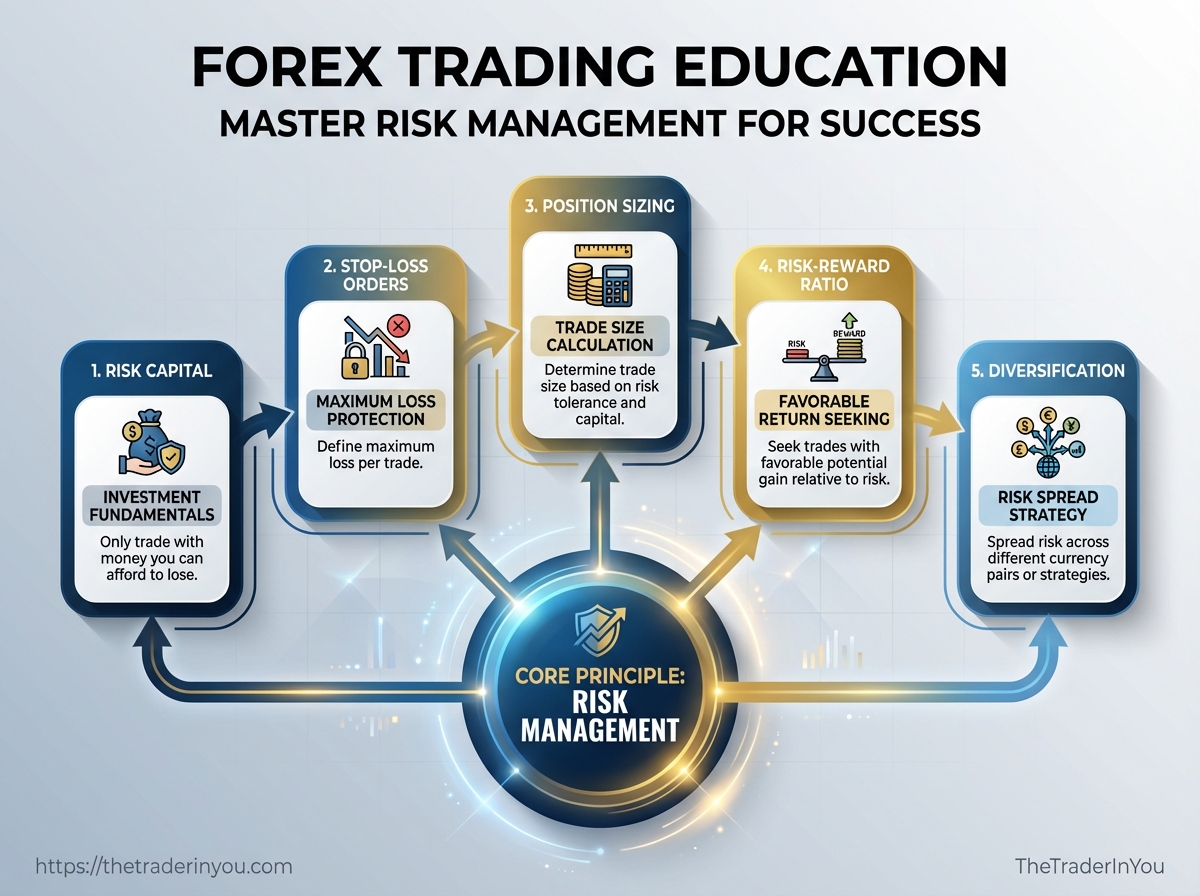
Every trade starts with a decision about how much you’re willing to lose if the market goes against you. Pick a risk-per-trade rule and stick to it: most traders operate between 0.5% and 2% of total capital per trade. That simple discipline prevents one or two losers from wrecking an account and forces setups to meet a risk/reward hurdle before execution.
Risk Controls Every Trader Must Use
- Fixed risk-per-trade: Decide a percent (e.g., 1%) and never exceed it on a single position.
- Maximum daily drawdown: Cap losses in a trading day (for example, 3–5%); stop trading if hit.
- Volatility-based stops: Use
ATRto place stops that reflect current market noise rather than arbitrary tick counts. - Position-size by stop distance: Convert stop distance into position size so dollar risk equals chosen percent.
- Correlation management: Treat highly correlated positions as one exposure; don’t double-down across similar bets.
- Portfolio-level exposure: Limit sector, instrument, or theme concentration to prevent cluster risk.
Calculating Position Size (practical)
- Choose capital and risk per trade.
- Measure stop distance using
ATR(14)or a chart-based logical level. - Convert stop distance to dollar risk:
dollar_risk = account_size * risk%. - Position size in units =
dollar_risk / (stop_distance_in_price * contract_size).
Example: With $100,000 account, 1% risk → $1,000. If stop is 0.50 in price per share, then buy 2,000 shares (ignoring commissions) because 1000 / 0.50 = 2000.
Using volatility to size positions forces consistency: when markets are choppy, position sizes shrink; when quiet, they grow. That adjustment keeps expected drawdowns stable.
Managing Correlation and Portfolio Exposure
Correlation awareness: Regularly check correlations across holdings. Two trades on EUR/USD and GBP/USD behave like one large FX bet if correlation is high. Portfolio caps: Set maximum exposure per sector or instrument (for instance, no more than 20% of capital in one sector). This prevents a single event from dominating outcomes.
Risk controls are where edge turns into survivability. Follow rules that align position size with market conditions and capital limits, and the trading plan becomes a tool for staying in the game long enough to realize an edge.
Trading Psychology and Performance Habits
A professional trader treats psychology and habits like a reliable trading edge: consistent routines, disciplined recordkeeping, and deliberate emotion management create predictability where markets are unpredictable. Start each day with the same checks, end each session with structured reflection, and the mental noise that wrecks performance begins to shrink.
A consistent routine
- Pre-market checklist: Scan macro drivers, news flow, and existing positions; verify risk per trade and margin availability.
- Execution window: Define the hours when you trade and the setups you accept.
- Post-market review: Close the day with trade logging and a short notes entry on emotions and decision quality.
Trade journal fields that matter
Date: The trading day.
Instrument: Ticker or contract traded.
Setup type: Entry trigger and timeframe.
Size & risk: Position size, stop, and risk in currency or percent.
Outcome: Profit/loss and duration.
Quantitative notes: Entry price, exit price, slippage, trade expectancy.
Qualitative notes: Mood, distraction level, conviction (1–5), any deviations from plan.
Keeping quantitative and qualitative fields distinct makes patterns visible — for example, recurring losses after late-night sessions or higher win rates when conviction scores are ≥4.
Step-by-step daily journaling process
- Before opening positions, log pre-session plan and expected setups.
- Immediately after each trade, record
entry,stop,size, and a one-line rationale. - End of day: fill outcome and qualitative reflections, then tag trades for follow-up.
Techniques to manage emotions and cognitive biases
Emotional labeling: Pause, name the emotion (e.g., frustration), then act only after a two-minute breathing break. Pre-commitment rules: Use if-then rules — if drawdown hits 3% of equity, then stop trading for the day. Debiasing check: Before entering, ask three questions — Is this data-driven? Am I chasing recent wins? Would I take this trade with half my account? Small stakes practice: Use reduced size to rehearse new rules until behavior sticks.
Confirmation bias: Tendency to favor information supporting a prior view. Recency bias: Overweighting recent events at the expense of longer-term data. Loss aversion: Stronger reaction to losses than gains, often causing premature exits.
Trading psychology is a skill set — habits replace willpower. Build routines that automate good decisions, and the cognitive taxes of trading fall dramatically.
📥 Download: Forex Trading Education Checklist (PDF)

Choosing a Forex Broker and Tools
Picking a broker starts with safety and ends with execution — everything in between directly affects P&L. Start by prioritizing regulated custody of client funds and transparent pricing, then layer in execution quality, platform stability, and the exact cost structure your strategy will eat. For short-term strategies, micro-pips and fast fills matter; for carry or swing, financing (rollover) and overnight risk controls become more important.
Regulation and safety Regulation: Look for brokers regulated by top-tier authorities (FCA, ASIC, CySEC, DFSA) or local equivalents; tighter oversight reduces counterparty risk. Segregated accounts: Ensure client funds are kept separate from the broker’s operating capital. Compensation schemes: Check whether the regulator provides investor protection or compensation limits.
Costs: spreads, commissions, rollover, hidden fees Spread vs commission: Low advertised spreads can hide commissions or markups. Compare all-in roundtrip costs. Rollover (swap): For swing and carry trades, swap rates can overwhelm small edge — inspect long/short rollover terms. Hidden fees: Funding, inactivity, or withdrawal fees add up — list fee types before funding an account.
Execution, slippage, platform stability Execution speed: Measured in ms — essential for scalpers; simulated latency tests are useful. Slippage: Review average slippage statistics or ask for execution reports; compare during news events. Platform stability: Uptime and order handling during volatility matter — check historical outage reports and user feedback.
Tools and integration Platform choice: MetaTrader 4/5 remain industry standards; proprietary platforms can offer better UX or faster fills. Data feeds: Tick-level history and reliable streaming are crucial for strategy backtests and live execution. * APIs: If automating, confirm REST/WebSocket or FIX support and rate limits.
Broker features relevant to strategy types (costs, regulation, platform, execution, region support)
| Broker | Regulation | Typical Spread (EUR/USD) | Platforms | Best For |
|---|---|---|---|---|
| Broker A (example) | FCA, CySEC | 0.6–1.2 pips | MT4, MT5, Web | Beginner/retail traders |
| Broker B (example) | ASIC, DFSA | 0.0–0.4 pips + commission | Proprietary, MT5 | ECN scalpers, algo trading |
| Broker C (example) | Local regulator (Tier-2) | 1.0–1.8 pips | MT4, Mobile | Regional access, small accounts |
Key insight: Brokers with ultra-low spreads often pair them with commissions or stricter margin rules; regulated, multi-jurisdiction brokers generally offer better fund protection and execution reliability, while regional or low-cost brokers may suit specific local needs.
Choosing the right broker reduces operational surprises and preserves strategy edge. Match the broker’s strengths to how you trade, then validate with a funded micro account before scaling.
Conclusion
Those mornings when a pair gaps through your stop and afternoons when an unexpected CPI print flips every indicator are precisely why the layered approach in this article matters: understanding market structure and participants, combining technical, fundamental and sentiment analysis, and wiring disciplined risk management and psychology into every trade turns surprise into manageable variance. Recall the example of a strategy that survived a news shock because its position sizing and stop placement were pre-tested; that’s not luck, it’s process. Ask yourself: am I trading a plan or reacting to price? Do my risk rules protect capital first? Can I reproduce my edge consistently?
Start with three concrete moves: formalize one trade plan and backtest it on historical data, set explicit position-size rules and a max-drawdown limit, and review brokers’ execution, spreads and margin terms before committing capital. When choosing a broker, compare features side-by-side to match your strategy’s needs — Compare Forex Brokers is a practical next step to move from theory to execution. Revisit small live experiments, log outcomes, and iterate; the combination of tested rules plus disciplined execution is where progress happens.

Follow Joshua for daily forex tips on X: @thetraderinyou or connect with him on LinkedIn: Joshua Okapes.
- Risk Management Techniques Every Forex Trader Should Master - March 24, 2026
- Understanding Different Forex Trading Strategies: A Comprehensive Overview - March 21, 2026
- Building a Resilient Mindset for Forex Trading Success - March 19, 2026

