
You know the moment: a platform flashes margin calls while a desk buzzer hums, and the familiar thought arrives—why do some traders thrive in that chaos while others don’t? That gulf often traces back to the realities of proprietary trading: capital constraints, firm risk rules, execution edge, and a discipline that survives the first big loss.
Prop trading isn’t exotic; it’s a systems game where process, technology, and broker fit matter as much as strategy. For traders evaluating execution and latency, useful starting points include Compare forex brokers for prop traders, Read broker review: IC Markets, Exness, HFM, and XM. Understanding these practical choices before optimizing models separates steady profits from weekend anxiety.

What Is Proprietary Trading?
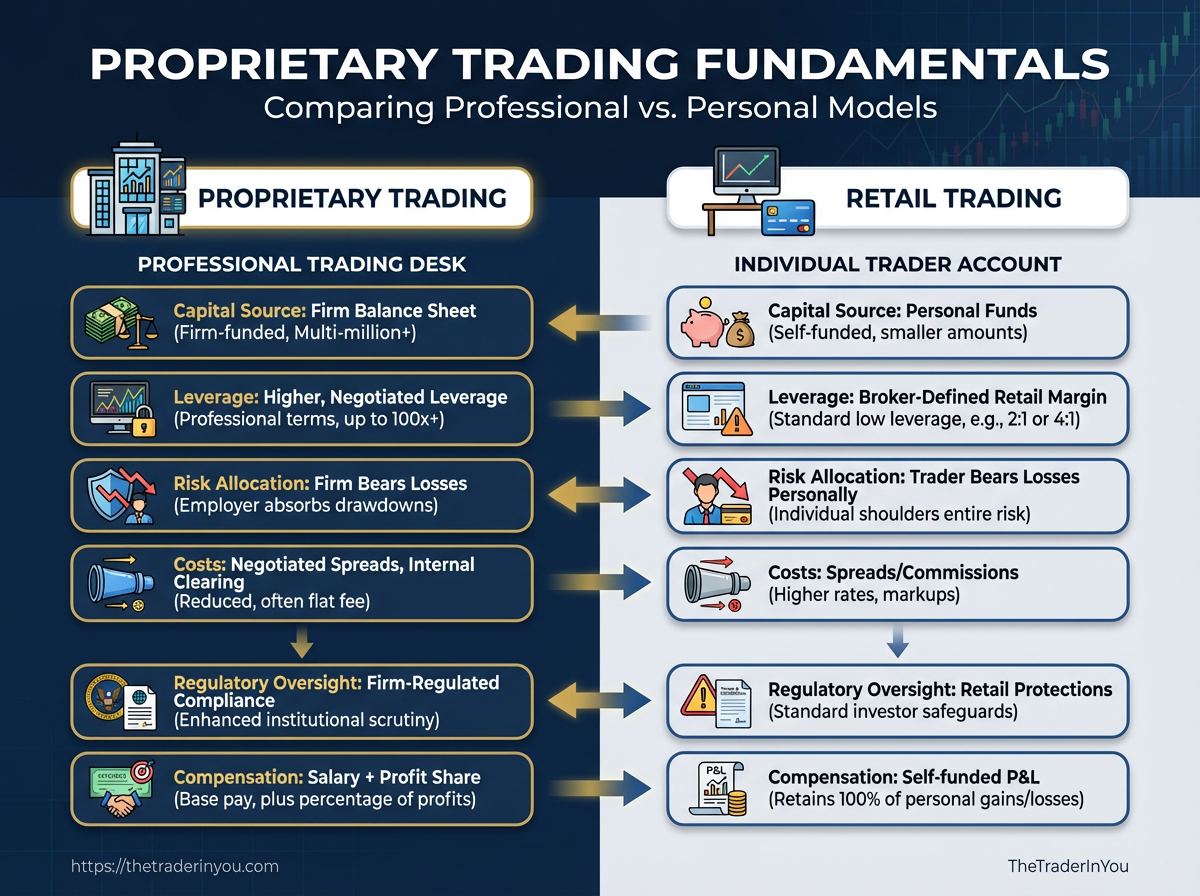
Proprietary trading is when a firm trades financial instruments using the firm’s own capital to generate profits, rather than executing trades on behalf of clients. Traders at a prop shop, bank trading desk, or quant fund use firm balance-sheet money, internal models, and infrastructure to take directional or relative-value positions across FX, equities, options, futures, and other markets. The objective is straightforward: turn the firm’s capital into more capital.
Firm capital vs. personal capital: Prop firms supply the cash and absorb gains or losses. Retail traders use personal accounts and are constrained by their own bankroll and retail broker rules.
Leverage and margin treatment: Proprietary traders typically access higher leverage, bespoke margin terms, and internal risk limits calibrated to the firm’s tolerance. Retail accounts get standard broker margin rules and often stricter retail protections.
Compensation structures: Pay can look very different.
Salary: A base salary may be provided to prop traders.
Profit share: Many firms pay a percentage of net P&L to the trader (50/50, 70/30, etc.).
Funded accounts: Some prop models place traders on funded accounts after a qualifying evaluation, combining low personal capital requirement with a split of profits.
Practical differences show up in how strategy, risk, and operations are run:
- Operational resources: Proprietary desks provide low-latency infrastructure, research, and data.
- Risk controls: Firms enforce real-time limits, automated kill-switches, and centralized clearing.
- Time horizon: Prop traders may hold intraday to multi-week positions depending on strategy.
- Performance pressure: Compensation ties closely to P&L, creating different incentives than retail investing.
Side-by-side comparison of retail trading vs proprietary trading across key attributes
| Attribute | Retail Trading | Proprietary Trading | Implication for Forex Traders |
|---|---|---|---|
| Capital source | Personal funds deposited with a broker | Firm balance sheet or pooled firm capital | Access to larger position sizes with prop capital |
| Leverage available | Broker-defined retail margin (often lower) | Higher, negotiated leverage and internal margining | Ability to scale positions; higher margin calls risk |
| Risk allocation | Trader bears losses personally | Firm bears losses; trader may face career consequences | Larger drawdowns possible without personal bankruptcy |
| Costs and fees | Spreads, commissions, overnight swaps, platform fees | Negotiated spreads, internal clearing, possible desk fees | Lower execution costs at scale; different P&L dynamics |
| Regulatory oversight | Retail protections, client classification rules | Firm-regulated (e.g., by national regulators) and internal compliance | Trading rules and allowed strategies can differ significantly |
Market practice shows prop setups let skilled traders operate at scale, but that scale changes behavior: strategies that look attractive at retail size sometimes break when size and leverage increase. Choosing between retail and prop paths depends on appetite for firm-level oversight, willingness to trade someone else’s capital, and tolerance for shared profit arrangements.
Proprietary trading opens access to capital, tools, and structure that change the game for active traders — for anyone serious about scaling a strategy, understanding these distinctions is fundamental.
How Prop Trading Firms Operate
Prop trading firms provide traders with access to capital and an operational framework that lets experienced market participants trade larger sizes than their personal accounts allow. Most firms fall along a spectrum from traditional salaried-desks to modern funded-account programs, and each model structures incentives and risk differently. That structure determines how profits are shared, what drawdown rules apply, and ultimately how big a position a trader can take.
Common features across models: Access to capital: Firms supply the trading capital, removing the need for traders to risk personal funds. Risk framework: Standardized drawdown limits, daily loss caps, and position-size rules control firm-wide exposure. * Performance incentives: Compensation ranges from fixed salaries to multi-tiered profit splits, aligning trader behavior with firm risk appetite.
Salaried prop trader: A trader employed full-time, often receives fixed pay plus bonuses. Profit-share trader: Trades firm capital and receives a percentage of net profits. Funded account program: Trader pays an evaluation fee or passes a challenge to unlock capital under set rules. Partner-funded desk: External investors supply capital and split returns with the trading team. Hybrid model: Combines salary, profit share, and escalation to larger capital pools.
Common funding models and the tradeoffs for a forex trader choosing each
| Model | Who funds capital | Typical profit split | Trader requirements | Best for (trader profile) |
|---|---|---|---|---|
| Salaried prop trader | Firm balance sheet | Salary + bonuses (0–30% on profit) | Track record, interview, in-office or remote desk rules | Experienced trader wanting steady income |
| Profit-share trader | Firm capital | 40–70% to trader | Proven P&L, adherence to risk rules | Skilled discretionary traders |
| Funded account program | Program firm (after evaluation) | 50–80% to trader | Pass simulated challenge; follow strict drawdowns | Retail traders scaling capital |
| Partner-funded desk | External investors/partners | Negotiated split (varies widely) | Track record, transparency, legal agreements | Traders who attract capital or syndicates |
| Hybrid models | Combination of firm + partner funds | Mixed: salary + ramped profit split | Performance thresholds to access more capital | Traders seeking growth with security |
Key insight: The choice of model shapes incentives and risk-taking. Funded programs can scale fast for retail traders but impose tighter rules, while salaried desks offer steadier income with less upside. Profit-share and partner-funded arrangements reward performance but require strict discipline around drawdowns and position limits.
How capital allocation affects sizing and risk: 1. Position sizing scales to allocated capital — double the capital typically doubles notional exposure for the same risk profile. 2. Risk limits (e.g., 1% of account per trade) force smaller sizes on lower allocations. 3. Drawdown rules create asymmetric incentives: traders may avoid necessary small losses to prevent rule breaches. 4. Margin requirements and overnight risk change intraday sizing decisions.
Practical note: when evaluating firms, compare profit split, maximum drawdown, and scaling path—these determine both upside and the behavioral constraints you’ll face. For trade execution and account access options, many traders use brokers like Exness depending on pair availability and leverage.
Understanding these mechanics helps match the firm model to personal goals — whether steady income, rapid scaling, or autonomy — and frames realistic expectations around returns and discipline.
Trading Strategies Used in Prop Forex Desks
Prop desks run a surprisingly wide range of FX strategies, but they cluster around a few clear approaches that suit different capital levels, tech stacks, and risk appetites. Discretionary trading still lives alongside systematic models: juniors learn price action and macro reads at the desk, while quants tune signals and execution for scale. Timeframe and liquidity drive strategy choice — what works on EUR/USD intraday won’t fit an emerging-market cross where liquidity thins outside London/New York sessions.
Discretionary spot FX: Traders use judgement, order flow, and macro context to take short-term positions.
Systematic trend-following: Rules-based entries/exits that capture multi-day to multi-month directional moves.
Mean reversion / stat-arb: Pairs trading and intra-day mean reversion exploiting microstructure and correlation breakdowns.
High-frequency / latency-sensitive: Market-making and micro-arbitrage requiring sub-millisecond execution and colocated infrastructure.
Macro / position trading: Large directional bets sized over weeks–months, often hedged and driven by macroeconomic forecasts.
Operationally, desks balance these with clear trade-offs:
- Capital usage: Discretionary and macro trades often require larger capital buffers; systematic strategies can scale with modest per-trade capital but need robust risk aggregation.
- Technology needs: High-frequency and systematic desks require low-latency connectivity, tick-level data, and execution algos. Discretionary desks prioritize fast displays, depth-of-book, and voice channels.
- Liquidity timing: Intraday scalps work best during London/New York overlap; position trades exploit lower-cost roll and swap dynamics.
Strategy types by timeframe, capital intensity, infrastructure needs, and risk profile
| Strategy | Timeframe | Capital intensity | Infrastructure needs | Risk profile |
|---|---|---|---|---|
| Discretionary spot FX | Intraday–days | Medium–high | Real-time data, advanced UI | Concentrated tail risk |
| Systematic trend-following | Days–months | Medium | Backtest engines, execution algos | Drawdown-heavy but diversified |
| Mean reversion/stat-arb | Minutes–days | Low–medium | Tick data, correlation models | Frequent small losses, rare large losses |
| High-frequency/latency-sensitive | Seconds–milliseconds | High | Colocation, FIX/UDP feeds, smart routers | Execution and microstructure risk |
| Macro/position trading | Weeks–months | High | Macro research, risk analytics | Large directional exposure |
Market practice shows desks choose mixes: a core systematic sleeve for steady P&L and discretionary traders for asymmetric opportunities. Execution partners and platforms matter; for practical execution choices consider venues like Exness for retail-proximate liquidity. Keep strategy fit practical — align timeframe, capital, and tech before scaling up.
Risk Management and Controls
Practical risk rules separate consistent prop traders from lottery players. For forex prop trading, that means strict position-sizing, hard drawdown fences, and regular stress-testing for event risk — all enforced, not optional. Below are concrete, repeatable controls that fit a prop desk’s operational needs and a trader’s mental wiring.
Position-sizing best practices
1. Decide a consistent risk-per-trade percentage and stick to it.
2. Calculate position size using account equity, stop distance in pips, and pip value.
3. Adjust risk-per-trade dynamically for correlated positions or high-volatility pairs.
Example: For a $50,000 funded account and risk-per-trade = 0.5%, maximum risk per trade is 50,000 × 0.005 = $250. If EUR/USD pip value = $10 and stop = 25 pips, position size = $250 / (25 × $10) = 1 mini lot.
- Use volatility-adjusted sizing: scale down on high-ATR pairs.
- Limit correlated exposure: cap aggregate risk across USD pairs.
- Apply a liquidity filter: avoid full-size entries around thin sessions.
Setting and enforcing drawdown limits
Max daily loss: A hard stop on losses that halts trading for the day when hit.
Max account drawdown: A trailing cap (e.g., 10%) that requires a cooldown or review when breached.
Leverage cap: Limit gross leverage to reduce tail risk; typical prop caps range from 10:1 to 30:1 depending on rules.
Enforcement techniques: automated blocks in the trading platform, tiered cooling periods (24–72 hours), * required coach/manager sign-off for reinstatement.
A quick matrix of common risk controls and how to implement them in FX trading
| Risk Control | Purpose | Implementation | Monitoring Frequency |
|---|---|---|---|
| Max daily loss | Prevent compounding bad days | Hard stop order or platform block at set $ level | Daily (end-of-day) |
| Max account drawdown | Protect capital base | Trailing limit like 10% with mandatory pause | Real-time + weekly review |
| Position-size limit per currency pair | Avoid concentration risk | Per-pair exposure cap (e.g., 3% equity) | Per-trade + portfolio check |
| Leverage cap | Reduce tail risk | Gross leverage limit 10:1–30:1 enforced in account settings |
Real-time |
| Stop-loss & exit procedures | Ensure consistent exits | Pre-defined stop rules, ATR-based stops, exit checklist | Per-trade audit |
Key insight: Treat these controls as programmable rules rather than guidelines. Automation and pre-trade checks remove emotion, while periodic reviews capture edge cases like overlapping news events.
Stress-testing FX portfolios for event risk
Scenario testing: Run hypothetical moves (e.g., 2% USD gap, 200 pip EUR shock) and compute P&L impacts.
Historical replay: Reconstruct past crises (2015 SNB, 2016 USD moves) against current positions.
Monte Carlo simulations: Generate distribution of equity paths using current trade characteristics and volatility assumptions.
These practices let traders see plausible losses and adjust sizing or hedges pre-emptively. Treat controls as living code: enforce them automatically where possible and review them after every outlier event. Risk rules preserve optionality — keep trading another day by surviving today.
Technology, Execution, and Infrastructure
For prop traders the platform, data quality, and execution stack are not nice-to-haves — they determine whether a strategy is viable live. Choose a platform that matches your strategy complexity, ensure historical tick-level data for accurate simulation, and measure execution quality (slippage, fills, latency) before scaling. Practical choices sit on a spectrum from plug-and-play retail terminals to fully custom low-latency APIs tied directly to liquidity providers.
Platform trade-offs and selection MT4/MT5: fast to deploy, vast community indicators, and wide broker support; limited for true low-latency or custom execution. Proprietary platforms: tailor-made order types, exchange-grade routing, and better surveillance; higher development cost and vendor lock-in risk. * API / Direct market access: FIX or REST/WS APIs give lowest-latency routing and precise control over fills; requires ops expertise and redundant connectivity.
Data and backtesting essentials Historical tick data: High-resolution tick datasets (spread, bid/ask, timestamps to ms) are essential for scalpers and high-frequency strategies. Backtesting framework: Simulate realistic order-book behavior, include variable spreads and latency models, and validate on out-of-sample periods.
Execution quality definitions
Slippage: Difference between order price and execution price; measure as distribution, not single mean.
Fill rate: Percentage of orders executed at requested size and price; critical for limit-order-heavy systems.
Latency: Round-trip time from order submission to execution acknowledgment; has direct P&L impact on fast strategies.
Practical execution best practices 1. Maintain colocated or geographically proximate servers to your venue when latency matters.
- Use synthetic testing with replayed tick data including microstructure to estimate realistic slippage.
- Monitor live metrics: track
average slippage,95th percentile latency, andfill rateby instrument. - Have fallback routing and throttling logic to prevent cascade failures when latency spikes.
Platform and data features important to prop forex traders
| Feature | MT4/MT5 | Proprietary platform | API/Direct market access | Notes |
|---|---|---|---|---|
| Order types supported | Market, limit, stop, basic OCO | Advanced algos, iceberg, TWAP | Full order palette via FIX |
Proprietary often exposes venue-specific algos |
| Historical tick data | Third-party vendors; varying quality | Integrated high-quality feeds | Vendor-provided or direct feed | Verify timestamps & spread fields |
| Execution latency | Typically 50–200ms (varies by broker) | Optimized <10ms possible | Sub-ms to low-ms with colocated links | Latency depends on network & venue |
| Backtesting framework | Strategy tester (demo-level) | Custom, multi-asset, replay engines | Custom frameworks required | Model slippage and partial fills |
| Cost | Low setup cost; broker fees | High setup + maintenance | Variable: bandwidth, exchange fees | Balance cost vs edge; proprietary expensive |
Market-oriented traders prefer a realistic, instrument-level view of execution performance rather than optimistic backtest returns. Integrating solid tick data with an execution-aware backtest and measuring live slippage continuously turns theoretical edge into real, repeatable profitability.
Careers, Hiring, and Transitioning to a Prop Firm
Getting hired by a proprietary trading firm or accepted into a funded program is less about flashy one-off wins and more about proving repeatable, controlled performance. Firms evaluate a combination of consistent P&L, disciplined risk management, and clear, reproducible strategy — and they expect candidates to present that evidence in a crisp, professional way. Practical preparation is straightforward: structure your track record, demonstrate risk controls, be ready for practical tests, and show how you think under pressure.
What firms evaluate and how to present it
- Performance consistency: Firms want steady returns, not a single big trade. Show monthly/quarterly returns, win rate, and
Sharpe-style metrics. - Risk management: Explain position sizing, max drawdown limits, and stop rules. Use charts that show equity curve and drawdown periods.
- Strategy clarity: Describe entry/exit logic, timeframes, and edge. Attach code snippets or pseudocode if you use algorithmic rules.
- Technical skills: Demonstrate order-management ability, familiarity with platforms (e.g., execution APIs), and basic data handling.
- Behavioral fit: Display discipline, responsiveness, and ability to follow firm rules.
Step-by-step process to increase your chances
- Prepare a concise performance dossier with monthly returns, max drawdown, and a clean equity curve.
- Build a one-page strategy summary that includes entry rules, risk per trade, and sample trades.
- Practice a timed evaluation: simulated trading for 1–4 weeks under realistic constraints.
- Polish interview answers explaining a losing streak and a recent trade where you followed the plan.
- Follow up with clean deliverables: spreadsheets, screenshots, and
backtestsnippets.
How to present track record and proof of performance
Monthly return table: Include month, gross P&L, drawdown, and commissions.
Trade list: Show date, instrument, direction, size, entry/exit prices, and rationale.
Code or strategy flow: A short pseudocode block or annotated chart that shows decision points.
Common firm evaluation criteria and what applicants should demonstrate
| Evaluation Area | What Firms Expect | How Candidates Demonstrate It | Resources to Improve |
|---|---|---|---|
| Performance consistency | Stable monthly returns, low churn | Equity curve, month-by-month P&L | Trade journaling, portfolio backtests |
| Risk management | Defined max drawdown & sizing rules | Drawdown chart, position sizing examples |
Risk tutorials, Kelly/volatility sizing |
| Strategy clarity | Reproducible entry/exit logic | One-page strategy summary, sample trades | Strategy templates, peer reviews |
| Technical skills | Platform and execution competence | Screenshots, small live/demo account | Execution APIs, platform docs |
| Behavioral fit | Rule-following and composure | Responses to hypothetical stress scenarios | Mock interviews, mindset coaching |
This table highlights where to focus effort and how to package proof of ability; firms are hiring process-followers who can document repeatability, not gamblers.
Practical interview prep and common evaluation tasks
- Mock trading: Expect simulated sessions with firm constraints.
- Live problem solving: Walk through a losing trade and show adjustments.
- Coding/logic test: Short tasks to implement an indicator or order logic.
A professional packet — clear performance, a one-page strategy, and practiced interview stories — moves candidates from curious to hireable. Transitioning to a prop firm rewards discipline more than bravado, so present reproducibility, not just results.

📥 Download: Proprietary Trading Checklist (PDF)
Regulation, Compliance, and Ethical Considerations
Regulation shapes what’s possible for FX prop traders: where you can trade, which counterparties you may use, how capital is treated, and what records you must keep. Awareness of jurisdictional differences, rigorous record-keeping, and avoiding common compliance traps are non-negotiable — they protect capital, reputation, and the ability to scale.
Key regulatory realities for FX prop traders
- Jurisdiction matters: Rules differ sharply between the United States (strict registration and reporting), the European Union/UK (MiFID II/PRU-style requirements and strong client protections), Australia (ASIC oversight and licensing), and offshore hubs (lighter supervision, higher counterparty risk).
- Broker vs regulator distinction: Brokers may be regulated in one jurisdiction while offering services globally; that doesn’t remove a trader’s obligation to comply with local law.
- Record-keeping requirement: Maintain trade tickets, P&L records, execution reports, and communications for the retention period specified by your regulator — often 5–7 years.
- Reporting and transparency: Trade reporting, suspicious-activity reporting, and periodic capital disclosure can apply to trading desks and prop firms.
- Ethical trading: Avoid front-running, wash trades, and market manipulation — these are illegal and easy to detect with modern surveillance systems.
Practical compliance steps
- Register your entity or confirm status with the relevant regulator (or maintain a documented legal opinion if operating through a broker)
- Implement
AML/KYCprocesses and transaction monitoring with logs retained for the regulator’s retention window - Keep automated, time-stamped trade records and daily P&L snapshots stored off-site or in immutable storage
- Run quarterly compliance reviews and an annual external audit to validate controls
AML/KYC: Anti-money-laundering and Know-Your-Customer processes to verify clients and monitor suspicious activity.
Trade reporting: Submission of trade details to a regulator or trade repository when required.
Best execution: Duty to seek the most favorable terms reasonably available for a client or fund.
Common pitfalls and how to avoid them
- Over-reliance on offshore counterparty: Increases legal and liquidity risk. Mitigate by contractual protections and escrow arrangements.
- Poor record hygiene: Leads to penalties during audits. Automate capture of tickets and communications.
- Mixing personal and firm capital: Blurs reporting and tax treatment; keep accounts segregated.
Summarizing note
Regulatory compliance is operational work as much as legal work — build controls that are auditable, automated, and defensible. Practical investment in clean records, clear entity structure, and routine reviews prevents costly disruptions and preserves trading freedom.
Summarize regulatory expectations across major jurisdictions for prop trading firms
| Jurisdiction | Regulatory body | Key requirements | Implication for traders |
|---|---|---|---|
| United States | CFTC / NFA | Registration for firms, strict reporting, capital and segregation rules | Higher compliance cost; limited use of certain leverage and onboarding controls |
| European Union / UK | FCA / ESMA (MiFID II framework) | MiFID II transparency, reporting, best-execution duties, client classification | Strong investor protections; robust record-keeping and reporting obligations |
| Australia | ASIC | Licensing (AFSL), conduct and disclosure obligations, financial crime controls | Clear licensing path; active enforcement and operational standards |
| Offshore hubs (Belize, Seychelles) | Local financial authorities (lighter) | Minimal capital requirements, lighter reporting | Lower costs but higher counterparty and legal risk |
| Best practice | N/A | Entity clarity, automated AML/KYC, immutable trade logs, quarterly audits |
Reduces regulatory friction and preserves operational scalability |
Key insight: Prop traders should match jurisdictional risk appetite to business model — prefer well-regulated counterparties and automated record systems to avoid enforcement and operational drag.
Conclusion
You’ve seen how proprietary forex desks blend strategy, risk controls, and tech to turn edge into consistent performance: disciplined position sizing and real-time risk limits stop small losses becoming disasters; low-latency execution and reliable data feeds shave slippage and protect alpha; focused career paths and firm support help talented traders scale faster. Remember the traders who shifted from discretionary to systematic approaches — they reduced emotional drawdowns and made performance more repeatable — and the desks that invested in execution infrastructure cut transaction costs enough to lift returns noticeably. Wondering whether prop trading fits your temperament or which parts to prioritize first? Start by testing strict risk rules on a demo and tracking slippage and execution quality for a month.
Start with three practical moves: – Set a concrete risk budget and never trade above it. – Measure execution performance (fills, slippage, latency) and fix the biggest drag. – Choose a broker and structure that supports scaling, not just low spreads.
When you’re ready to evaluate providers, take the next step and compare options tailored to prop traders: Compare forex brokers for prop traders. That page helps translate these insights into concrete choices so the next time the platform buzzes, the response is calm and profitable.

Follow Joshua for daily forex tips on X: @thetraderinyou or connect with him on LinkedIn: Joshua Okapes.
- Risk Management Techniques Every Forex Trader Should Master - March 24, 2026
- Understanding Different Forex Trading Strategies: A Comprehensive Overview - March 21, 2026
- Building a Resilient Mindset for Forex Trading Success - March 19, 2026


