When a surprise central-bank statement widens spreads and rushes open orders, traders tighten their grips and make quicker decisions.
That immediate response exemplifies the impact of stress in trading.
It makes solid plans feel distant and nudges traders toward hasty moves that erode edge.
High-stakes events trigger this response more frequently than traders often recognize.
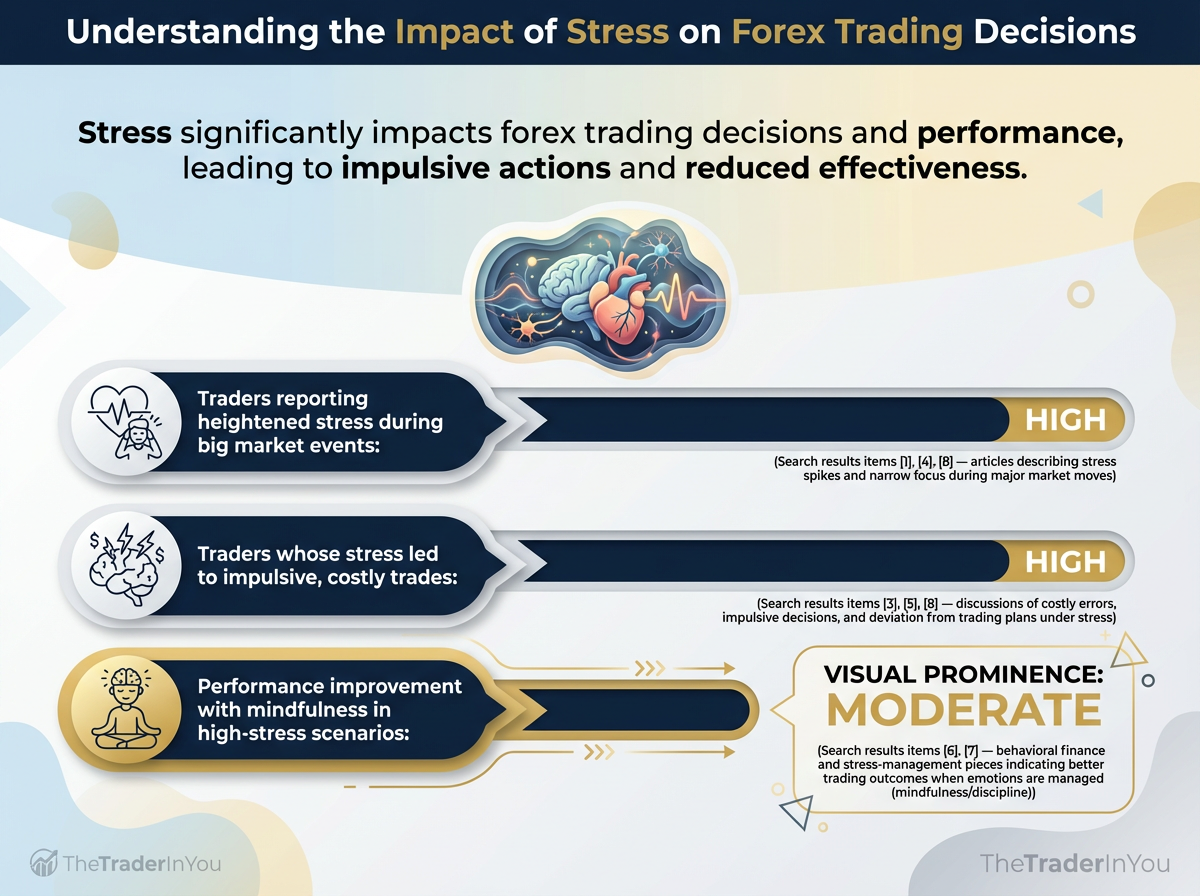
About 70% admit to feeling more stress during major market events.
Approximately 35% say that stress has led to impulsive trades that cost them money.
Those shifts show up in position sizing and rule-breaking.
These patterns aren’t just about feelings.
They change decision rules and undermine risk management.
Practical training matters: traders using mindfulness report roughly 25% better performance in high-stress scenarios (2025).
Regular breaks also reduce strain and sharpen focus, according to trading psychology programs (2025).
Understanding these forces is essential if trading under stress is going to stop eroding results.
Recognizing the psychological effects of trading separates repeatable winners from short-lived streaks.
Recognizing the stress moment in forex trading
Ever been blindsided by a gap at open, a margin call flashing on your platform, or a surprise news shock that sends pairs reeling? Those are familiar stress moments for every trader who spends nights watching charts.
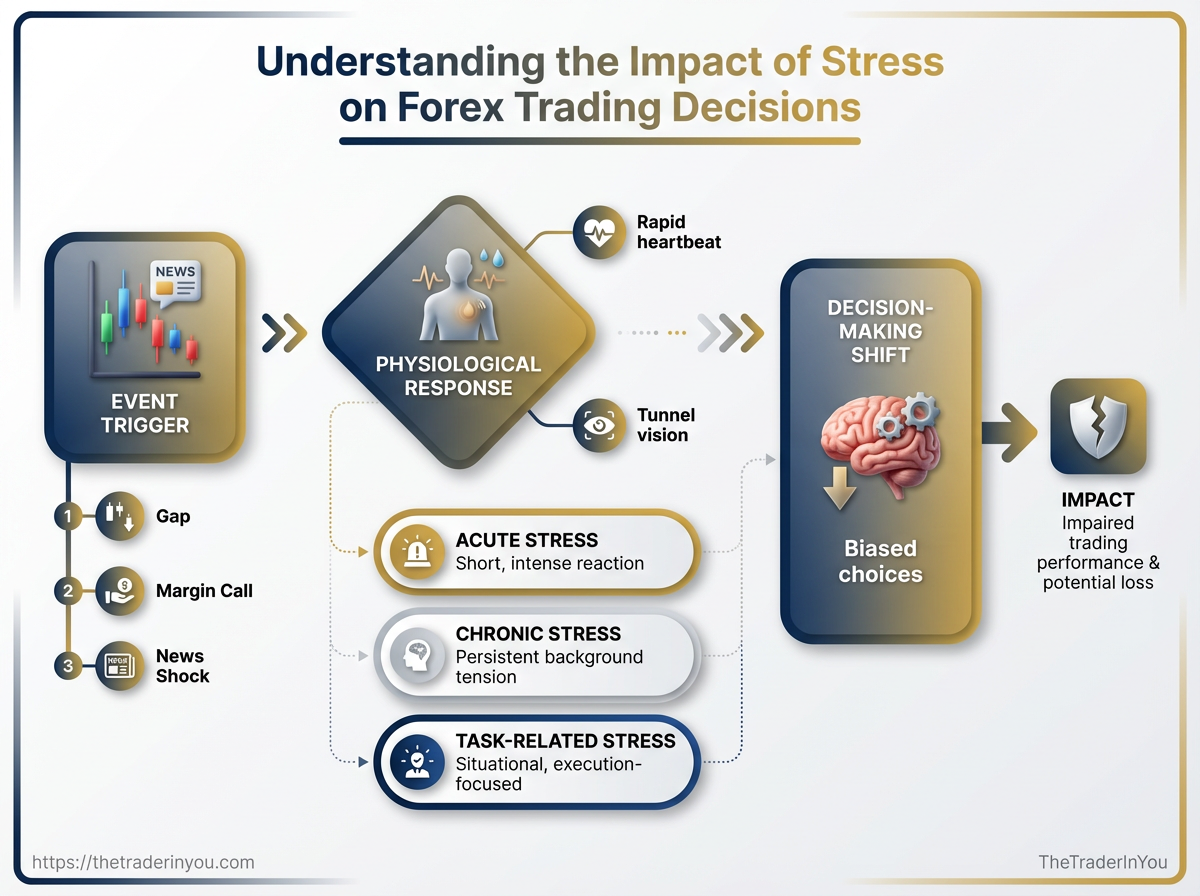
A stress moment in forex is a short window where a market trigger interacts with your body and habits, producing a measurable shift in decision-making.
It often starts with an event — a gap, margin call, or breaking news — and proceeds through an immediate physiological response, then into biased choices.
This sequence explains why 70% of traders report heightened stress during major market events (2025), and why 35% say stress has caused impulsive trades (2025).
Recognizing that sequence early is the point.
Spotting the trigger, the bodily signs, and the first biased thought gives you a chance to pause.
Traders who train for this moment — through mindfulness, scheduled breaks, or platform tools — reduce error-prone reactions.
Mindfulness users report about 25% better performance in high-stress situations (2025), and regular breaks improve concentration, according to trading psychology programs (2025).
What a stress moment looks like
Visual cues and internal signals usually happen together.
Price gaps, sudden liquidity shifts, or margin alerts are the external triggers.
Rapid heartbeat, tunnel vision, and a racing inner monologue are the internal signs.
- Price trigger: sudden gap, flash spike, or unexpected news release causing immediate price movement.
- Account trigger:
margin callor large negative equity notification demanding quick attention.
- Physiological cue: sweaty palms, shallow breathing, or muscle tension appearing within seconds.
Types of stress relevant to forex
Acute stress: Short, intense reaction to an immediate trigger — for example, an overnight gap.
Acute episodes often end after the trade is closed or the market stabilizes.
Chronic stress: Persistent background tension from repeated losses, overtrading, or long-term performance pressure.
This erodes discipline and risk management over weeks or months.
Task-related stress: Stress tied to a specific task, like executing a stop-loss under volatility or managing multiple positions.
This type is highly situational and often controllable with procedures.
Mapping common scenarios to stress types
- Overnight market gap → Acute stress. The trader wakes to a large unrealized loss and feels urgent compulsion to fix it.
- Repeated losing streak over months → Chronic stress. Rules slip, position sizing expands, and risk management degrades.
- Margin call during high volatility → Task-related plus acute. Immediate procedural steps are needed while emotions spike.
- Breaking macro news during session → Acute with task-related overlay. Decisions must be rapid but measured.
The flowchart maps trigger → body response → decision bias so you can see where interventions matter.
It highlights two intervention points: immediate physiological pause and the decision-rule checkpoint.
Recognizing the stress moment is the first practical step toward stopping impulsive trades.
Spot the trigger, watch your body, and build one simple interrupt (a breath, a pre-set stop, or a rule in MetaTrader 5) to break the automatic reaction.
How stress changes decision-making: cognitive and behavioral pathways
Stress rewires the trader’s decision engine.
Sudden spikes in cortisol and adrenaline take control from the thinking part of the brain.
This shift leads to reduced working memory and higher cognitive load.
As stress increases, traders are more likely to react emotionally instead of using evidence.
Research indicates that during significant market events, a high percentage of traders experience heightened stress and report impulsive decision-making.
Neurochemistry and overloaded cognition explain why traders’ adherence to their own rules diminishes under pressure, resulting in altered risk assessments, missed signals, and accelerated decisions either to exit positions or increase exposure.
Evidence: research findings and real-world trading studies
Stress affects trading records long before it is visible on a trader’s face.
Multiple controlled experiments, broker analytics, and program evaluations converge on the same pattern: when stress rises, decision quality and risk discipline tend to fall.
That pattern is visible in lab tasks that measure physiology during simulated trades, in broker session data that flags behavior changes during market shocks, and in surveys run by trading psychology programs.
Together these data build a practical case for treating stress as an operational hazard, not just a private problem.
> 70% of traders reported heightened stress during significant market events (2025). > 35% of traders said stress caused them to make impulsive trades (2025).
Brokerage data and case studies that show stress-driven P&L patterns
Each source type points to stress as a measurable driver of worse P&L and rule violations.
The practical implications column shows concrete risk controls that bridge research and trading desks.
Academic and industry studies that link stress to trading performance
A string of behavioral-finance experiments shows stress shifts traders toward affect-driven choices and away from deliberative processes.
Lab studies measuring cortisol and HRV find those biomarkers correlate with poorer calibration of risk.
Broker-level analyses, including session-level patterns captured by platforms like MetaTrader 5, confirm the same signals on real accounts.
Services such as https://thetraderinyou.com also incorporate psychology modules because industry programs show training reduces error under pressure.
Mindfulness training stands out as a repeatable intervention, with program results showing roughly 25% better performance in pressured scenarios (2025).
Regular, scheduled breaks also appear to lower stress and boost on-task focus, according to trading psychology program evaluations (2025).
Limitations in the research and gaps traders should watch
Most studies mix methods and measures, which makes direct comparisons tricky.
Lab tasks are tightly controlled but may not reproduce the emotional stakes of real money trading.
Field and broker reports capture real behavior but often rely on behavioral proxies instead of physiological measures.
Long-term randomized controlled trials are still rare.
- Measurement inconsistency: different studies use cortisol, HRV, or self-reports, making aggregation hard.
- Sample bias: many samples over-represent active retail traders or volunteers in training programs.
- Intervention durability unknown: benefits from mindfulness or breaks are shown short-term; long-term effects need more study.
There is enough evidence to act on now: monitor stress signals, test simple countermeasures, and treat stress management as part of trade risk control rather than an optional extra.
Practical techniques to manage stress before and during trading
Could a ten-minute routine prevent impulsive trades that jeopardize daily gains? Traders who build short, repeatable routines cut stress-driven errors before they happen.
These routines work by transforming reactive moments into planned responses.
Stress spikes are common: about 70% of traders feel heightened stress during major market events (2025).
That increases the chance of impulsive trades — roughly 35% of traders say stress provoked an impulsive decision (2025).
Practical routines interrupt that cascade and keep reasoning in control.
Pre-trade routines that reduce stress and decision errors
A good pre-trade routine primes the brain and limits surprises.
It’s not about perfection; it’s about predictable inputs that reduce emotional friction.
- Market checklist: Confirm economic releases, margin, and liquidity windows before placing trades.
- Defined watchlist: Limit pairs to 3–5 instruments to reduce context switching.
- Pre-commit trade plan: Write entry, stop, target, and contingency before clicking execute.
- Volatility check: Use
ATR(14)or implied-volatility bands to size positions to current conditions. - 5–10 minute mindfulness: Short breathing or focus exercises increase clarity; studies show mindfulness improved high-stress performance by about 25% (2025).
In-trade tactics: breathing, micro-breaks, and execution rules
During active sessions, small pauses beat big mistakes.
Micro-habits preserve cognitive bandwidth and prevent emotional overruns.
- Box-breathing for 60–90 seconds: Calm heart rate and reset attention during drawdown or news spikes.
- Scheduled micro-breaks: Step away every 60–90 minutes to reduce fatigue; regular breaks lower stress and improve concentration (2025).
- Execution rules: Favor limit and stop orders over manual exits to avoid late and emotional decisions.
- Pre-set timers: Use a
trade-cooldowntimer (e.g., 10 minutes) after a loss to avoid revenge trading.
Behavioral safeguards: automated orders, position sizing, and rule-based systems
Behavioral safeguards turn good intentions into enforced behavior.
Automation and simple rules are the bridge between plans and execution.
Behavioral safeguards checklist
| Action | When to apply | Expected benefit | Difficulty to implement |
|---|---|---|---|
| Set maximum daily loss and stop trading after it | Pre-trade / intra-day | Prevent catastrophic drawdowns and preserve capital | Medium |
| Use limit and stop orders instead of manual exits | During order placement | Reduce slippage and emotional late exits | Low |
| Pre-define position size using volatility-based rules | Pre-trade | Keeps risk consistent with market conditions | Medium |
| 5-minute breathing or box-breathing before key sessions | Before session start | Lowers baseline arousal and sharpens focus | Low |
| Limit screen time and disable non-essential alerts | During session | Reduces distractions and cortisol spikes | Low |
| Use automated trailing stops for winners | During trade | Locks gains without constant monitoring | Medium |
| Apply time-based exits (e.g., close positions before session end) | Pre-trade | Avoids overnight risk and decision fatigue | Low |
| Use algorithmic execution for large orders | During execution | Minimizes market impact and manual error | High |
| Maintain a trading journal with mandatory fields | Post-trade / daily | Improves pattern recognition and reduces repeat mistakes | Low |
| Use a fixed risk-per-trade percentage rule | Pre-trade | Simple control that prevents oversized bets | Low |
Implement them gradually; start with low-difficulty steps and add stricter controls as consistency grows.
MetaTrader 5 and similar platforms can enforce many of these safeguards through order templates and alerts.
Building simple, enforceable habits beats raw willpower.
Small routines and automated rules stop stress from turning into costly impulsive trades.
Tools and systems to mitigate stress-related errors
Imagine if the platform could serve as a calm backup when markets become chaotic.
Trading systems and simple wearables can catch the reflexive mistakes a stressed trader makes before they become losses.
A pragmatic stack combines enforceable trading rules, physiological monitoring, and broker-side protections.
That trio turns stress into data and limits, rather than a hidden force that bends behaviour.
Nearly 70% of traders report heightened stress during major market events (2025), and about Approximately 35% say that stress has pushed them into impulsive trades.
Using tools that both detect and constrain those moments reduces error rates and preserves capital.
Technology that enforces sane behavior
Build rule-based safety into the execution layer so emotion has to work around the system, not the other way round.
- Algo rules: Set
max position size,max exposure, and time-based entry windows so an automated gate prevents reckless entries. - Trailing stops and conditional orders: Use trailing stops and OCO (one-cancels-other) logic to lock in gains without micro-managing.
- Pre-trade confirmations: Add a two-step confirmation for orders above a threshold to force a pause before risk is taken.
- Automated position-sizing: Implement a
risk-per-traderule (for example0.5%of equity) to keep losses predictable.
MetaTrader 5 supports many of these features natively and can be scripted for bespoke rules.
Monitoring your physiology and session behavior
Stress becomes actionable when it shows up as data.
Track the body and the process so deviations trigger fixes.
- Heart-rate sensors: A sudden HR spike can flag an elevated stress state and prompt an automatic “no-new-entry” flag.
- Trading journal apps: Timestamp trades and emotions. Later analysis exposes patterns where stress predicts bad exits.
- Session analytics: Review metrics like trade frequency, average holding time, and win rate per hour to spot stress-driven behavior.
Trading Psychology programs often pair journaling with structured review routines that reduce impulsive trades and improve performance under pressure (2025).
Choosing a broker and platform with trader-protective features
Platform choice matters when stakes are high.
Prefer firms that bake protection into the user experience.
- Look for guaranteed stop-losses and transparent slippage policies.
- Check for daily loss limits or account-wide circuit breakers you can enable.
- Confirm the platform supports conditional orders and order confirmations.
- Test how fast positions can be closed from the mobile app under stress.
These systems don’t remove responsibility, but they buy needed space to think and recover.
Use technology to turn stressful moments into simple, manageable events.
Building long-term resilience: training, routines, and performance review
In trading, resilience is not just about bravery; it’s more about consistent practice.
Train cognitive skills, rehearse stressful scenarios, and build review routines that catch patterns before they calcify into repeated losses.
That combination converts short-term coping into durable competence for trading under stress.
Training should include deliberate exposure to realistic market pressure, not just reading psychology tips.
Simulations that mimic margin stress, slippage, and noisy fills teach the brain to follow rules when cortisol rises.
Complement that with structured recovery routines and peer review so learning becomes social and repeatable.
> 70% of traders report heightened stress during significant market events (2025), and 35% say stress led to impulsive trades (2025).
Mindfulness training has been associated with a 25% performance improvement in high-stress scenarios (2025), and regular breaks measurably reduce concentration loss (2025).
Training programs: cognitive training, simulation, and stress exposure practice
Start training with short, focused drills that target weak points.
Work memory, decision speed, and error detection in low-risk settings first.
- Create stress-exposure simulations that escalate difficulty.
- Run sessions on demo accounts or offline spreadsheets to force rule-following under pressure.
- Debrief each simulation immediately, noting cognitive slips and recovery time.
- Cognitive drills: 15–30 minute exercises for attention and working memory that translate to better trade management.
- Simulated pressure sessions: timed entries, randomized news shocks, and execution delays to practice adherence to
stop-lossand sizing rules. - Guided mindfulness: short breathing or focus cues practiced pre- and intra-session to lower reactivity.
MetaTrader 5 and similar platforms can host realistic replay drills and built-in analytics for simulation work.
Pair platform tools with a structured program like established Trading Psychology courses for technique and accountability.
Trading journal design for tracking stress triggers and patterns
Detailed notes beat vague impressions when stress affects decision making.
The table below gives a journal layout that highlights stress markers and how to review them.
Trading journal design for tracking stress triggers and patterns
| Journal Field | Description | How it reveals stress impact | Review frequency |
|---|---|---|---|
| Pre-trade emotional state | Short note: calm, anxious, rushed | Links mood to rule adherence and risk-taking | Daily |
| Triggering news or events | Headlines, unexpected announcements | Shows external stressors that precede impulsive actions | Weekly |
| Execution vs. plan variance | Entry/exit vs. plan, slippage, timing | Quantifies deviations caused by reactive choices | Weekly |
| Physiological notes (HR, sleep) | Resting HR, sleep hours, HRV notes |
Correlates physical arousal with errors | Weekly |
| Post-trade reflection and lesson | What went well, what to change | Captures learning and emotional closure | Daily |
| Position sizing rationale | Why size chosen, confidence level | Reveals over- or under-sizing when stressed | Weekly |
| Risk limit breaches | Instances where limits were ignored | Flags stress-driven risk tolerance shifts | Monthly |
| Time-of-day / context | Session start, breaks, distractions | Identifies circadian or situational vulnerability | Weekly |
| Peer feedback / action items | Notes from review partners or coach | Tracks social accountability and corrective steps | Monthly |
Review cadence balances short-cycle tweaks with monthly trend analysis.
Use the fields to turn vague regret into precise corrective actions.
Organizational habits: schedule design, recovery, and peer review
Design a trading week that alternates focused sessions and recovery.
Block high-concentration windows and assign low-stakes tasks to slow market periods.
- Structured schedule: fixed start, planned breaks, and a strict end-of-day routine for unwinding.
- Recovery rituals: sleep hygiene, active rest, and short post-session decompression to restore decision capacity.
- Peer review: regular pair reviews or small-group post-mortems to surface blind spots and social accountability.
Practicing these elements systematically reduces the psychological effects trading has on behavior.
Small, repeated habits compound; resilience grows when training, journaling, and routines are treated as a single, connected program.
Measuring impact and iterating: KPIs and review methods
Most traders know stress hurts performance.
Measuring its impact turns vague feelings into clear signals you can fix.
Quantitative KPIs reveal patterns; qualitative signals explain why those patterns appear.
Tracking the right metrics makes review sessions productive rather than accusatory.
When 70% of traders report heightened stress during major events (2025), a disciplined measurement routine separates normal variance from stress-driven deterioration.
Use tools you already trust to collect data, then meet a simple cadence: weekly micro-checks to catch drift, monthly audits to change strategy.
This keeps learning continuous instead of reactive.
Quantitative KPIs to track stress-related performance
Start with metrics that move when emotion replaces process.
These are objective, easy to pull from your platform, and quick to compare over time.
- Maximum drawdown: largest peak-to-trough loss during a period — tracks worst-case stress fallout.
- Average trade size vs. planned size: deviation shows rule slippage under pressure.
- Trade frequency change: sudden spikes or drops indicate impulsivity or freezing.
- Win-rate by hour/session: stress often clusters at certain market opens or news windows.
- Decision latency: median time from signal to order; shorter-than-usual times can indicate knee-jerk moves.
For clarity, calculate drawdown with ((peak - trough) / peak) * 100 and log it daily.
Export trade logs from platforms like MetaTrader 5 to visualize patterns across sessions and instruments.
Maximum drawdown: Measure peak-to-trough losses over each calendar month and flag >5% as needing review.
Trade frequency change: Compare weekly trade counts to a 12-week rolling average and mark >30% deviation.
Qualitative signals: confidence, clarity, and decision latency
Numbers need context.
Subjective signals tell whether the trader felt clear or rushed during trades.
- Confidence score: rate 1–5 after trading sessions to capture perceived control.
- Clarity notes: brief free-text on whether signals were clear or confusing.
- Emotional triggers log: note events that provoked strong feelings (news, family stress).
- Physical state: sleep quality, caffeine intake, and breaks taken.
Consider a simple post-session form: three questions, two-minute completion.
Over weeks, correlate low confidence scores with rising drawdown or compressed decision latency.
Regular review cadence: weekly check-ins and monthly performance audits
Weekly check-ins are quick maintenance.
Monthly audits force deeper pattern analysis and rule changes.
- Weekly: review top three winners and losers, check drawdown, and record confidence scores.
- Weekly: confirm adherence to risk limits and note any rule violations.
- Monthly: run a session-by-session drawdown heatmap, analyze trade frequency shifts, and review
decision latencytrends against stress events. - Monthly: create one action — adjust a stop rule, schedule extra breaks, or run a simulation of the stressful scenario.
Consider a practical scenario.
Imagine a trader whose median decision latency falls from 35s to 10s during a volatility week.
Weekly notes flag more impulsive entries; the monthly audit shows a 4% jump in max drawdown.
The audit leads to a specific mitigation: enforce a 20-second minimum decision hold on all signals.
Regular measurement converts stress from an unhelpful excuse into actionable feedback.
Keep the cadence simple, focus on a few reliable KPIs, and let the data guide measured changes.
Keep the pause when the market pulls the rug
Stress is the circuit breaker in your decision loop: when a surprise central-bank statement widens spreads and slams orders, reflexes beat reason.
This scenario—where traders instinctively tighten their grip as price gaps emerge—highlights a critical insight: structured rules and simple rituals protect cognitive bandwidth and stop small stress moments from becoming big losses.
Research and real trades both show the psychological effects of trading are predictable, not mystical, which means they can be measured and changed.
Practical systems, KPIs, and routine reviews reduce the damage of trading while under stress and make stress management in forex an operational habit rather than an occasional hope.
Start today with one small, repeatable change: add a three-step pre-trade pause—three deep breaths, verify position size, and set a hard stop-loss—before every live order.
Track the outcome in your trade log for a week and compare error rates.
For templates and routines that scale this practice, tools like TheTraderInYou can be a helpful next stop.
Will your next surprise move find you reacting—or pausing?

Follow Joshua for daily forex tips on X: @thetraderinyou or connect with him on LinkedIn: Joshua Okapes.
- Cultivating Self-Discipline in Forex Trading: Tips for Long-Term Success - April 1, 2026
- Risk Management Techniques Every Forex Trader Should Master - March 24, 2026
- Understanding Different Forex Trading Strategies: A Comprehensive Overview - March 21, 2026