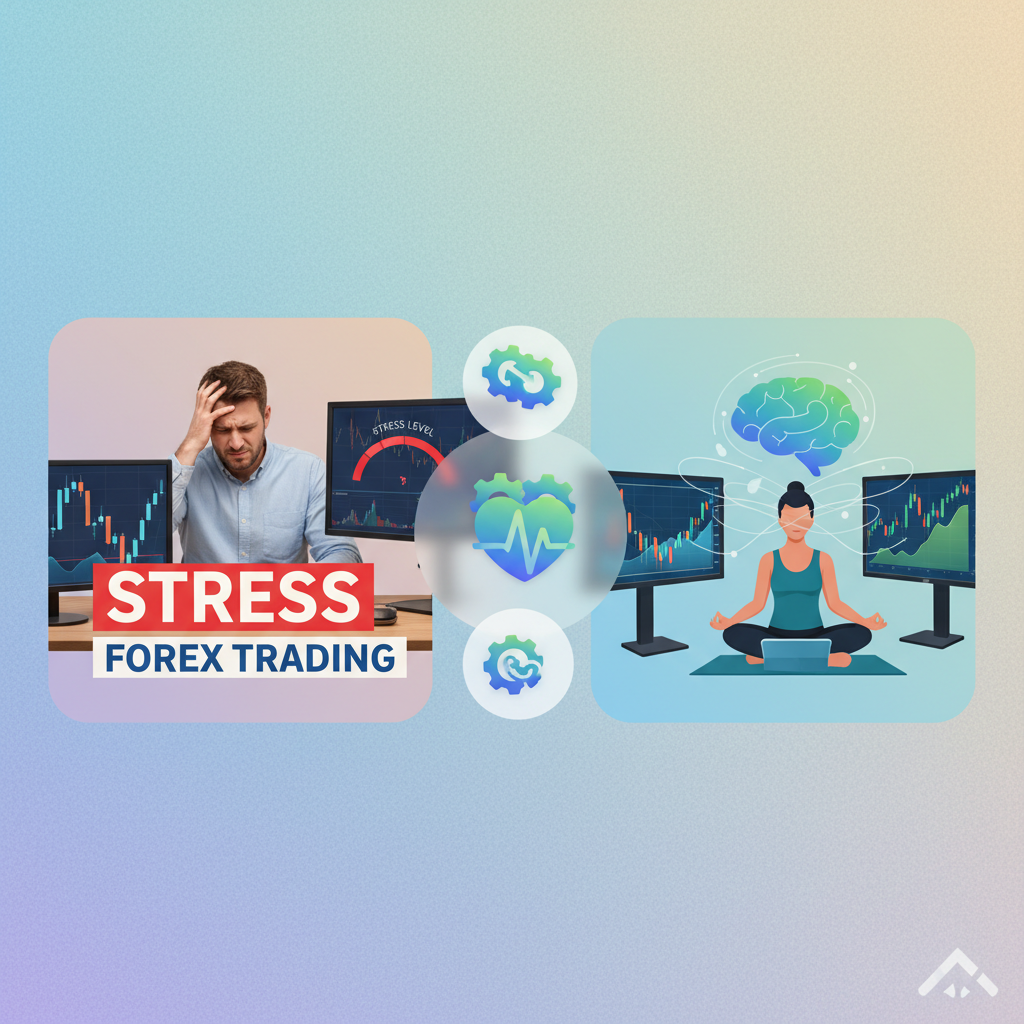
The hardest part of self-discipline trading is not reading the chart.
It is sitting on your hands when the market starts pressing every emotional button you have.
A clean plan can fall apart fast after two losses.
One extra trade.
A slightly bigger size.
A quick revenge move to get back what the market just took.
That is where most tips for forex success start sounding simple and then get ignored.
Behavioral finance has shown why: losses hit harder than equal gains, so traders often bend their own rules right when they need them most.
Long-term traders treat discipline like a position size rule, not a mood.
They use fixed risk limits, wait for valid setups, and stop guessing after a bad run.
Research by Barber and Odean found that more active individual trading tends to lead to weaker net results, which is a brutal reminder that busy is not the same as effective.
The real edge in long-term trading strategies is boring consistency.
A trader who protects capital, follows the plan, and keeps emotion out of execution usually survives long enough for skill to matter.
That is the whole game.
Table of Contents
Practical Methods to Strengthen Trading Discipline Over Time
How Self-Discipline Supports Better Broker and Platform Decisions
Why Self-Discipline Is the Real Edge in Forex Trading
Why do some traders read the market well and still lose money? Usually, the problem is not knowledge.
It is the gap between knowing what to do and doing it the same way every day.
A skilled trader can spot a clean setup. A consistent trader can wait, size the trade correctly, and walk away when the plan says so.
That second part is where self-discipline trading turns into a real advantage.
Behavioral finance has a simple warning here.
People feel losses more sharply than gains, so the urge to change size, chase, or skip rules gets stronger after a bad streak.
Barber and Odean’s brokerage-account research also showed a familiar pattern: traders who trade more often tend to end up with worse net results than those who trade less.
Daily discipline is not dramatic.
It looks boring on purpose.
A trader checks the plan, confirms the signal, uses the same risk cap, and resists the urge to “make it back” on the next candle.
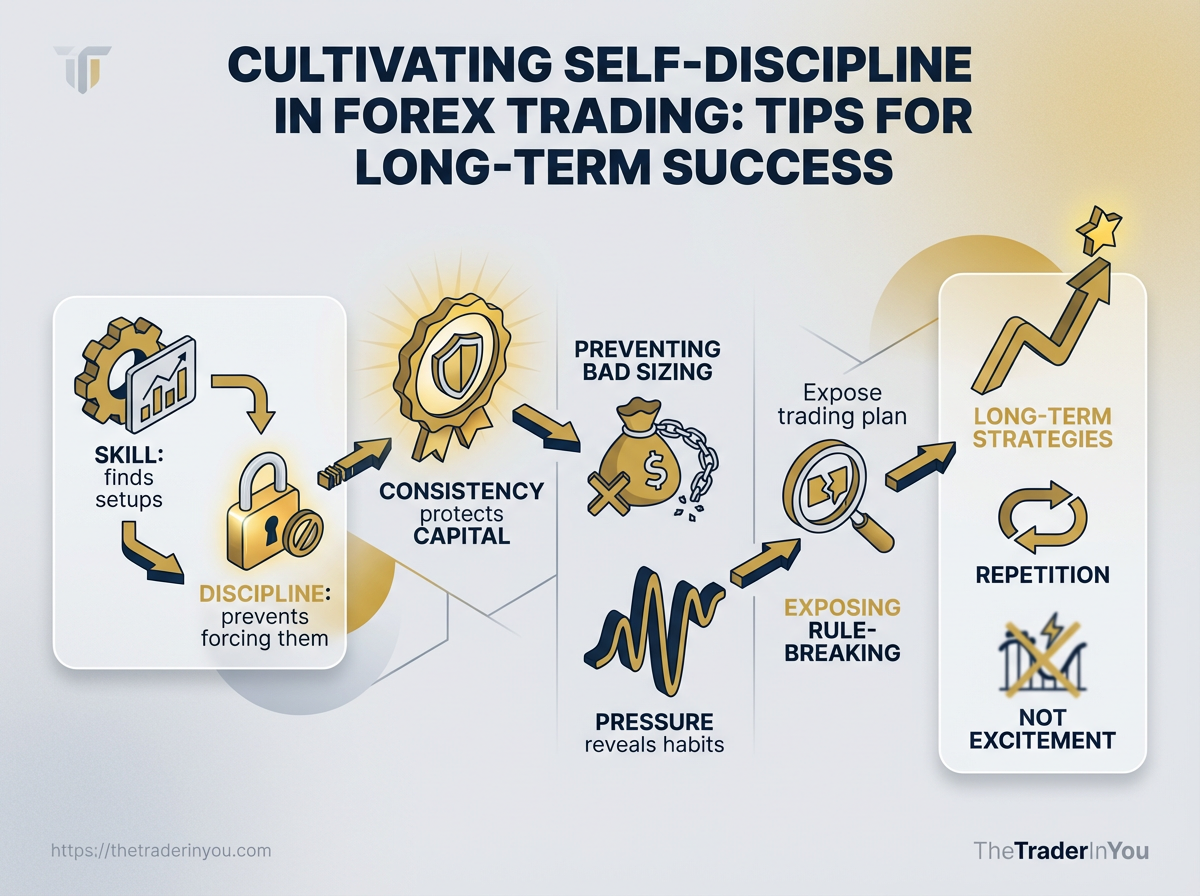
Skill finds setups. Discipline keeps you from forcing them.
Consistency protects capital. A good idea with bad sizing is still a bad trade.
Pressure reveals habits fast. Drawdowns expose rule-breaking, not just bad luck.
Long-term trading strategies depend on routine. The edge is often in repetition, not excitement.
A simple paper-trading routine in TradingView can help here.
Practicing entries, exits, and risk limits without real money makes it easier to spot where emotion slips in.
The daily loop matters most when it is written down and followed the same way every session.
That is why a workflow beats vague intention.
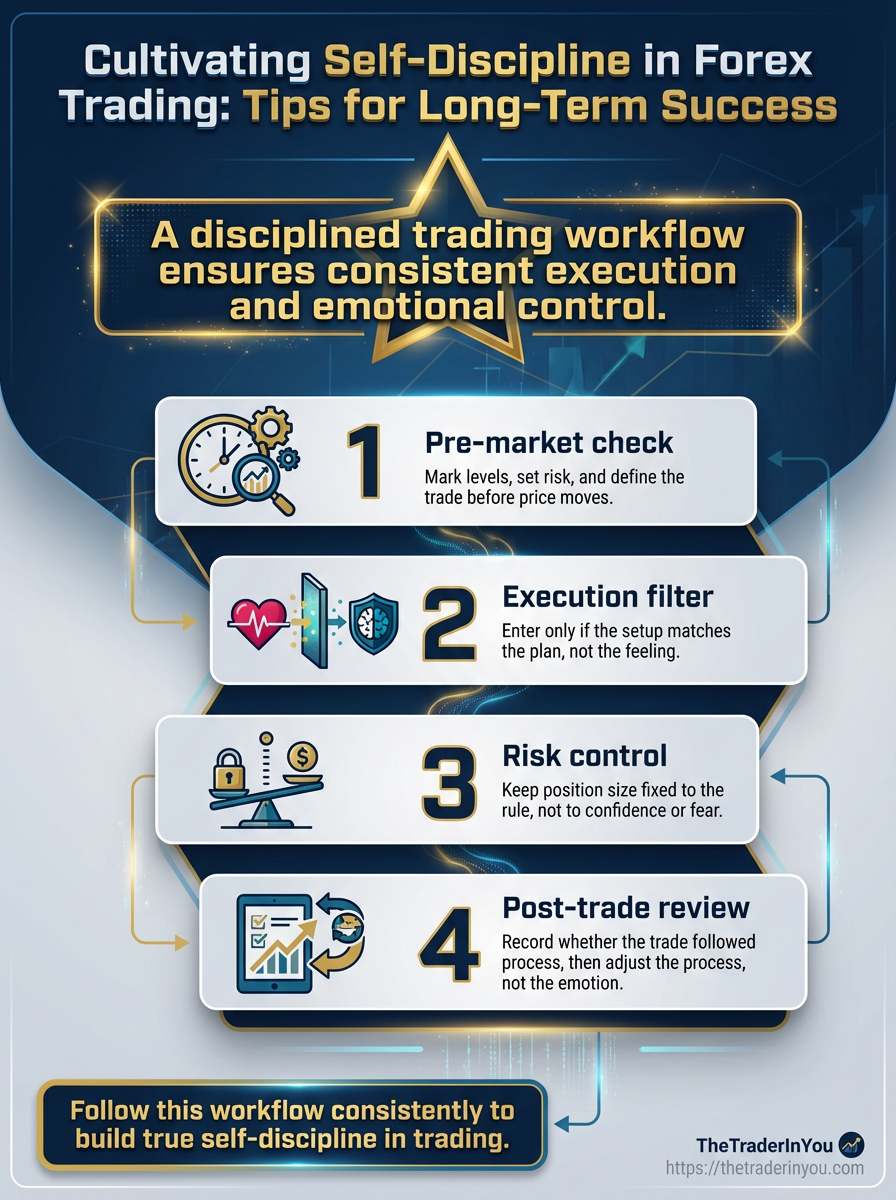
The diagram should show the path from pre-market planning to post-trade review.
The important part is the decision points, where discipline stops impulse from taking over.
After the trade, the work is not over.
A good review asks one blunt question: did the trade follow the rules, or just the mood?
Pre-market check: Mark levels, set risk, and define the trade before price moves.
Execution filter: Enter only if the setup matches the plan, not the feeling.
Risk control: Keep position size fixed to the rule, not to confidence or fear.
Post-trade review: Record whether the trade followed process, then adjust the process, not the emotion.
That is why self-discipline matters more than raw screen time.
Markets reward traders who can repeat good behavior when pressure rises, not just when conditions feel easy.
The Core Habits That Support Long-Term Trading Success
Why do some traders can be right on direction and still end up stuck? The pattern is usually boring, and that is exactly why it matters: they drift from their plan, change risk on the fly, and let one bad session spill into the next.
Long-term trading success comes from a few repeatable habits, not dramatic flashes of insight.
A written plan keeps the session anchored.
Fixed risk rules keep one trade from becoming a full-blown mess.
The best traders treat execution like a checklist, not a mood.
That matters because behavioral finance keeps showing the same human weakness: when losses sting, people are more likely to break rules, size up, or chase back ground.
Barber and Odean’s work on brokerage accounts is often cited for the same ugly pattern too — more trading tends to hurt net results for individuals.
Daily habits that separate disciplined traders from emotional ones
Trading Habit | Disciplined Action | Undisciplined Action | Impact on Results |
|---|---|---|---|
Pre-trade planning | Write entry, exit, and invalidation rules before the session | Decide trade details after the chart starts moving | Fewer impulsive entries and cleaner execution |
Position sizing | Risk a fixed share of account equity on every trade | Increase size after losses or “good feelings” | Keeps drawdowns from snowballing |
Stop-loss placement | Place the stop where the setup is wrong | Move the stop wider to avoid taking a loss | Preserves the logic of the trade |
Trade review | Rate trades by rule quality and execution | Judge trades only by whether they won or lost | Builds better habits over time |
Session limits | Set a daily loss cap and stop when it is hit | Keep trading after frustration or fatigue | Reduces revenge trading and careless mistakes |
Fixed rules work best before the first click.
In practice, that means knowing your maximum account risk, your daily stop, and the exact conditions that invalidate a setup.
Platforms such as TradingView can help traders rehearse that routine through paper trading and strategy testing, which makes the habit feel less theoretical.
The point is not to predict every market turn.
It is to practice the same execution pattern until it becomes normal.
A simple review loop finishes the job.
After each session, ask whether the trade followed the plan, not whether it paid.
That habit keeps long-term trading strategies focused on process quality instead of emotional scorekeeping.
The traders who last are usually the ones who make good behavior the default.
That is where self-discipline trading becomes practical, not just motivational.
Building a Trading Framework You Can Follow Under Pressure
When price starts whipping around, the trader who survives is not the one with the hottest opinion.
It is the one with a framework that already decided the hard parts.
A solid framework answers three questions before the order goes live: when to enter, when to exit, and how much pain is acceptable.
That matters because pressure does strange things to judgment, especially when loss aversion kicks in and the urge to “fix” the trade gets loud.
The cleanest self-discipline trading setups are usually simple.
They set rules for entries, exits, and a maximum daily loss, then leave less room for improvisation.
Academic work by Barber and Odean on trading frequency also supports the caution here: more trading often hurts net results when emotion starts driving the clicks.
Low-confidence conditions need a rule too.
If the market is choppy, the news calendar is packed, or the setup only looks good after a lot of wishing, the best trade is often no trade.
A repeatable pre-trade checklist
Checklist Item | Why It Matters | Pass/Fail Criteria |
|---|---|---|
Trend confirmed | Keeps you aligned with market structure | Pass if the higher-timeframe trend supports the setup; Fail if direction is unclear or conflicting |
Risk-to-reward acceptable | Stops weak trades from sneaking through | Pass if the target offers at least 2:1 reward to risk; Fail if the payoff is too thin |
News risk assessed | Helps avoid being blindsided by volatility | Pass if no high-impact release is near or the plan accounts for it; Fail if you are entering blindly into news |
Stop-loss defined | Caps damage before emotion can interfere | Pass if the stop is placed at a logical technical level; Fail if the stop is vague or still undecided |
Position size calculated | Prevents one trade from becoming a bad day | Pass if size matches the preset account risk; Fail if size changed after emotion or recent losses |
A checklist like this works because it turns judgment into a sequence.
That is exactly what long-term trading strategies need when the market gets noisy and your patience starts to fray.
Tools such as MetaTrader 5’s Strategy Tester or TradingView’s paper trading can help pressure-test these rules before real money is on the line.
The real win is not perfect timing; it is repeatable execution when the chart gets messy.
Common Discipline Breakdowns That Hurt Forex Performance
Ever notice how one good trade can turn into three bad ones by lunchtime? That pattern usually starts with emotion, not analysis.
The first trap is overtrading after a win or loss.
Barber and Odeon’s brokerage-account research showed a familiar pattern: people who trade more tend to earn worse net returns than those who trade less, which fits the way impulsive decisions pile up costs and mistakes.
The second trap is quieter.
A trader moves a stop, widens risk, or “gives the trade room” without a real change in the setup. In practice, that is often just loss aversion wearing a technical mask.
Overtrading after a win: A win can create confidence that feels earned, but it often turns into forced follow-up trades.
The clean response is to stop after the original plan is done, not chase another entry.
Overtrading after a loss: A loss can trigger revenge trading, especially when the last trade felt “almost right.” A simple guardrail helps: cap the number of trades per session and walk away after the limit.
Moving stops without a rule: A stop should only move for a defined reason, such as trailing a valid structure break.
If the move comes from fear, the trade is already in trouble.
Widening risk after entry: Adding more room after the market moves against you often turns one planned loss into a much larger one.
Pre-set risk limits protect long-term trading strategies far better than hope does.
Getting distracted by broker noise: Platform alerts, account reviews, and endless feature menus can pull attention away from execution.
MetaTrader 5’s Strategy Tester and TradingView’s paper trading are useful for practice, but they help most when they support a written plan instead of replacing it.
A strong routine treats the platform like a tool, not a temptation.
Use the tester, run your rules, and compare every live trade against the same checklist.
That kind of self-discipline trading is rarely flashy, but it is one of the best tips for forex success.
It keeps the focus on process, where real consistency lives.
Practical Methods to Strengthen Trading Discipline Over Time
Why does discipline feel solid on Monday and shaky by Friday? Usually, the market did not change your standards.
Repeated stress, small losses, and a few sloppy trades did.
That is why self-discipline in trading has to become a system, not a mood.
Barber and Odean’s widely cited brokerage-account research found that more active trading tends to hurt individual investors’ net results, which is exactly why a calmer process often beats a busier one.
Journaling is where that process starts.
Not just “what happened,” but why the trade was taken, whether the plan was followed, and what was happening right before the mistake.
Behavioral finance helps explain the pattern.
Loss aversion can push traders to exit too early, size up after a loss, or force one more trade when the plan says stop.
A clean way to fight that is to track process metrics alongside profit and loss.
A flat week can still be a good week if the trader followed rules; a profitable week can still be a warning if it came from rule-breaking.
A simple accountability stack
Tool | Primary Use | Best For | Frequency |
|---|---|---|---|
Trading journal | Track entries, emotions, and rule breaks | Traders spotting repeat behavior | After each trade |
Pre-trade checklist | Confirm setup, risk, and timing | Discretionary traders | Before each trade |
Rule-based alerts | Trigger reminders at key levels or sessions | Active intraday traders | Real-time |
Weekly review template | Compare plan vs. execution | Swing and day traders | Weekly |
Accountability notes | Record promises and follow-through | Solo traders | Weekly |
Screenshot archive | Save chart proof of entries and exits | Pattern-based traders | After each trade |
Process scorecard | Rate rule adherence, not just outcomes | Systematic traders | Daily or weekly |
Risk limit sheet | Cap size and maximum loss exposure | All traders | Each session |
Session plan card | Define focus, max trades, and stop point | Active traders | Each session |
Backtest log | Compare live behavior with tested rules | Strategy builders | Monthly or after changes |
A table like this works because it makes discipline visible.
Once the pattern is written down, excuses get much smaller.
The best long-term trading strategies usually look boring from the outside.
That is a compliment.
Boring routines, honest reviews, and tight limits are often the difference between random effort and steady progress.
A platform like MetaTrader 5’s Strategy Tester can help anchor those habits before real money is on the line.
That kind of practice makes review less emotional and far more useful.
📥 Download: Download Template (PDF)
How Self-Discipline Supports Better Broker and Platform Decisions
Why trust a shiny broker page when the costs are hiding in the fine print? The disciplined trader does not start with bonuses or smooth marketing copy.
They start with execution quality, spreads, slippage, and whether the platform behaves the same in fast and quiet markets.
That habit matters because broker choice is not just a setup decision.
It shapes every entry, exit, and adjustment after that.
Research by Barber and Odean on brokerage account data found that more active trading tends to lead to worse net outcomes for individual investors, which is exactly why careful selection beats emotional hopping from one platform to another.
A clean platform can still be a bad fit.
MetaTrader 5’s Strategy Tester and TradingView’s strategy backtesting and paper trading are useful because they let traders check behavior before real money is on the line.
That kind of testing is a quiet form of self-discipline trading: rules first, action second.
Watching a platform review with that filter makes the process a lot less guessy.
The right video should show how spreads behave, how orders fill, and what happens when markets get jumpy.
A polished interface is nice, but reliability pays the bills.
Questions worth asking before believing the marketing
How do fills behave in live conditions? A broker can advertise tight spreads and still deliver poor fills when volatility rises.
What is the full cost per trade? Check spreads, commissions, swap charges, and any inactivity or withdrawal fees.
Is the broker easy to verify? Regulation, company details, and complaint history matter more than bonus offers.
Does the platform match your trading style? Scalpers, swing traders, and automated traders need different levels of speed and control.
What to review before committing capital
A disciplined trader checks the boring stuff first.
That includes order types, chart stability, mobile access, and whether the platform supports backtesting or paper trading cleanly.
Execution behavior: Test market orders, stop orders, and limit orders on a demo account.
Risk tools: Look for position sizing, stop-loss controls, and alerts that actually work.
Data quality: Poor pricing feeds can distort both live decisions and strategy testing.
Workflow fit: If switching screens slows you down, the platform is probably working against you.
The best tips for forex success often look unexciting.
They are the habits that stop a trader from paying for bad structure twice.
The real edge is simple.
Self-discipline keeps you from falling for a broker pitch that sounds good and a platform that only looks good.
Conclusion
The Real Edge Lives Between the Trades
The hardest part of self-discipline in trading is still the same one from the opening example: not reacting when the market starts pushing every emotional button.
That quiet pause is where long-term trading strategies survive, because it stops one bad impulse from turning into a messy week.
The best tips for forex success are often boring on purpose: follow the plan, respect risk, and wait for the setup you already defined.
That discipline also shapes smarter decisions outside the chart.
When you know your rules, you stop chasing shiny broker promises and start judging platforms by execution, costs, and the tools that support your process.
Resources like thetraderinyou.com can be useful when you want education and market context that reinforce that habit.
A practical move for today is simple: write one pre-trade rule you will not break, then test it on your next three trades.
If the trade does not fit the rule, skip it without negotiating with yourself.
That single act says more about your future as a trader than any indicator ever will.

Follow Joshua for daily forex tips on X: @thetraderinyou or connect with him on LinkedIn: Joshua Okapes.