A chart can look perfect right before a trade falls apart.
That is the strange part of technical analysis: it can feel precise, then price slips through the setup anyway.
On the other side, fundamental analysis can explain why a currency should rise, yet the market may ignore that logic for days or weeks.
In a forex trading comparison, that gap between “should” and “is” is where most traders get frustrated.
The real question is not which method sounds smarter.
It is which one fits the way you make decisions, hold risk, and read the market.
A fast day trader watching London and New York sessions usually cares about entries, exits, and momentum.
A longer-term trader may care more about interest rates, inflation, and central bank tone.
Both can work, but they solve different problems.
What if the better question is not which method wins, but when each one matters?
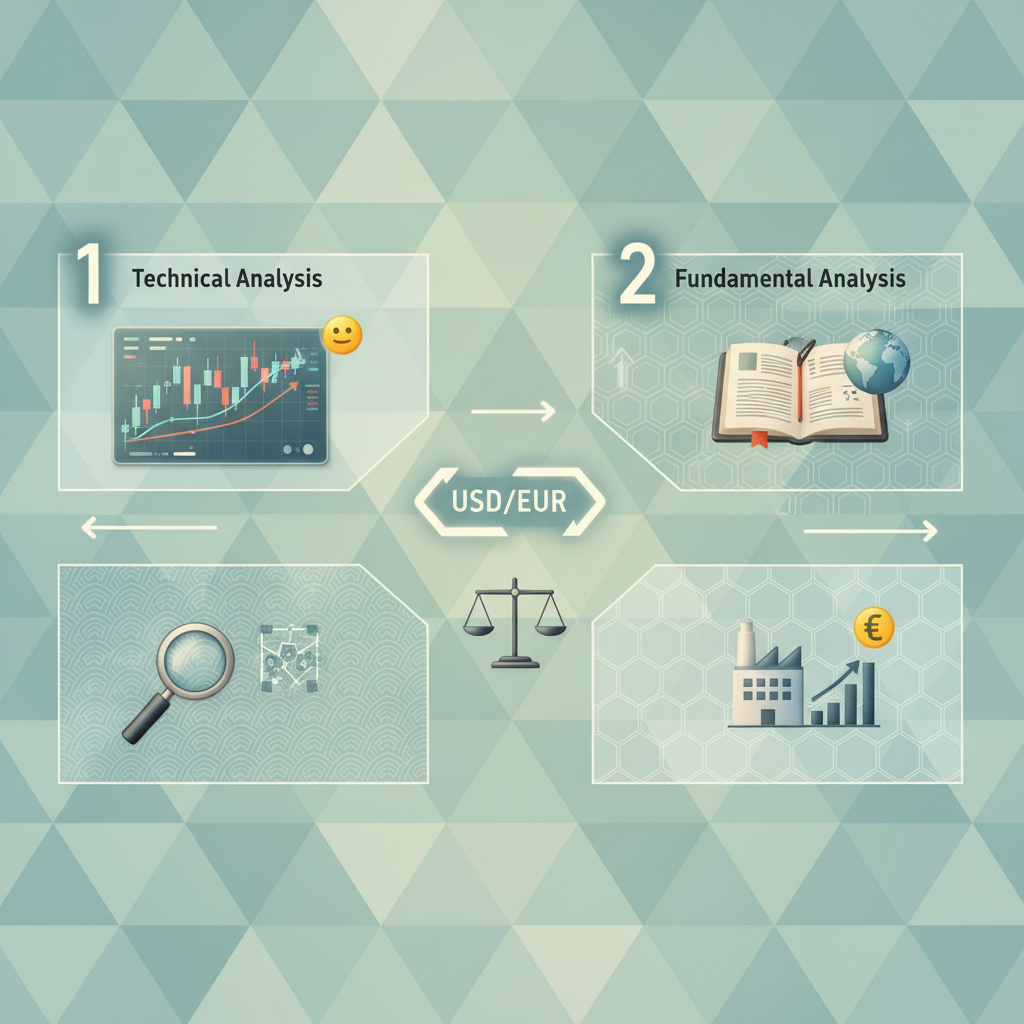
A trader staring at EUR/USD on a Monday morning often feels pulled in two directions.
One screen shows candles, support, and momentum.
Another shows central bank speeches, inflation prints, and rate expectations.
That split is exactly why this forex trading comparison matters. Technical analysis and fundamental analysis are not rivals in the clean, tidy sense people like to imagine.
They answer different questions, and they do it on different time frames.
A chart can tell you where price is reacting right now.
Macro analysis can tell you why that reaction may keep going, or suddenly fail.
In forex, where currencies move on both sentiment and policy, ignoring either side usually leaves blind spots.
Traders usually frame the choice as a simple either-or.
They ask whether they should trust the chart setup or the economic story.
That framing is tempting, but it misses the part that actually hurts accounts: using the wrong lens for the wrong market condition.
A clean breakout during a quiet session can be pure technical analysis territory.
A sharp trend after a central bank surprise often belongs to fundamental analysis first, with the chart serving as a timing tool later.
Most traders eventually sort the debate into a few practical questions:
Entry timing: Charts help with precise entries and stops.
Macro context helps explain whether the move has room to run.
Trade horizon: Intraday traders usually care more about technical analysis.
Swing and position traders often need fundamental analysis to avoid fighting the bigger trend.
Event risk: A beautiful setup can fail fast before a rate decision, CPI release, or employment report.
Market regime: Trend days, range days, and news-driven days all reward different tools.
The real mistake is treating this as a loyalty contest.
A better forex trading comparison asks which method fits the moment, the pair, and the trader’s time frame.
That is where the edge starts to appear.
Not from picking a side, but from knowing when the chart speaks louder than the news, and when the news changes everything.
Technical Analysis in Forex: What It Tells Us
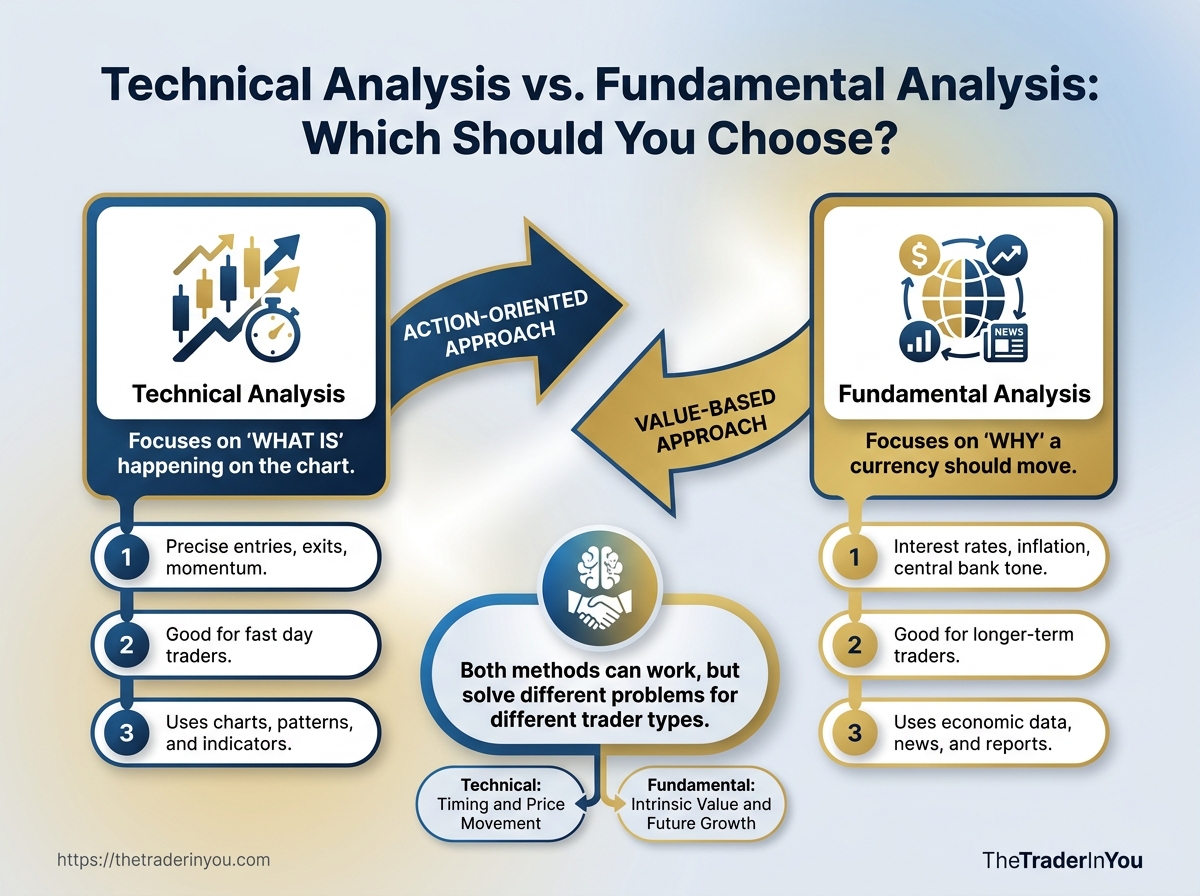
In forex, technical analysis isn’t really about predicting the future—it’s about identifying the recurring decisions traders keep acting on. In a forex trading comparison, technical analysis and fundamental analysis answer different questions.
Fundamentals ask why a currency should move.
Technical analysis asks where price is likely to react.
That difference matters because FX prices move in waves, not straight lines.
A strong jobs report can shift the bigger bias, but the actual entry often comes from a level, a trend break, or a momentum pause on the chart.
That is why technical analysis is so useful for timing, even when the broader story is fundamental.
The core ideas stay simple, even if the chart looks busy.
Price tends to respect prior highs and lows, trends often persist until structure breaks, and repeated reactions near the same zone usually signal real market memory.
Where technical analysis tends to work best
| Element | What It Helps With | Main Limitation | Best Market Condition |
|---|---|---|---|
| Trend identification | Spotting higher highs, lower lows, and directional bias | Late entries after a move is already extended | Clean, liquid sessions with clear structure |
| Entry timing | Finding pullbacks, breakouts, and retest entries | False signals in choppy, low-volatility trade | Markets with steady participation and follow-through |
| Stop placement | Placing invalidation near obvious swing points | Stops can be too tight around crowded levels | Well-defined support, resistance, or trend lines |
| Signal confirmation | Using candles, momentum, or moving averages to add confidence | Confirmation can lag and reduce reward | Trend continuation after a fresh catalyst |
| False breakout filtering | Avoiding traps around round numbers and prior highs/lows | No filter removes every fake move | Range edges with thin liquidity or repeated tests |
It also helps most in liquid pairs like EUR/USD or GBP/USD, where reactions are usually cleaner and spreads stay tighter during active sessions.
During major news shocks, though, chart signals can get wrecked fast.
The practical use is rarely “chart only” versus “fundamentals only.” Strong traders often let fundamentals set the backdrop, then use technical analysis for the actual trade plan.
That combination tends to be far more useful than treating either method like a crystal ball.
In real trading, the chart tells us where crowd behavior is visible.
That is its real edge, and it shows up most clearly when price is orderly, liquid, and still willing to respect structure.
Fundamental Analysis in Forex: What Drives Currency Values
Sometimes a pair looks convincing on the chart, but the market keeps drifting the other way. When that happens in a forex trading comparison, fundamental analysis is often the deciding factor.
In forex, price is constantly reacting to growth, inflation, interest-rate expectations, and the mood around risk.
A clean setup on a chart can still lose if the economy behind that currency starts to weaken.
This is where the technical analysis versus fundamental analysis debate gets practical, not philosophical.
Technical analysis focuses on timing and market behavior, while fundamental analysis asks whether traders should want the currency in the first place.
Currencies usually move for three broad reasons: macroeconomic data, central bank policy, and market sentiment.
If those three point in the same direction, the move can last longer than most traders expect.
Growth data: Strong GDP, hiring, or retail sales can support a currency because they signal a healthier economy.
Inflation data: Hot inflation often pushes central banks toward tighter policy, which can lift a currency through higher rate expectations.
Central bank tone: A hawkish central bank usually helps its currency, especially when it sounds ready to keep rates elevated.
Rate differentials: Traders compare returns across currencies.
A higher expected yield can attract capital, even when the chart looks messy.
Sentiment and risk appetite: In nervous markets, money often flows into perceived safe havens.
In calmer markets, higher-yielding currencies can catch a bid.
The trick is not reading one headline in isolation.
A weak jobs report can matter, but the reaction depends on whether it changes the central bank story.
Imagine the U.S. economy cooling while inflation stays sticky.
If the Federal Reserve sounds patient about cuts, the dollar can stay supported even when growth data softens.
That kind of price action is common in a real forex trading comparison between the story on the chart and the story in the economy.
Fundamental analysis works best when you track the full picture, not just the number itself.
The release matters, but the surprise relative to expectations matters more.
Technical Analysis vs. Fundamental Analysis: A Direct Forex Comparison
A trader can be right on direction and still pick the wrong method.
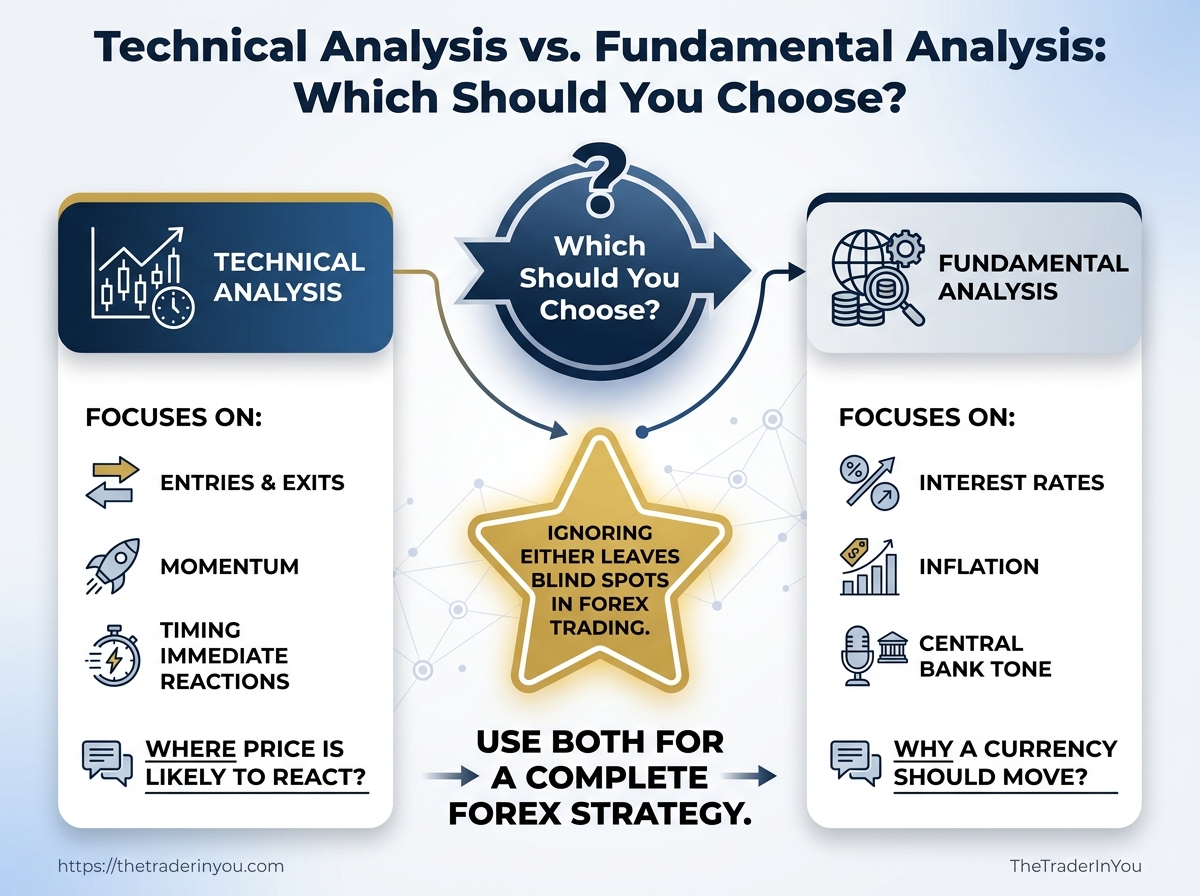
In forex, technical analysis and fundamental analysis answer different questions, so they shine on different timelines.
Technical analysis focuses on when to enter and exit.
Fundamental analysis focuses on why a currency should drift higher or lower over time.
That difference matters because not every trading style needs the same kind of edge.
Side-by-side comparison
| Dimension | Technical Analysis | Fundamental Analysis | Practical Forex Implication |
|---|---|---|---|
| Entry timing | Best for precise entries around levels, breakouts, and momentum shifts | Better for deciding when a currency is undervalued or overextended | Scalpers usually need technical timing; fundamentals rarely act fast enough |
| Trade horizon | Works well on minutes, hours, and a few days | Works better over weeks to months | Swing traders often use both; position traders lean harder on fundamentals |
| Reaction to news | Reacts after price absorbs the news | Interprets the news itself and its likely economic effect | Major releases can upset chart signals, but they often confirm the bigger macro view |
| Signal frequency | Produces many setups across pairs and timeframes | Produces fewer, broader signals | More chart signals can mean more opportunity, but also more noise |
| Suitability for trend trading | Strong when a trend is already visible on the chart | Strong when policy or growth gaps support a trend | Trend traders often use fundamentals to pick direction and technicals to time entries |
| Suitability for range trading | Very strong in sideways markets with clear support and resistance | Weaker unless the range is driven by a temporary macro standoff | Range traders usually get cleaner setups from price action than from macro data |
They need quick reads, clean levels, and repeatable entry points.
Swing traders sit in the middle.
They often get the best results by using fundamentals to decide the bias, then using charts to fine-tune the trade.
Position traders tend to care most about fundamental analysis.
Interest-rate policy, inflation, and growth gaps often matter more than a short-lived candle pattern when the holding period stretches for months.
A practical forex trading comparison usually ends with this: charts help with execution, while macro helps with conviction.
Traders who know which one to trust for their timeframe waste less energy fighting the market.
For this section, a simple internal link opportunity would be a charting checklist or a macro event calendar guide.
That combination fits the way real traders blend both methods without overcomplicating the process.
When One Method Can Mislead You
Even the cleanest level can stop working quickly—especially around high-impact FX events—because the trade you’re seeing on the chart and the trade you can actually execute are often different things.
When spreads widen, liquidity thins, and event-driven orders hit at the same time, price may briefly respect your structure and then “break” it for reasons that have nothing to do with your technical thesis.
Major releases such as U.S. CPI, Nonfarm Payrolls, or an ECB rate decision can change order-flow so fast that the first few candles reflect execution friction and positioning, not a stable trend you can rely on.
Technical setups can get punished by execution conditions
During volatile news windows, pending orders often cluster around obvious highs/lows. After the number lands, that clustering can trigger a sweep—pushing price beyond the level you expected to hold—before normal liquidity returns.
That’s why a breakout can look “right” in hindsight and still fail in real time: the chart may be showing the move, while your fills (spread, slippage, stop hunting) can tell a different story.
If you trade through event risk, consider focusing your technical plan on execution-safe behavior rather than on perfect patterns:
- Size for the spread: If your invalidation is tight, widen the risk buffer or reduce size so widened spreads don’t decide the trade.
- Only trade levels with nearby liquidity: Prior highs/lows that are heavily trafficked pre-news are more likely to become event magnets.
- Wait for liquidity normalization: Look for reduced churn after the initial impulse before trusting structure-based targets.
Fundamental narratives can be correct—but poorly timed
Fundamental analysis can explain why EUR/USD should rise (policy direction, inflation dynamics, rate expectations), but it may not tell you where the next usable entry is—especially when markets front-run the narrative or mean-revert after the first emotional impulse.
In practice, late buyers often chase after the market has already priced the “obvious” takeaway, while late sellers fight moves that started earlier than their headline-driven conviction.
A useful habit is to separate:
- Direction (what the macro story supports),
- Timing (where price is in the sequence), and
- Risk distance (how far invalidation is relative to the move).
If any one of those doesn’t line up, the problem isn’t that the method is “wrong”—it’s that you’re using it at the wrong moment.
That is the core lesson in this forex trading comparison: each approach can fail even when the other is right.
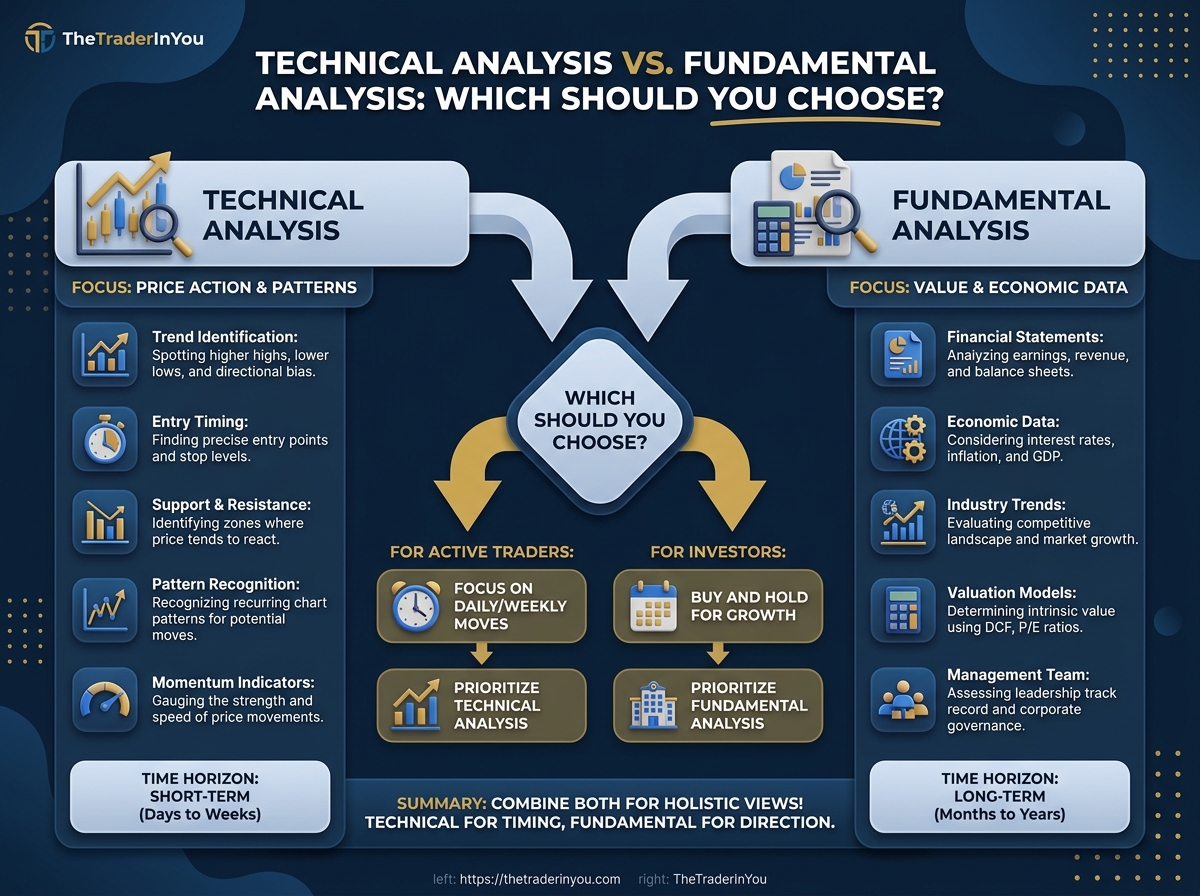
A Practical Hybrid Framework for Forex Traders
A workable blend of the two approaches is simple: let fundamental analysis set direction, then use technical analysis to structure timing and execution. In a forex trading comparison, that pairing keeps the process grounded.
A central bank tone, inflation surprise, or growth gap can point the market one way, while the chart decides whether the entry is clean, crowded, or late.
Broker conditions sit in the middle of that decision.
A wide spread, slow execution, or expensive overnight financing can weaken both approaches, but in different ways.
A simple decision filter helps here.
Start with the macro bias: Pick the currency that has the cleaner policy story, stronger data trend, or clearer rate expectation.
Wait for chart confirmation: Use trend structure, pullbacks, and breakout levels to avoid chasing the first emotional move.
Choose your primary method by horizon: If you hold for days or weeks, fundamental analysis should lead.
If you trade intraday, technical analysis usually deserves the bigger role.
Check broker friction before entry: A setup that needs a tight stop can fail fast if the spread is bloated or execution is slow.
Match the method to the pair: Majors with lower spreads suit chart-based timing better, while slower-moving themes can give macro trades more room to breathe.
For example, a trader may like a stronger U.S. rate outlook versus another central bank, but still wait for a clean retest before entering USD strength.
That keeps the bias from becoming blind conviction.
Broker quality changes the edge more than many traders admit.
Tight spreads help technical entries, while fair swap pricing matters when the macro view needs time to play out.
Build the habit around that sequence, and the technical analysis vs. fundamental analysis debate gets a lot less noisy.
The goal is not to pick a permanent winner.
It is to know which tool deserves the first vote on each trade.
Conclusion
A clean chart can still be the wrong trade, and a strong macro story can still arrive at the wrong moment. The way to stay consistent is to treat technicals and fundamentals as inputs to different decision steps—then let your broker conditions and the current market regime decide which input deserves priority.
Use the hybrid framework from earlier (macro bias → chart confirmation → broker friction check) as your default process, and refer back to the comparison matrix to keep the emphasis aligned with your style (scalp, swing, or position) and the event environment.
When the story and the tape disagree, don’t force it. Reduce size, wait for acceptance, or stand aside—because the goal isn’t to prove a method right. It’s to make fewer avoidable “wrong moment” mistakes.
What is the difference between technical analysis and fundamental analysis?
Technical analysis identifies where price is likely to react by using chart behavior and levels to time entries and exits. Fundamental analysis explains why a currency should move by focusing on growth, inflation, and interest-rate expectations, including central-bank drivers. In forex, one answers “where/when,” while the other answers “why.”
Which approach is better for forex trading?
No single method is universally better; the best approach depends on what you need most—direction or execution. For forex, use fundamentals to set the market bias (e.g., interest-rate and central-bank expectations) and technicals to decide the timing and price levels for entry and exit. Chart setups can fail around major news releases like U.S. CPI, Nonfarm Payrolls, or ECB rate decisions, so confirm technical plans with the economic calendar.

Follow Joshua for daily forex tips on X: @thetraderinyou or connect with him on LinkedIn: Joshua Okapes.