The chart looks clean until the trade goes wrong.
That is usually where trading mistakes show up—not in the entry, but in the assumptions behind it.
A trader can read price action, check the news, and still miss the bigger problem: the analysis itself was built on shaky ground.
Those forex analysis errors are sneaky because they often feel like discipline.
They can look like confidence, or speed, or even “good preparation” when they are really just noise dressed up as conviction.
Most losses in forex do not come from one dramatic blunder.
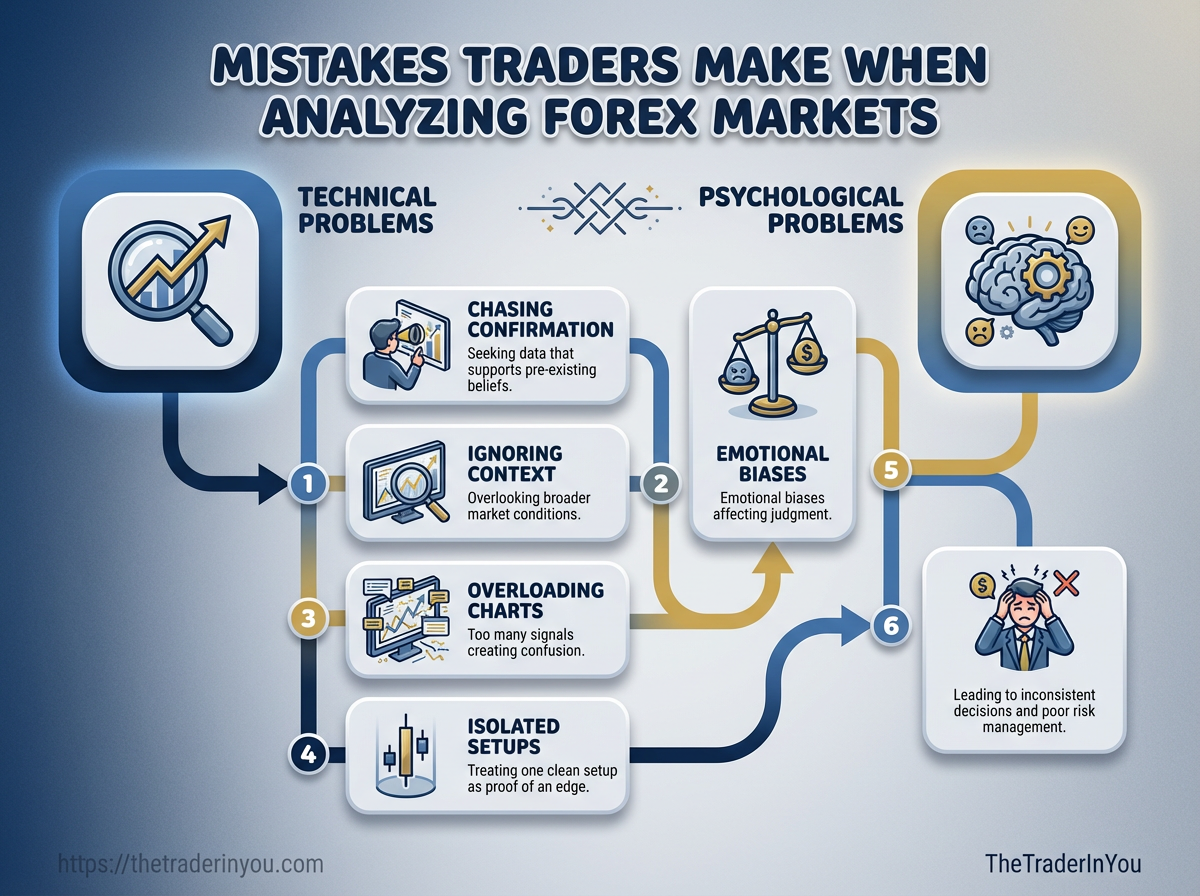
They come from a handful of common pitfalls that repeat quietly: chasing confirmation, ignoring context, overloading a chart with signals, or treating one clean setup like proof of an edge.
Research from BabyPips catalogs how analysis failures cluster around the way traders gather inputs and interpret them—often at the same time.
The hard part is that these mistakes rarely announce themselves.
They creep into routine decisions, then turn a decent read into a bad trade.
Quick Answer: Most forex analysis mistakes happen when traders treat the first “readable” signal as enough—without validating it against what the market is actually doing (timeframe alignment, session/liquidity conditions, and the current news/rate regime) and without sanity-checking the quality of the inputs they’re using (platform data and broker claims). Action (big picture): Validate before you commit. Cross-check the higher timeframe and the conditions under which the move formed, confirm what your data is really showing (timestamps, fills/execution behavior, and feed consistency), and then run the idea through a simple decision checklist so confirmation bias and correlation traps don’t sneak in. This article breaks the most damaging errors into five buckets (chart noise, indicator overreliance, timeframe blindness, broker/data misinformation, and decision traps) and shows how professionals reduce them with practical checklists, scenario planning, journaling, and stricter event-discipline when live risk is highest.
The Most Common Forex Analysis Mistakes Traders Make
A candle that flashes hard, then fades just as fast, has fooled more traders than most people admit.
The problem is not the chart itself.
It is the rush to call every sharp move a meaningful signal.
A lot of forex analysis errors come from treating incomplete evidence like it is finished proof.
If you want a useful mental model for how these mistakes show up, Babypips on common trading analysis mistakes is a good reminder that the failure often starts before the trade—when traders misread inputs or lock onto the first story.
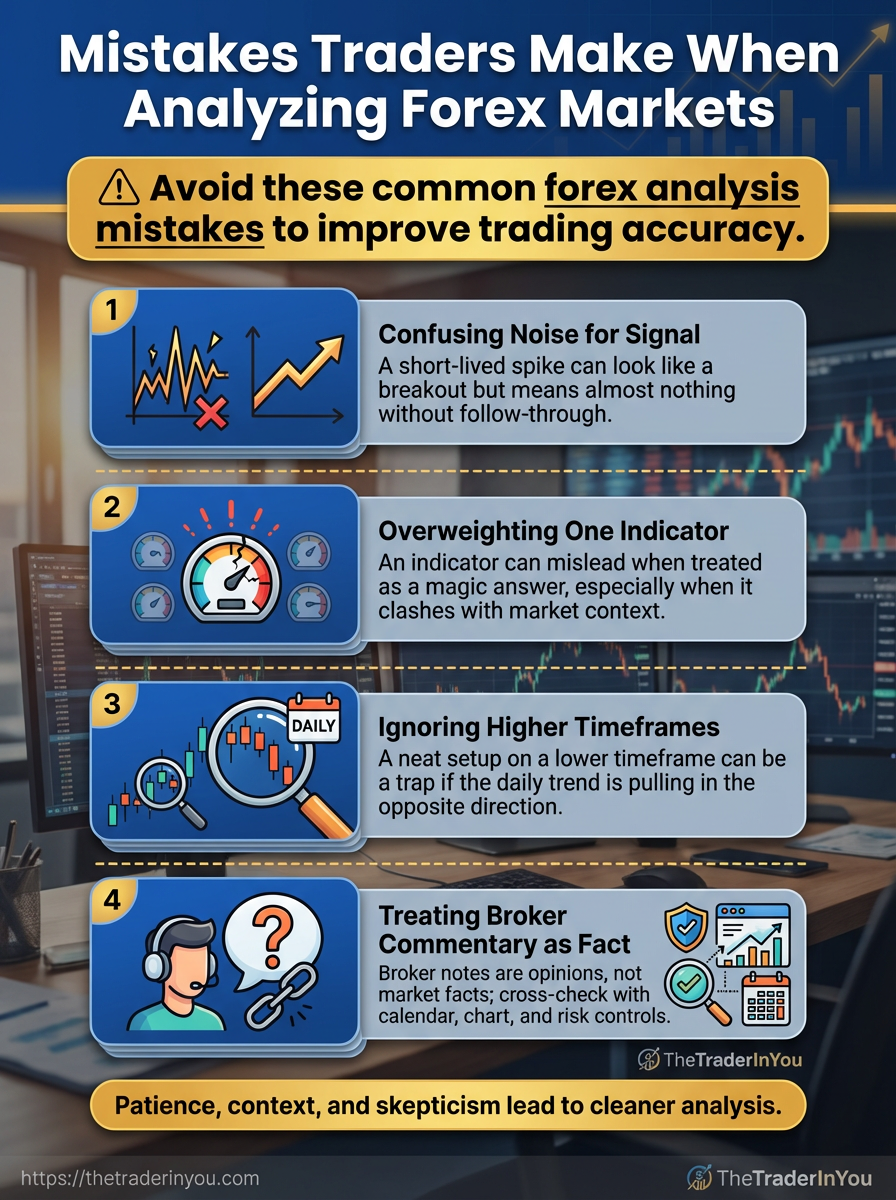
1. Confusing noise for a valid market signal
A short-lived spike during news, session overlap, or thin liquidity can look like a breakout and still mean almost nothing.
Traders often jump in because the move feels urgent, not because it is structurally sound.
A cleaner read comes from asking whether price held, retested, and continued with follow-through.
If it did not, the move was probably noise dressed up as opportunity.
2. Overweighting one indicator and ignoring market context
An indicator can be useful and still mislead you badly when it is treated like a magic answer.
A moving average cross, RSI reading, or divergence signal means far less when it clashes with trend, session behavior, or major news.
That is one reason analysis gets messy: the “signal” is real, but the market conditions make it unreliable.
A better habit is to verify whether price action and regime conditions support the indicator output—before you let the indicator become the decision.
3. Reading the chart without checking the higher timeframe
A neat setup on the 15-minute chart can be a trap if the daily trend is still pulling in the opposite direction.
Traders who skip the higher timeframe often end up buying into resistance or selling into support without realizing it.
This is where a simple habit helps.
Check the D1 and H4 before trusting the lower chart, then line up entries with the larger flow instead of fighting it.
4. Treating broker commentary as market fact
Broker notes can be useful, but they are still opinions wrapped in research language.
They are not the market itself.
That distinction matters during fast markets, when commentary can sound certain while price is doing something else entirely.
A better habit is to cross-check broker views with a calendar, the chart, and basic risk controls—especially when position size is getting aggressive.
FOREX.com’s guide to common forex trading mistakes is a good reminder that risk discipline matters just as much as analysis.
These common pitfalls are easy to miss because they feel rational in the moment.
Clean analysis comes from patience, context, and a willingness to doubt the first story the chart tells.
Where Forex Analysis Errors Usually Start
A trader can have a decent idea and still get junk results if the inputs are crooked.
Biased broker reviews and thin platform data distort the picture before a trade even exists.
Babypips splits trading analysis mistakes into technical and psychological buckets, and this sits squarely on the technical side: bad sources create bad conclusions.Babypips on trading journal analysis mistakes
The same problem shows up with news.
A single headline can punch price around for minutes, then fade once the first burst of emotion clears.
Traders who chase every release or anchor on the loudest headline often miss the broader move, a trap highlighted in New York City Servers’ breakdown of forex news trading mistakes.
Session context matters just as much.
A pair can look calm on a sleepy chart and act wild during London-New York overlap, especially when spread, slippage, and liquidity shift at the same time.
That is one reason FOREX.com CA’s course on common forex trading mistakes keeps hammering on leverage, margin, and risk conditions.
Comparing reliable and unreliable research inputs
| Source type | What it claims | What to verify | Common red flags | Trader impact |
|---|---|---|---|---|
| Broker review site | “Best broker” or “top platform” | Disclosure, methodology, update date, testing method | Hidden sponsorship, vague scoring, no negatives | Distorted broker selection |
| Promotional ranking page | “Best for scalping” or “lowest spreads” | Whether the ranking is paid, how spreads were sampled | Affiliate-heavy pages, no test details | Wrong fit for your style |
| Regulation page | “Safe” or “licensed” broker | Legal entity, regulator register, license scope | Logo-copying, missing license number | False trust in the broker |
| Execution claims | “Fast fills” and “low slippage” | Fill logs, timestamps, order status, average slippage | Cherry-picked screenshots | Unrealistic expectations |
| Fee comparison page | “Cheapest trading costs” | Commission, swap, withdrawal, and average spread | Only minimum spread shown | Underestimated trading cost |
| Platform account history | Trade results and fills | Server time, timezone, rejected orders, partial fills | Missing history, delayed refresh | Wrong performance analysis |
| Chart feed | Price action and levels | Symbol suffixes, feed source, candle consistency | Gaps across platforms | False support and breakout reads |
| Order-flow / depth data | Liquidity and pressure | Session coverage, timestamp alignment, refresh speed | Stale book, thin sample size | Mistimed entries and exits |
If the broker review hides sponsorship, the platform history skips rejected orders, or the headline only captures the first spike, the analysis is already off.
These errors start upstream, not on the chart.
Check the source, the session, and the timing before trusting the signal, and a lot of common trading mistakes stop looking mysterious.
Decision Traps That Distort Forex Analysis
A trader sees EUR/USD and GBP/USD rising together and assumes the relationship “proves” the move.
That is how bad calls get dressed up as smart analysis.
Confirmation bias does the first bit of damage.
Once a trade idea feels right, the mind starts collecting only the facts that agree with it and quietly ignores the rest.
BabyPips groups trading journal analysis mistakes into technical and psychological errors, and this one sits firmly in the psychological camp: the chart did not change, but the interpretation did.
See BabyPips on trading journal analysis mistakes.
The second trap is chasing a setup after the move has already run.
A late entry often feels like discipline, but it is usually FOMO wearing a neat shirt.
That is where traders drift into the common pitfalls of overtrading and abandoning the original plan, which is exactly the kind of behavior covered in WeMasterTrade’s guide to common forex mistakes.
Correlation check before calling it a signal
| Check | What to ask | Why it matters | Action if unclear |
|---|---|---|---|
| Time horizon | Is the relationship stable across sessions and weeks? | Short bursts often vanish when the market regime changes. | Reduce position size or wait for confirmation. |
| Macro driver | Are both pairs reacting to the same central bank or rate story? | Shared drivers can create a fake sense of cause and effect. | Separate the fundamental catalyst first. |
| Liquidity condition | Did the move happen during thin liquidity? | Illiquid moves can distort pair relationships. | Avoid treating the move as a durable signal. |
| Event alignment | Did both pairs move around the same release time? | The same headline can produce temporary co-movement. | Check the calendar before reading causation into it. |
| Regime change | Has one pair shifted from risk-off to rate-driven behavior? | Correlations break when the market’s main story changes. | Re-test the link on recent data only. |
| Lead-lag pattern | Is one pair always moving first? | A lag is not the same thing as causation. | Wait for independent confirmation. |
| USD exposure | Is the dollar the real driver in both pairs? | The USD can fake pair-to-pair correlation. | Strip out the dollar leg mentally. |
| Session filter | Does the pattern only appear in London or New York overlap? | Session flow can create a temporary pattern. | Compare it with Asian-session behavior too. |
A pair relationship that appears during one event window can disappear the next day, especially when liquidity is thin or the dollar is the real driver.
The habit that saves traders is simple: test the story before acting on the chart.
If the move needs three explanations to make sense, it is probably not a clean setup.
How Professionals Reduce Forex Analysis Errors
Professionals do not rely on a cleaner chart or a sharper gut feeling.
They reduce forex analysis errors by putting the same guardrails around every decision, even on days when the setup looks obvious.
That discipline matters because many trading mistakes come from the process, not the market.
The point is simple: when your method is consistent, your analysis can be audited—and your mistakes become easier to spot before they cost real money.
11. Build a pre-trade analysis checklist
A good checklist makes trading boring in the best way.
It forces the same questions before entry, so the mind cannot quietly skip the awkward parts.
This works because it removes improvisation when pressure is highest.
It also lines up with the risk focus in VPFX’s 2026 overview of common forex mistakes, where poor risk control and oversized exposure keep showing up as recurring problems.
- Trend context: Check the higher timeframe before touching the entry chart.
- Risk box: Define stop, target, and maximum loss before entry.
- Catalyst check: Ask whether news, session timing, or a scheduled event changes the setup.
- Invalidation level: Write the exact price that proves the idea wrong.
A trader who uses the same four-step filter every time removes a lot of common pitfalls before they become expensive.
12. Separate scenario planning from prediction
A scenario is conditional.
A prediction is a guess dressed up like certainty.
That distinction saves traders from forcing trades that only work in one imagined version of the market.
A clean scenario sounds like, “If price reclaims this zone and the catalyst holds, the long idea stays alive.” A prediction sounds like, “It has to go up.” Those are very different animals.
The point is not to forecast perfectly.
It is to know which market conditions justify action and which ones should kill the setup.
That habit keeps analysis honest when the chart is tempting and the story sounds convincing.
13. Keep a trade journal that records analysis quality
Profit and loss alone tell a lazy story.
A trade can make money and still be a bad analysis—which is why journals that only track outcomes miss the real lesson.
BabyPips emphasizes that traders often review results without separating the quality of their decision-making steps. (BabyPips on common trading analysis mistakes)
BabyPips on common trading analysis mistakes is a good reminder that the review should cover the quality of the decision, not just the result.
- Setup grade: Rate how clean the entry conditions were.
- Evidence used: Note which signals mattered and which were ignored.
- Rule breaks: Record every deviation, even the tiny ones.
- Review note: Write one sentence on what would change next time.
That kind of journal turns experience into a pattern library.
Over time, it exposes the same bad habits before they keep repeating—where the real improvement shows up.
Our team treats that habit as part of trader education, not admin.
The traders who keep these records usually spot their own trading mistakes much faster than the ones chasing the next new indicator.
Mistakes That Require Extra Attention in Live Market Conditions
A trader can read the chart correctly and still lose money on the next minute’s fill.
That usually happens when live conditions are changing faster than the analysis.
The dangerous part is that these mistakes do not look dramatic at first.
They show up as revenge trading after a losing streak, valid setups that fail on execution, and calm analysis that ignores a central bank headline waiting just ahead.
Mixing analysis with emotion after a losing streak
After three losses, a clean setup can start feeling like a challenge.
That is when analysis turns into a scorecard, and the trade plan starts answering the last loss instead of the current market.
BabyPips separates trading-analysis mistakes into technical and psychological problems, and this is the psychological side in its messiest form (BabyPips on trading journal analysis mistakes).
The fix is boring, but it works: keep the same entry rules, cut size for the next trade, and write down whether the setup still fits before you touch the order button.
Ignoring execution conditions when the setup looks right
A chart can look perfect and the fill can still be ugly.
Wide spreads, thin liquidity, and fast quotes can turn a valid entry into a late one, especially when traders chase price instead of waiting for a pullback.
That problem gets worse around news, where execution mistakes stack up fast.
A recent roundup of news-trading errors points to spread changes, overleveraging, and chasing moves as recurring problems (8 Forex news trading mistakes that cost traders money).
Forgetting the event risk sitting overhead
Central bank decisions and major economic releases change the rules for a few minutes.
The analysis may still be right, but the market can widen spreads, spike volatility, and whip both directions before direction settles.
FOREX.com’s trading academy reminds traders that leverage and risk go hand in hand, especially when the market gets jumpy (FOREX.com on common forex trading mistakes).
Around CPI, NFP, or a rate decision, the cleaner move is often to reduce size, wait for the first reaction to cool off, or stand aside completely.
Live market conditions punish sloppy timing more than sloppy theory.
That is why the best traders treat emotion, execution, and event risk as one problem, not three.
Clean Charts Still Punish Bad Assumptions
The most useful thing to carry forward is simple: most trading mistakes do not begin with the entry, they begin with the story built around the chart.
A neat setup can still fail if the trader is forcing a bias, ignoring context, or treating a single signal like proof.
That came through clearly in the live-market examples.
Forex analysis errors get louder when volatility expands, spreads widen, or news hits and price stops behaving like the tidy backtest everyone wanted.
The traders who last are usually the ones who notice their own common pitfalls early, especially the habit of reading certainty into uncertainty.
Write down the reason for every trade before you place it. Then compare that reason with what actually happened after the trade closed.
If you want a steadier framework for that kind of discipline, our courses and market analysis tools are built around the same habit: slow the decision down, check the context, and make the process harder to fool.

Follow Joshua for daily forex tips on X: @thetraderinyou or connect with him on LinkedIn: Joshua Okapes.
- Mistakes Traders Make When Analyzing Forex Markets - May 8, 2026
- How to Leverage News Releases for Forex Trading Success - May 6, 2026
- The Role of Customer Support in Forex Broker Selection - May 4, 2026