What drives FX moves around news isn’t the headline—it’s how quickly the market re-prices from expectation to reality.
A strong number can still push a currency lower if traders were positioned for something even stronger.
Forex news releases create volatility because they shift rate bets, inflation views, and growth expectations almost instantly.
By the time most traders finish reading, liquidity can already thin out and the pair may have repriced.
That’s where execution problems show up: slippage, wider spreads, and stop-outs that don’t reflect your original idea.
The fix isn’t a better guess—it’s a better process.
Build strategies around the range of outcomes the market might trade: overreaction, pause, or reversal.
That means using the calendar to define the risk window, deciding in advance whether the release is a trade, a wait, or a no-go, and setting your invalidation before price moves.
Some events demand caution.
Others are tradable only if you plan for how the market can react when expectations change.
Quick Answer: Forex news trading works by trading the expectation gap—the difference between what the market priced in (consensus forecasts and rate-path expectations) and what the data/release actually changes about growth, inflation, and policy. Instead of reacting to the headline direction, you pre-decide your action for the specific event: enter only if the market behavior stays inside your invalidation plan; otherwise reduce size or skip and wait for the post-release confirmation. Use your high-impact calendar to choose the event and the risk window, then rely on Sections 6 and 9 for the exact invalidation and execution-risk controls. (Example context: Argentina inflation moved sharply across 2024–2026, which would be the kind of regime shock that forces rapid repricing when expectations change.)
Use next week’s calendar to front-run repricing
Most news traders don’t lose because the chart is “late”—they lose because they treat the move as a surprise.
If CPI, a central-bank decision, or payroll numbers are on the calendar, the market has already been positioning for them. When the print lands, currency repricing can happen before your usual technical read catches up.
That’s why forex news releases matter.
Major releases reshape expectations around inflation, growth, and interest rates—the same variables that drive FX volatility.
News trading differs from trend-following and range trading because it starts with the event, not the pattern.
- Trend-following waits for direction to prove itself after the move starts.
- Range trading fades extremes back toward familiar boundaries.
- News trading focuses on the surprise versus consensus and how that changes expectations in real time.
Execution matters more here than in many other trading strategies.
A dedicated calendar-and-risk workflow isn’t a side note—it’s the map. The calendar tells you when repricing is likely. Your risk plan decides whether you’re trading the outcome or avoiding the failure mode.
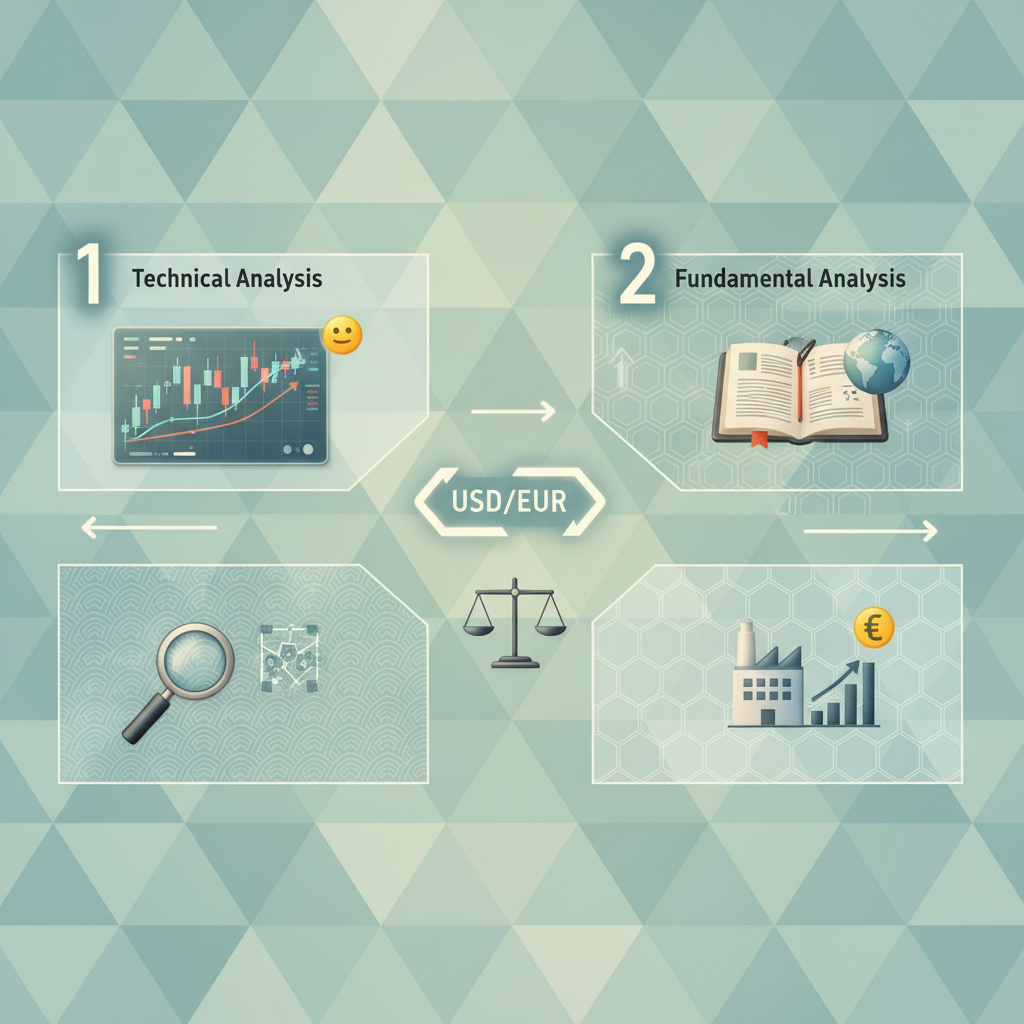
This section also fits the broader forex education approach: combining technical structure, fundamentals, and execution discipline instead of letting them compete.
The best trades often come from knowing when not to trade first.
Learn which forex news releases deserve your attention
The headline is only half the story. The other half is what the market expected—and how positioned it was beforehand.
A release can be “good” on paper and still trigger weakness if it misses or changes the rate path less than traders priced in.
A release can be “weak” and still spark a rally if it shifts expectations toward easier policy more than the market expected.
News trading is built on surprise versus expectation.
Axiory’s 2026 guide on forex news trading and economic releases emphasizes how interest-rate decisions, inflation, employment, policy statements, and geopolitical shocks can move FX. IronFX similarly notes that volatility, liquidity thinning, and slippage risks rise during major announcements.
Our filter is simple: if a release can change the policy path or materially alter growth/inflation assumptions, it deserves your attention.
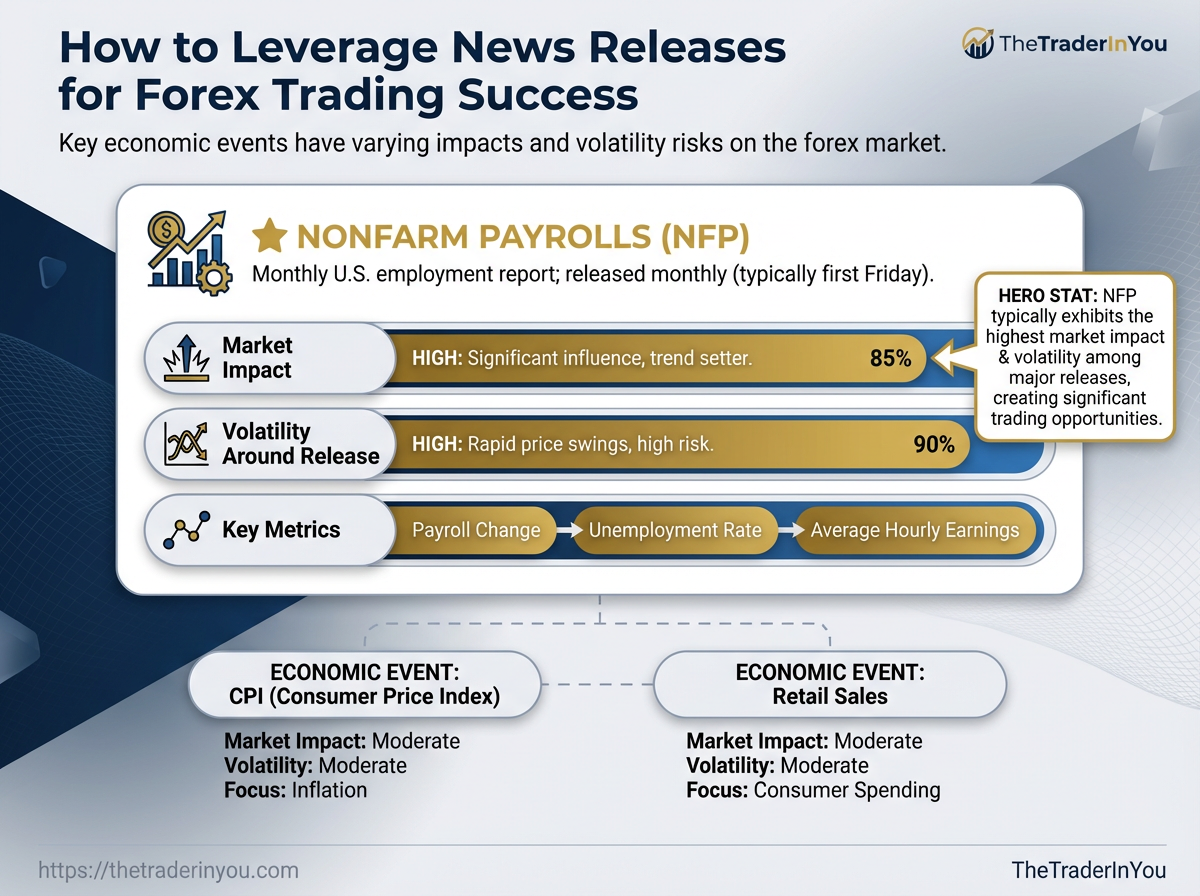
That’s why the biggest focus usually goes to central bank decisions, CPI, NFP, GDP, PMI, and retail sales.
LMFX makes the same point in its news-trading guidance: the market reacts to the event, the timing, and the expectations around it—not the headline in isolation.
The highest-impact economic events for news trading
| News release | Typical market impact | Volatility risk | Best pairs to watch | Common trader reaction |
|---|---|---|---|---|
| Nonfarm Payrolls | Strong USD repricing, especially on wage and unemployment surprises | Very high | EUR/USD, GBP/USD, USD/JPY | Fast spike, then wider swings as details sink in |
| CPI inflation | Reprices rate expectations fast | Very high | EUR/USD, USD/JPY, GBP/USD, AUD/USD | Direction follows the gap versus consensus |
| Central bank rate decisions | Can reset the entire policy outlook | Extreme | All majors tied to that currency | Sharp jump, then press conference drives follow-through |
| GDP releases | Measures growth momentum and policy pressure | Moderate to high | EUR/USD, GBP/USD, USD/CAD | Brief reaction unless revisions surprise hard |
| Retail sales | Shows consumer demand strength or weakness | Moderate | GBP/USD, AUD/USD, USD/CAD | Often a quick move, then fade |
| PMI surveys | Early growth signal before hard data arrives | Moderate | EUR/USD, GBP/USD, AUD/USD | Repricing if the reading breaks a key trend |
| PPI inflation | Early inflation hint before CPI | High | EUR/USD, USD/JPY, GBP/USD | Reacts if it shifts CPI expectations |
| Unemployment claims | Labor market pulse, especially in the U.S. | Moderate | USD pairs broadly | Small surprise can still move a crowded market |
A clean beat that matches expectations can do less than a smaller miss when positioning is stretched—because the first move is really a repricing of rates, growth, and risk.
So the best strategies for forex news releases start with the calendar, then consensus, then what reaction is most likely.
If the event doesn’t change expectations, it’s usually background noise. If it does, the market often moves before most traders finish reading the headline.
Build a pre-release plan before the data hits
Your edge before a major release isn’t predicting the headline—it’s deciding what you will do before price starts moving.
Around forex news releases, the most common damage comes from improvising mid-spike, not from being wrong about direction.
A clean pre-release plan turns a chaotic five-minute burst into a simple decision tree: trade it, fade it, or stand aside.
That matters because major releases reshape rate expectations quickly—and volatility is exactly when liquidity and execution costs tend to worsen.
Start with the calendar, then classify the event by type.
A CPI print isn’t the same risk as a second-tier release, and a rate decision isn’t merely “high impact”—it can shift the entire tone of the session.
Use tools like the FOREX.com economic calendar, Babypips’ economic calendar, and the Forex Factory Calendar guide to sort events by impact, time zone, and alert level before the market gets noisy.
- Check the event and classify it. Label it as directional, volatility-heavy, or mostly background noise.
- Map likely pairs and correlated assets. If the release is USD-focused, watch pairs such as EUR/USD, GBP/USD, and USD/JPY, then check the broader USD picture.
- Set your invalidation level before the release. Decide the exact price level that proves your setup is wrong; if price crosses it, you’re done.
- Define a no-trade zone. Avoid fresh entries inside the release window unless your plan was built for that specific volatility.
- Account for execution constraints. News trading punishes slow fills. Spread quality and order handling matter more than usual.
A practical habit helps: write the event name, your pair map, and your invalidation price on one line before the data drops.
That routine keeps you from guessing when the screen starts moving faster than your thinking.
When you pre-decide the hard parts, the trade decisions feel calm—because they’re no longer being made during the spike.

Apply trading strategies that fit the news environment
The strategy has to match the event’s behavior, because major data rarely produces a single, predictable path.
Prices often reprice in seconds—before the headline is even fully processed—so the right approach depends on what the first reaction actually does.
A high-impact release on EUR/USD can behave very differently from a smaller event on a quieter cross. Your job is to read the move, not force a one-size-fits-all setup.
In practice, forex news trading strategies usually fall into three buckets: breakout, retracement, or wait-and-confirm.
Pick the setup the market is actually offering
- Use the breakout approach when price expands.
- Use the retracement approach when the first burst fades.
- Use the wait-and-confirm approach when the move looks messy.
- Match the strategy to event strength and pair behavior.
For timing and execution, keep the focus on the conditions that break most news trades: tight spreads, reliable fills, and order handling when volatility spikes.
A practical example helps.
- If jobs data beats expectations and price keeps extending, breakout logic becomes more relevant after the hold.
- If the first move stalls and folds back into the prior range, retracement logic usually fits better.
The market does not owe you a clean setup.
It only offers the one that matches the moment—and your job is to trade that behavior, not the idea.
Manage risk when spreads widen and price moves fast
What if your stop-loss was technically correct and still useless? That happens in forex news releases, especially when spreads blow out and price jumps over your order.
Major releases can trigger fast repricing, and poor execution can turn a good idea into a bad fill.
Position size has to shrink before that kind of event.
A normal trade size can become too heavy once volatility expands, so many traders cut exposure to half-size or skip the trade entirely before CPI, rate decisions, or surprise headlines.
That matters because you are not just betting on direction anymore.
You are also paying for spread expansion, slippage, and the chance that your order gets filled far from where you expected.
Stop-loss placement needs more breathing room too.
A tight stop may sit inside the noise generated by the release itself, and then the market hits it before the move even settles.
FOREX.com’s economic calendar and Babypips’ economic calendar both center event risk for the same reason: scheduled news can move price faster than a tidy chart setup can handle.
Pre-trade checks for fast markets
| Risk factor | What can go wrong | What to check before entry | Action if conditions worsen |
|---|---|---|---|
| Spread widening | Entry and exit costs jump fast, turning a decent setup into a poor one | Compare current spread with normal session levels on your live platform | Stand aside until spreads settle |
| Slippage | Your fill lands worse than the trigger price | Test recent order reports for fast-market fills | Reduce size or use no trade |
| Order rejection | Market orders fail or come back partial | Confirm broker execution rules and order type limits | Switch to a cleaner execution window |
| Latency | Price updates arrive late and entries chase the move | Check platform response time during active hours | Avoid market orders during release seconds |
| Overexposure | One headline wipes out several small wins | Keep risk per trade small and track daily drawdown | Stop trading after a preset loss limit |
If a broker cannot handle fast fills cleanly, the setup is weaker before it even starts.
That is why traders often test execution under live conditions and watch broker order reports closely during volatile windows.
The clean habit is simple: size down, widen stops enough to survive the noise, and respect the event when the market stops behaving politely.
News trading works better when the risk is already contained before the headline hits.
Choose the right broker and platform for news trading
A broker can turn the same CPI release into two very different trades.
On one setup, the fill lands cleanly and the move is tradable; on another, the spread jumps, the order slips, and the entry is already stale.
That is why news trading is not just about reading forex news releases.
It is also about the plumbing underneath the trade.
Axiory’s 2026 guide on forex news trading warns that slippage and stop-outs can hit fast when liquidity thins during major announcements.
The safest way to compare brokers is to test how they behave before real money is involved.
Calendars from Forex Factory and Babypips help mark the risk window, while FOREX.com’s economic calendar and 90-day demo gives a live-market practice setup for event-driven conditions.
What to compare before funding a live account
| Feature | Why it matters for news trading | What to look for | Potential red flags |
|---|---|---|---|
| Execution speed | Fast markets punish slow fills. | Tight spreads and reliable fills; HotForex and Exness are commonly evaluated for this, and XM is often checked as well. | Requotes, laggy order tickets, or freezes during volatility. |
| Spread policy | Costs can explode when releases hit. | Clear disclosure of variable spreads during high-impact events. | “Fixed spread” marketing with no news disclaimer. |
| Order types | Different orders fit different trading strategies. |
Market, limit, stop, and stop-limit orders; one-click trading helps when timing matters. | Missing pending orders or hidden restrictions around releases. |
| Slippage handling | Slippage can make a good setup lose money. | Clear policy on positive and negative slippage, plus partial fills. | No written slippage policy in legal documents. |
| News trading rules | Broker rules can change the trade before price does. | Read terms for scalping limits, widened margin, or event restrictions. | Vague wording like “conditions may change at any time.” |
| Platform stability | A good idea is useless if the platform buckles. | Stable desktop, web, and mobile performance under load. | Disconnects, delayed charts, or order rejection spikes. |
| Margin policy | News moves can hit account equity hard. | Stop-out levels, leverage caps, and negative balance protection. | Unclear margin calls or leverage changes without notice. |
| Demo and testing tools | Live-style practice exposes weak spots early. | Demo pricing that mirrors live conditions, ideally with calendar support. | Demo fills that look cleaner than real trading ever will. |
The better question is whether the platform can survive the exact conditions you plan to trade.
That is the real filter.
If the calendar flags the event, the broker handles execution cleanly, and the platform stays stable, the setup is worth a closer look.
Review post-release price action to improve future trades
A trade can close green and still teach the wrong lesson.
After forex news releases, the real question is whether price respected the data or traded the story around it.
Axiory notes that news moves FX by shifting expectations for growth, inflation, and rates, so the first reaction often matters more than the headline itself.
That is why news trading gets better when the trade journal focuses on behavior, not just profit and loss.
At The Trader In You, we keep the review tight: capture the event, the consensus, the actual print, and the first reaction.
Pair that with a scheduled-event calendar such as FOREX.com’s economic calendar or Babypips’ economic calendar, and the pattern starts to show.
Record these notes every time
- Event setup: write down the release name, pair, session, consensus, actual number, and previous reading.
- Execution details: log entry, exit, stop, fill quality, and any gap between intended and actual execution.
- First reaction: note the initial spike direction, how fast it moved, and whether the move held.
- Follow-through: mark whether price trended, stalled, or snapped back into the prior range.
- Context markers: tag nearby support or resistance, plus any older theme that may have dominated the move.
Separate the data from the narrative
A strong data print does not always produce a strong currency move.
Sometimes the market cares more about the central bank message, the prior trend, or whether the result was already priced in.
That is where surprise versus expectation matters.
Our macro indicators guide on major forex releases and market context points to the same thing: algorithms often reprice before most traders finish reading the headline.
A data-led move usually keeps direction after the first burst.
A narrative-led move often fades fast, especially when price refuses to extend beyond the first obvious level.
Turn the review into a routine
- Check three timestamps: review the chart right after the release, after the first candle, and at session close.
You want to see whether the move was impulse, trend, or fade.
- Label the trade honestly: tag it as data-led, narrative-led, or mixed.
That keeps the journal useful instead of sentimental.
- Compare patterns over time: review 10 to 20 trades together.
Repeated mistakes and reliable setups start to stand out fast.
The best review is boring in the right way.
It turns forex news releases into feedback, and that feedback makes future trading strategies sharper.
What if the most expensive news-trading mistake is the habit of changing the plan mid-release?
Most traders don’t lose because the direction was wrong. They lose because their process stops being the process the moment volatility spikes.
Mistake 1: Plan drift during the burst
If your invalidation, no-trade zone, or size rule is written before the event, keep it that way. When the first candle flashes, it’s tempting to “improve” the plan—moving stops, resizing, or re-entering after you already decided it was a no-go. News trading is a decision framework; drift turns it back into discretion.Mistake 2: Confirmation without evidence of execution quality
Confirmation isn’t just price action—it’s fills. If spreads widen, slippage is inconsistent, or your orders are partially filled, the market may be doing exactly what your idea assumed—while your execution removes the edge. Use Section 9’s pre-trade checks before you interpret momentum.Mistake 3: Filtering failures (but not the obvious kind)
Yes, not every release is tradable. But the subtler error is treating “high impact” as a guarantee. You still need: expected rate-path change likelihood, whether the move is already priced, and whether your specific pair tends to react cleanly versus messy repricing.Mistake 4: Journal omission (or biased journaling)
A trade can be green and still teach the wrong lesson. If you only log profit/loss, you’ll keep repeating the same execution and interpretation mistakes. Use the review structure from Section 12 to separate (1) data vs narrative and (2) intended levels vs actual fills.Mistake 5: Overtrading the same mechanism
Breakout, retracement, and wait-and-confirm all work when the market is behaving in their favor. The error is forcing one mechanism across unrelated conditions (different pair liquidity, different session dynamics, or different “expectations vs reality” behavior). Match the strategy to what the market is actually offering (Section 8), not what you wish it would offer.The fix is boring but precise: pre-commit to the rules, verify execution conditions, and review outcomes in a way that makes repeats obvious.
How do I create a forex news trading plan before high-impact releases?
Create your plan from the economic calendar, then pre-decide your action for each high-impact event before the data hits. Build a simple decision tree: trade it, fade it, or stand aside, because price often reprices in seconds and liquidity can shift fast. Focus on the expectation gap (surprise versus what the market priced in), not just the headline direction.
What risk management rules should I use to avoid stop-outs during CPI or NFP news?
Use stricter execution risk controls by shrinking position size before CPI or NFP and refusing to improvise during the burst. When spreads widen and price jumps over your order, treat normal sizing as too heavy—cut exposure to about half-size or skip the trade entirely. Combine this with a predefined risk window and avoid chasing the first spike to reduce slippage-driven stop-outs.
Trading the Expectation Gap
The part worth remembering is simple: in news trading, the market usually prices the story before the headline lands.
A clean number during a major forex news release can still trigger a whipsaw if the result was already expected, which is why the best trading strategies start with the calendar, not the candle.
That shift in thinking saves more accounts than any clever entry trick.
The traders who last are the ones who do the boring work first.
They mark the event, define the trigger, and decide what happens if spreads blow out or the first move reverses, then they watch how price behaves after the initial spike.
That review step is the one most people skip, yet it is often where the real edge shows up.
Open your economic calendar today and choose one upcoming release. Write down the consensus number, your entry condition, and the most you are willing to lose before the data hits.
If you want a more structured way to practice that process, our courses and market analysis tools are built around the same discipline that separates impulsive trades from repeatable news trading.

Follow Joshua for daily forex tips on X: @thetraderinyou or connect with him on LinkedIn: Joshua Okapes.