
Forex doesn’t react to a headline in isolation—it reacts to what that data changes about the market’s expectations for rates, growth, and inflation.
In practice, traders aren’t really trading “news”; they’re trading the revised outlook for the central bank’s next moves, which can also be shaped by positioning going into the release.
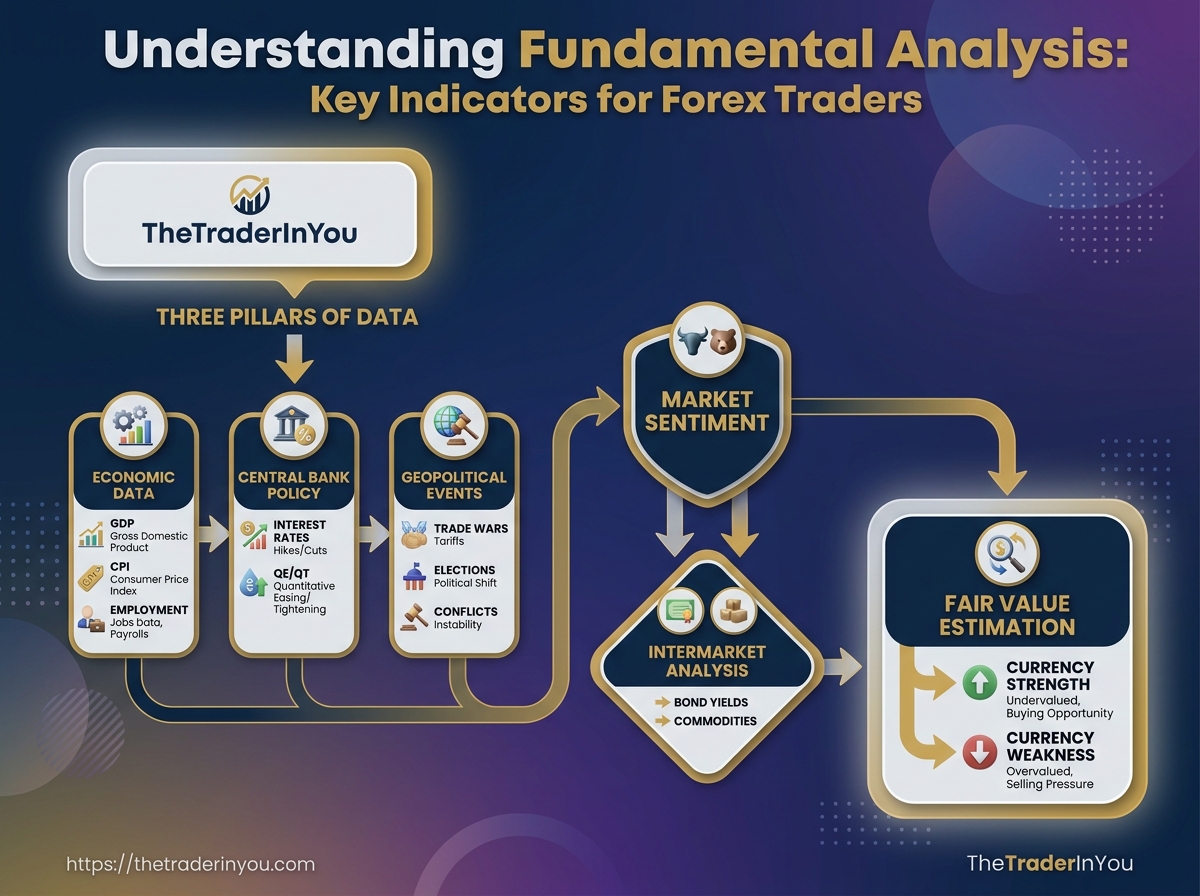
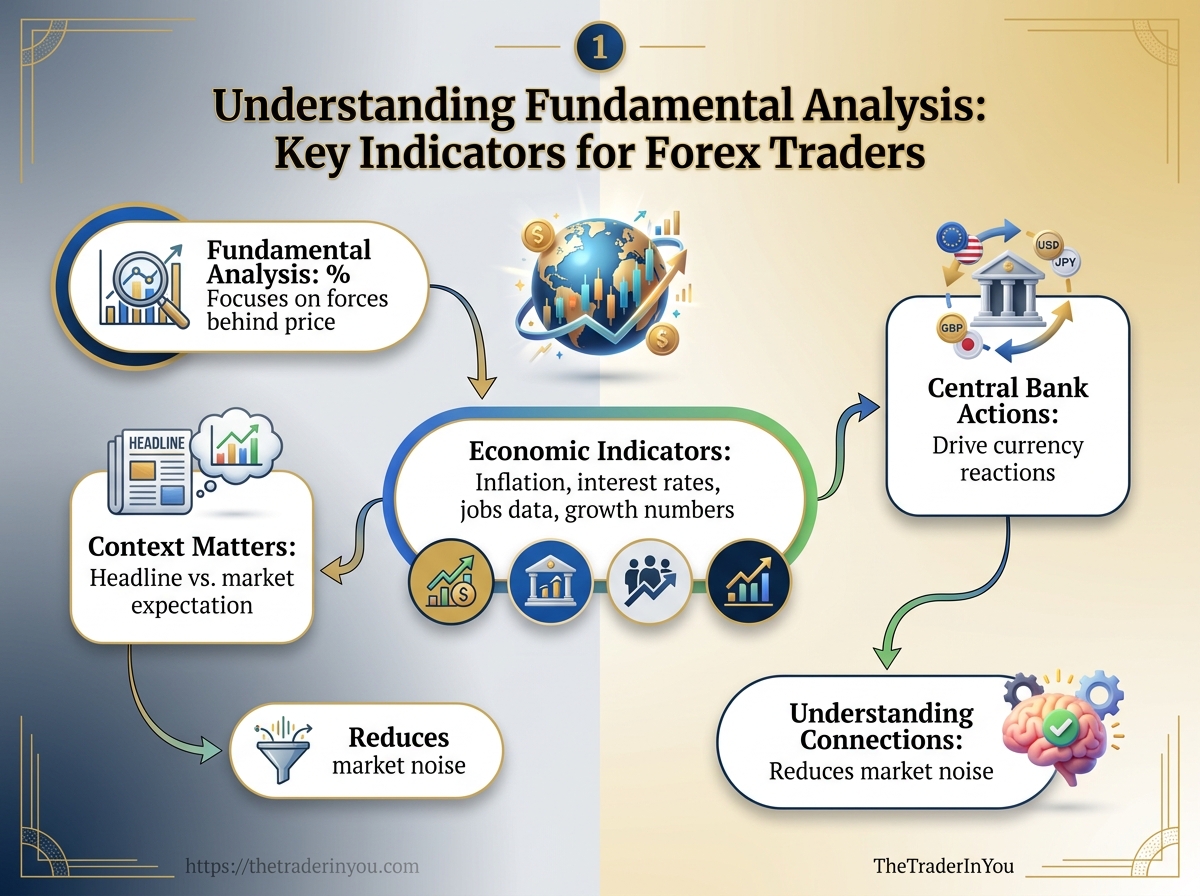
That’s where fundamental analysis fits: it looks at the forces behind price movement, and in forex those forces usually arrive through economic indicators like inflation, interest rates, jobs data, and growth numbers.
According to FOREX.com, fundamental analysis uses multiple data sources to estimate an asset’s fair value.
The key twist is that forex rarely responds to a single print on its own.
A strong payroll report can help only if it makes traders think the next central-bank move is likely to be tighter (or less dovish) than they expected.
A weak GDP print may hurt less than the headline suggests if the market decides the slowdown won’t derail the inflation outlook or the policy path.
Once you connect economic indicators to the central bank reaction function, the “puzzle moves” start to follow a pattern instead of feeling random.
Quick Answer: Use fundamental analysis in forex to decide how a data release changes the expected policy path—not whether the headline is simply “good” or “bad.” Track which releases can move rate expectations for inflation, jobs, and growth, then judge the market reaction by comparing the surprise versus expectations and whether price accepts or fades the repricing. The payoff is a clearer directional bias you can test with your timeframe and execution rules.
Table of Contents
- What Fundamental Analysis Means in Forex
- The Core Economic Indicators Forex Traders Watch
- How Central Banks Shape Currency Trends
- How to Interpret Data Releases Without Getting Misled
- Building a Fundamental View for a Forex Pair
- Practical Framework for Prioritizing Economic Indicators
Even when price action looks calm, FX can still “reprice” as traders update their probabilities about what central banks are likely to do next.
Fundamental analysis is the bridge between macro data and those probabilities. Instead of asking whether a release is merely “strong” or “weak,” you ask what it changes about inflation pressure, labor/growth momentum, and the implied policy reaction.
Once you make that connection, the rest of the process becomes structured:
- Interest rates: Changes in expected rate differentials often drive FX directly.
- Inflation: Moves rate expectations by altering the odds of tighter policy (or the odds of easing).
- Employment data: Signals slack/tightness and wage pressure—feeding into future inflation and policy credibility.
- Growth indicators: Determines whether the economy can support policy tightening without breaking inflation dynamics.
Fundamental and technical analysis complement each other: fundamentals help you decide what should happen next based on macro/policy incentives, while technicals help you time entries, manage risk, and judge whether the market is accepting or fading the repricing.
Use this logic throughout the article: the next sections break down the key indicators, how central bank communication shifts expectations, and how to interpret the surprise using the market’s reaction—not the headline alone.
Inflation data often gets treated like a “leading” signal in forex because it can shift rate expectations quickly. The headline matters—but the detail (like core vs headline measures) often determines whether the market believes policy will tighten or ease.
In fundamental analysis, traders watch the releases that can move rate expectations fast.
Forex.com describes fundamental analysis as using multiple data sources to judge fair value, while BabyPips frames it around the economic, social, and political forces that move currencies.
That is exactly why CPI, payrolls, and GDP keep coming back to the top of the watchlist.
Inflation data traders track first
CPI often hits the market like a drumbeat, but the details matter more than the headline.
Core CPI strips out food and energy, while PCE gives a broader read on spending and is watched closely by central banks.
| Indicator | What It Measures | Why It Matters for FX | Typical Currency Impact | Release Frequency |
|---|---|---|---|---|
| CPI | Change in consumer prices for a basket of goods and services | Signals near-term inflation pressure and possible rate response | Hotter than expected is usually currency-bullish; softer prints can weigh on the currency | Monthly |
| Core CPI | CPI excluding food and energy | Filters volatile items and shows underlying price pressure | Strong core readings often support a firmer currency outlook | Monthly |
| PCE | Consumer spending prices across a wider set of goods and services | The Federal Reserve watches it closely for inflation trends | A firm PCE print can lift rate expectations and support the currency | Monthly |
| Producer Price Index | Prices received by producers at the wholesale level | Can hint at pipeline inflation before it reaches consumers | Rising PPI can lift inflation fears and support the currency if policy tightening looks likelier | Monthly |
This mix is why one inflation print rarely tells the whole story.
Traders compare the broad CPI move, the cleaner core trend, and the central bank’s preferred gauge before they decide whether the rate path changed.
Employment reports can swing the whole rate story
Payrolls are the headline number, but wage growth and unemployment often tell the better story.
A strong jobs report can support a currency even when inflation is quiet, because traders start pricing tighter policy again.
Nonfarm payrolls: Measures job creation and often drives the first reaction.
Unemployment rate: Shows how tight or loose the labor market is.
Average hourly earnings: Tracks wage pressure, which can feed inflation.
Growth data checks whether demand is real
GDP is the broadest read, yet retail sales and manufacturing surveys often move earlier.
DailyForex lists GDP, retail sales, employment data, and manufacturing among the main indicators traders watch in forex trading.
GDP: Captures the size and pace of the economy.
Retail sales: Shows consumer demand in real time.
Manufacturing surveys: Offer a fast pulse on business activity.
Those releases matter because they tell the market whether inflation and jobs are supported by real demand.
A hot CPI number is more convincing when retail sales and factory surveys are also firm.
The cleanest forex setups usually come from watching these indicators together, not in isolation.
One number can be noisy; a cluster of strong or weak releases usually tells the real story.
Central banks move FX mainly by changing how traders expect policy to evolve—especially through the interest-rate path and the surrounding communication.
They are pricing the path of policy, and that path starts with interest-rate expectations.
Central banks shape forex trading through rate differentials.
When one country’s policy path looks tighter than another’s, its currency often attracts more demand, since traders can earn a better yield while holding it.
The trickier part is that markets rarely wait for the actual decision.
They react to hints in statements, minutes, and press conferences.
A small shift in wording, like dropping a promise to stay patient, can move yields and currencies fast because traders immediately adjust expectations.
Rate expectations matter most. A currency can rise before any hike happens if the market believes higher rates are coming.
Policy gaps matter too. If one central bank sounds hawkish while another sounds cautious, the stronger policy outlook can support its currency.
Language matters more than people think. Traders parse words like “restrictive,” “data dependent,” and “inflation progress” for clues.
Minutes reveal disagreements. They show whether policymakers are aligned or split, which often changes how credible the next move looks.
Press conferences add context. A calm tone can soften a strong decision, while a sharp tone can make a modest decision feel much bigger.
Then there is quantitative tightening, which many newer traders underweight.
When a central bank shrinks its balance sheet, it can push bond yields higher or keep them elevated, and that often puts pressure on currencies that become less attractive for easy funding.
Broader fundamental analysis frameworks, including AvaTrade’s market analysis guide and OANDA’s introduction to fundamental analysis, both point to how these policy forces shape price direction over time.
A practical way to read it is simple: follow the rate path, not just the decision.
Then check whether the central bank is signaling tighter policy, slower easing, or a longer period of restraint.
That habit keeps forex trading grounded in the real driver underneath the noise.
It also helps you separate a one-day reaction from a trend that can last for months.
Not every CPI or jobs print produces the move you expect—because the market cares about the expectation gap and the broader context, not just the headline.
The trap is treating every release like a standalone verdict.
In fundamental analysis, the market is usually pricing the gap between actual, forecast, and prior readings, not the headline alone, as explained in Forex.com’s introduction to fundamental analysis and OANDA’s introduction to fundamental analysis.
A number that beats expectations can still disappoint if traders were positioned for something much stronger.
A clean way to read a release is to compare all three numbers before reacting.
Actual versus forecast: The forecast is the market’s guess.
A small beat often matters less than the size of the surprise.
Actual versus prior: If the prior reading was already extreme, the new print may only confirm a trend rather than create one.
Forecast versus prior: A shifting forecast can tell you more than the final number, especially when traders have already adjusted positions.
Imagine CPI prints at 3.2%, versus a 3.0% forecast and a 3.4% prior.
That looks bullish on paper, but the reaction may be muted if the market had been leaning toward 3.3% or higher.
That gap between expectation and reality is where forex trading gets interesting.
Strong data also gets ignored when it arrives in the wrong market mood.
A currency can shrug off a solid retail sales number if risk sentiment is deteriorating, if a central bank already sounds committed, or if traders are focused on a bigger release later in the week, a pattern consistent with the broader market context approach described by Babypips’ forex fundamental analysis guide and AvaTrade’s 2026 fundamental analysis guide.
The fastest filter is simple: ask whether the release changes the policy path, shifts expectations, or just adds noise.
If it does none of those, the move may fade quickly.
A useful habit is to keep a small pre-release checklist beside your chart.
That keeps you from chasing the first candle and helps you separate a real shift from a noisy headline.
Building a Fundamental View for a Forex Pair
What matters more when you trade EUR/USD: one strong report, or the gap between two economies over the next few months?
That gap matters more.
In FOREX.com’s introduction to fundamental analysis, the point is simple: you are trying to judge fair value from several data sources, not from one headline.
In forex trading, that usually means asking which economy looks healthier, which one is cooling, and which central bank has more room to stay firm.
Start with the relative outlook
A pair is really a comparison.
If one economy is slowing while the other still shows steady growth, the stronger side usually has the cleaner currency story.
That is why pair analysis beats single-country analysis.
BabyPips’ fundamental analysis guide frames the market around economic, social, and political forces, and that mix matters because currencies trade in relationships.
A solid job number means less if the other country is printing even better numbers.
Growth gap: Compare growth trends, not just one release.
Inflation path: Ask which side is moving closer to target.
External balance: Trade and capital flows can shape demand for the currency.
Fiscal tone: Heavy spending can help growth now, but worry markets later.
Match data to the policy path
A data point only becomes useful when it fits the central bank’s likely next move.
Strong inflation in a country already warning about growth risks can matter more than the same print in a bank that is still comfortable tightening.
This is where traders often drift into lazy thinking.
They treat every release as if it matters equally, when the market really cares about how the release changes the next policy meeting.
AvaTrade’s fundamental analysis overview makes the broader point that serious analysis links data to market expectations, not just the headline itself.
Blend fundamentals with chart context
A clean fundamental view still needs a chart.
If the pair is already trending in the same direction as the economic story, the trade has more room to breathe.
If the story says one currency should rise, but price is stuck under resistance, the market may already be pricing it in.
In that case, sentiment matters too, because crowded positioning can turn good news into a short squeeze and then a fade.
Check the relative story first. Decide which economy looks stronger over the next quarter.
Map the policy path. Ask which central bank can stay firmer for longer.
Read the chart last. Look for trend, range, or breakout setup.
Test sentiment. If everyone already agrees, the move is often smaller.
A pair view works best when the economics, the policy path, and the price structure point the same way.
That is where fundamental analysis starts feeling less like theory and more like a live edge in forex trading.
Practical Framework for Prioritizing Economic Indicators
When the calendar is packed, the goal isn’t to watch every headline—it’s to watch the releases that can actually change rate expectations.
In practice, that usually means focusing on indicators that can move inflation, employment, and the central bank’s policy outlook quickly.
Forex trading remains a comparison game: different pairs care about different central banks, so the “top” release depends on the currency you’re trading.
- EUR/USD: typically most sensitive to Fed vs. ECB rate expectations (inflation, labor, and policy communication).
- USD/JPY: often reacts sharply to changes in U.S. yields and Bank of Japan messaging that alter the spread outlook.
To decide what deserves your attention, sort indicators by time horizon.
1) Intraday (minutes to a few sessions): trade the first repricing
Intraday, prioritize releases that can trigger an immediate shift in the market’s near-term rate expectations. Think: high-impact inflation prints, the main jobs report, and any policy-relevant central bank commentary.
2) Swing (days to weeks): trade the build-up
For swing trading, you’re looking for whether the data is coherently changing the trend: inflation persistence, labor-market cooling/tightening, and activity signals that alter the path of policy rather than just the day’s move.
That’s why indicators like CPI/labor/GDP-related components and high-frequency surveys (e.g., manufacturing activity) often matter more when they reinforce each other across multiple releases.
3) Position (weeks to months): trade the policy path
At longer horizons, the market cares less about the single print and more about whether successive releases make the central bank’s likely reaction function change. This is where inflation and employment trends tend to dominate.
A simple release checklist (prioritize first, then review)
| Step | What to Do | Why It Matters | Trading Relevance |
|---|---|---|---|
| Confirm “rate relevance” | Ask whether the release can realistically change the next policy path (tightening vs. easing vs. “hold”). | Non-rate-related surprises usually fade faster. | All horizons (highest weight for event-driven trades). |
| Prioritize by horizon | Decide whether you care about the first reaction (intraday) or a multi-release trend (swing/position). | The same data can matter differently depending on what you’re trading. | Use with your strategy timeframe. |
| Use expectations method from the prior section | When the release hits, apply the expectation-gap thinking (actual vs. forecast vs. prior) to judge how big the surprise really is. | “Beat” headlines can still be bearish if the expectation was even higher. | Most useful before forming bias. |
| Validate with the first minutes | Watch whether price confirms the repricing or snaps back (move holds vs. fades). | Initial acceptance/rejection reveals whether the market believed the signal. | Especially intraday and around major events. |
| Re-check the broader policy trend | After the dust settles, confirm whether the move aligns with the dominant inflation/labor story and central bank tone. | If it clashes with the policy narrative, the move often runs out of fuel. | Most important for swing/position trades. |
The checklist works because it prevents two common mistakes: treating every headline as tradable, and reacting emotionally to the first spike instead of the repricing.
Conclusion
Reading the market beneath the headline
The edge in fundamental analysis isn’t deciding whether news is “good” or “bad.” It’s translating data into how markets will update three things: (1) the inflation outlook, (2) the labor/growth outlook, and (3) the timing/tone of policy.
That’s why a weak headline can still strengthen a currency. If traders were positioned for a worse outcome, the release becomes a smaller-than-feared problem—and the implied policy trajectory can improve.
Use this three-step “translation” when you read any major release:
- Inflation trajectory: Does the data confirm accelerating prices, easing pressure, or a mixed picture?
- Real-economy pressure: Does it change demand and slack (jobs, wages, activity) in a way that matters for future policy?
- Policy timing/tone: Does it shift expectations for rate hikes, cuts, or “hold,” based on the central bank’s reaction function?
A practical way to build the skill today: pick one pair (e.g., EUR/USD or USD/JPY), identify the next high-impact release, and write down what you think traders will expect when it hits. Then compare your expectation with (a) the central bank framing you see around the release and (b) whether price accepts or rejects the repricing in the first minutes.
If you want a structured way to sharpen this process, our trading courses are designed to turn the routine into a repeatable skill rather than guesswork.

Follow Joshua for daily forex tips on X: @thetraderinyou or connect with him on LinkedIn: Joshua Okapes.
- Understanding Fundamental Analysis: Key Indicators for Forex Traders - May 11, 2026
- Mistakes Traders Make When Analyzing Forex Markets - May 8, 2026
- How to Leverage News Releases for Forex Trading Success - May 6, 2026