
Why does one trader keep improving while another repeats the same mistake for months?
The answer is rarely more chart time.
It is usually the missing trader feedback that exposes what you cannot see alone.
A solid trading community changes that fast—through honest trade reviews, blunt questions, and shared lessons that turn private guesswork into clearer decisions.
That matters because trading pressure is not just technical. When stress rises, your judgment narrows and small errors compound. Community feedback helps you catch those blind spots sooner—before they become a habit.
Good community support does not hand out shortcuts.
It gives traders a faster mirror, a steadier rhythm, and a place where weak habits get noticed before they become expensive.
Quick Answer: Community feedback improves trading success when you treat it as testable input, not consensus. Verify the source and trading context, prioritize evidence that reflects execution reality (fills/slippage and operational handling), and then validate any implication against your trading journal using a pre-committed metric. The decision-card workflow and the feedback-loop system are laid out in Sections 8 and 11.
A trader can spend weeks studying a setup and still miss the part that breaks it in live conditions: context.
A trading community fills that gap fast, because another pair of eyes can spot session timing, news pressure, or a liquidity trap that solo research never flags.
That matters even more when pressure rises. When your mind is rushed, it is easier to confuse “what should work” with “what actually worked.” Shared market experience helps you keep your process grounded.
Shared context beats solo guesswork
Individual research gives you the setup. Shared market experience tells you when that setup actually works.
That is the difference between a clean theory and a tradable edge.
- Shared timing clues: Traders often notice when a pattern works in one session and fails in another.
- Faster reality checks: A blunt comment from a peer can expose overconfidence before it turns costly.
- Cleaner discipline: Feedback turns vague frustration into rules about entry, size, and exit.
The best part is that community support does not replace your own work. It gives that work a stress test—where trust gets earned and bad habits get exposed.
That kind of ongoing loop matters because good decisions rarely come from silence. When feedback is honest and repeated, discipline gets sharper and decision quality improves.
Used well, a strong trading community helps you see more, guess less, and act with better timing.
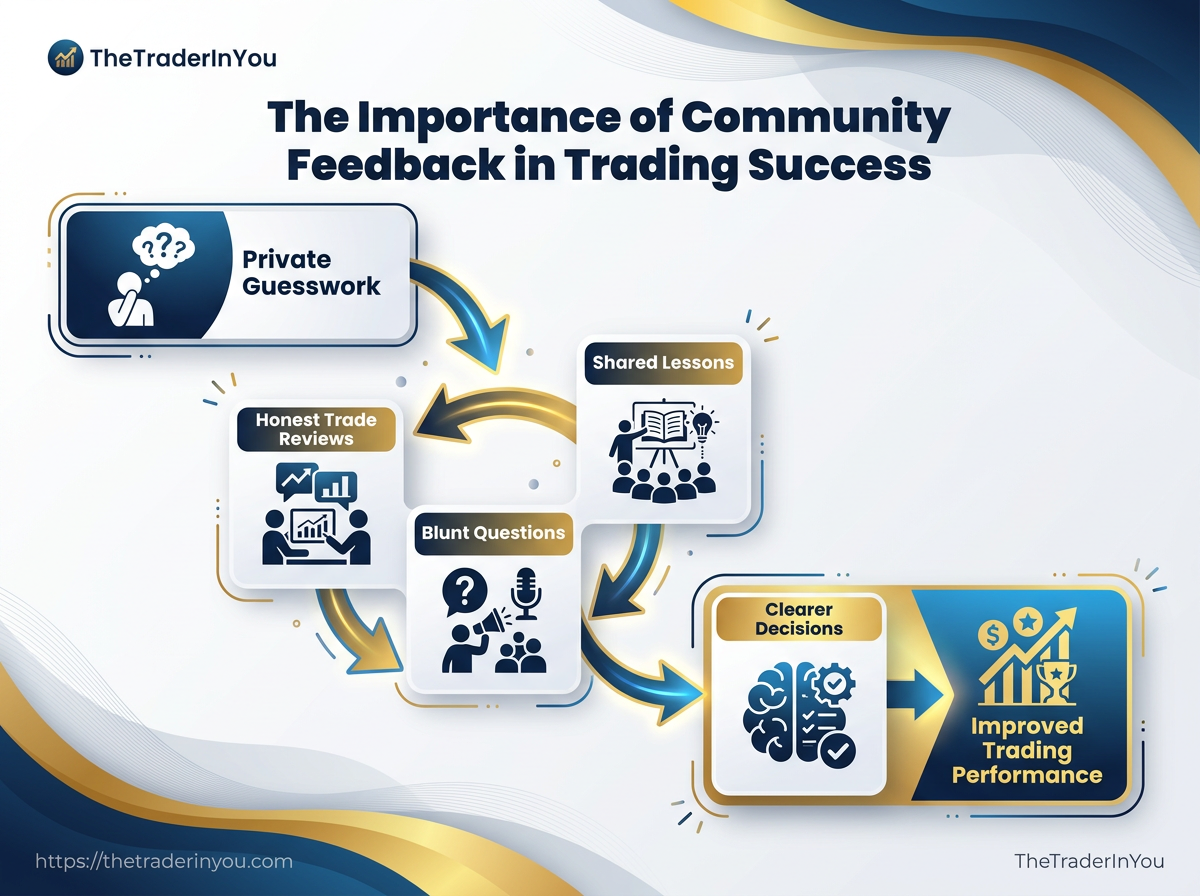
The role of trading communities in reducing information risk
Why do two traders using the same broker tell such different stories about execution?
One gets smooth fills, another gets slipped at the worst possible moment. The gap usually sits in details nobody notices until money is on the line.
A good trading community reduces that uncertainty fast.
It surfaces broker behavior, platform glitches, and execution gaps that look fine in marketing copy but show up in live conditions.
Strong communities also make it easier to spot real community support versus polished noise.
That kind of layout makes trader feedback easier to evaluate. The most useful groups behave more like a living support system than a marketing funnel.
TradeZella makes a similar point from another angle: journaling as a structured habit records trade data, context, and psychology in one place, helping you separate repeatable patterns from gut feel.
What trusted community support looks like versus promotional noise
| Signal type | What it looks like | Trust level | Best use case |
|---|---|---|---|
| Verified trader reviews | Clear broker name, instrument, date, and follow-up after the trade | High | Checking whether an issue repeats |
| Detailed execution reports | Mentions spread, slippage, platform version, and market session | High | Comparing brokers during volatile hours |
| Broker-sponsored testimonials | Polished wins, no negatives, no order details | Low | Brand awareness only |
| Anonymous forum complaints | Emotional language, little context, no evidence | Low to Medium | Spotting possible weak spots |
| Community moderation and fact-checking | Mods ask for logs, timestamps, and duplicate confirmation | High | Filtering signal from noise |
| Repeated slippage reports | Several users flag the same symbol or session | High | Testing execution risk |
| Platform crash or API threads | Build numbers, region, and workaround steps appear in the post | High | Assessing stability and integration risk |
| Hype-driven praise with referral links | Vague profits, urgency, and affiliate codes | Low | Avoiding promotional chatter |
| Threads with trade IDs and screenshots | Order history, timestamps, and broker responses are visible | High | Verifying claims before acting |
| Event-day discussion threads | Traders compare fills around CPI, Fed, or earnings releases | Medium to High | Understanding event-risk behavior |
That is where information risk drops.
The best trader feedback is specific, repeatable, and a little boring—in the best possible way.
Using trader feedback to evaluate brokers and platforms
What people complain about says a lot, but not everything.
A trader ranting about “bad fills” might be describing a real platform problem, or just a fast market on a thin pair.
The useful feedback is the kind you can test.
That matters because trading journals give you your own baseline.
A clean way to read trader feedback is to sort it by category, not emotion.
- Spreads: Look for comments that name the market, session, and account type. “Wide spreads during the London open on EUR/USD” is useful; “broker is expensive” is noise.
- Fills and slippage: Repeated reports around news events, market opens, or volatile assets deserve attention. One bad fill can happen anywhere, but a pattern across many traders usually points to execution quality.
- Withdrawals: This is where consistency matters most. Delays tied to verification are normal; repeated complaints about unexplained holds or support silence are much harder to ignore.
- Isolated edge cases: A single angry post after a rule breach, bonus dispute, or user mistake should not move your decision much. Clustered complaints over time carry far more weight.
A good trading community also helps you spot the difference between product issues and personal habits.
The best read is never one loud review. It is a pattern, checked against your own records, with community support acting like a reality check instead of a rumor mill.
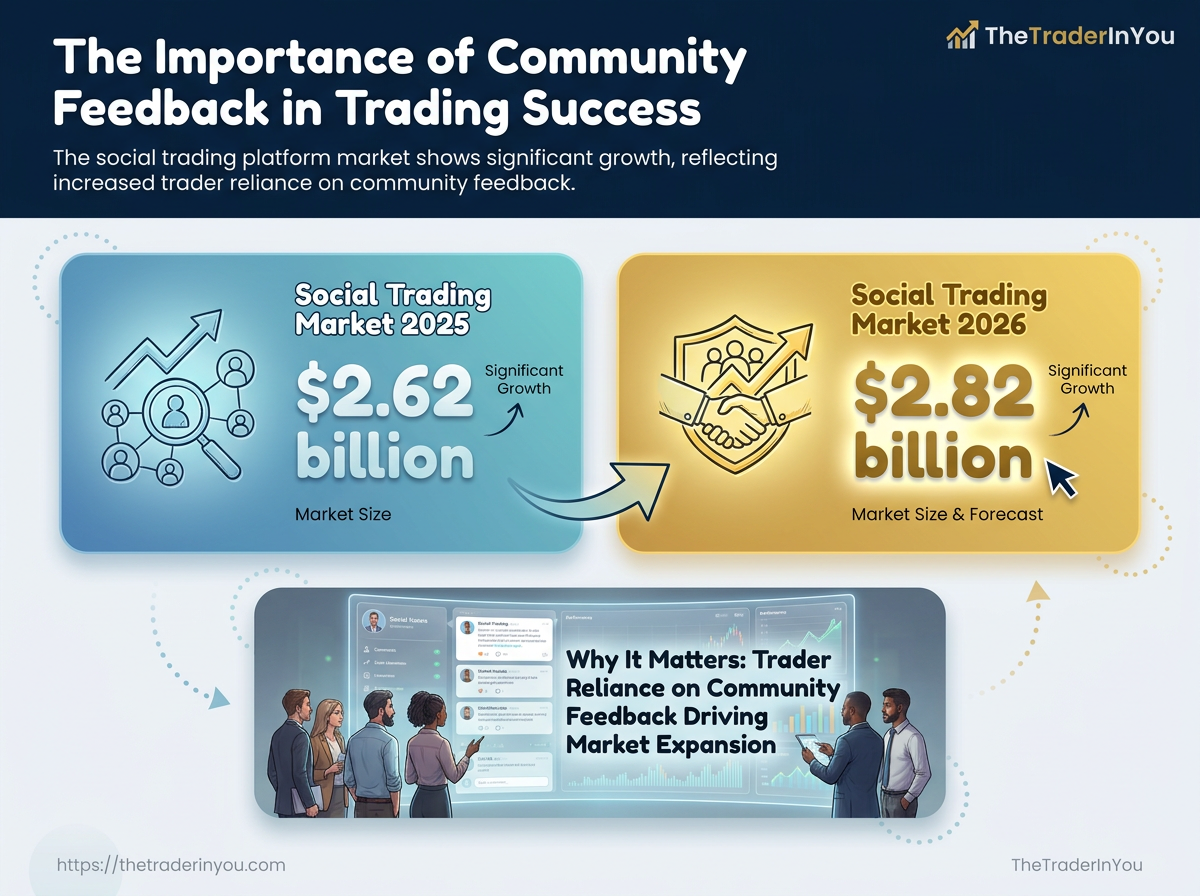
A trading community can sharpen judgment—but only when you convert trader feedback into a specific, testable rule.
Instead of filtering comments and then “hoping” they help, capture each useful claim as a decision card with three parts:
1) Condition (when): the market context the commenter claims is responsible (e.g., session + volatility regime + news window). 2) Action (what): the exact change you would make (entry timing, order type, size rule, stop/exit behavior). 3) Proof (how you’ll verify): the evidence you’ll check in your journal (what metric proves the change worked—spreads at entry, slippage distribution, rejection rate, withdrawal timing, etc.).
Then run a simple rule-test workflow:
- Tag the comment to your journal categories (broker/platform, instrument, session, and strategy module).
- Pre-commit the check (what metric must improve, and by how much) before you alter your behavior.
- Limit the scope (test one variable at a time—e.g., only order type during a specific news window—so you know what caused the result).
Sometimes ignoring community chatter is correct—but the decision should be driven by your decision-card evidence, not the loudness of the thread.
If your plan already produces the outcomes your decision card is trying to achieve (and your journal shows it in similar conditions), the community’s role is informational—not directive.
Used this way, trader feedback becomes a structured input that upgrades your process rather than competing with it.
The risks of relying on community feedback without discipline
A crowded trading thread can feel like a safety net.
It is often the opposite.
When sentiment is loud, traders start borrowing conviction instead of building it.
That is dangerous because group confidence can make a weak idea feel “obvious,” even when the market has already moved on.
Psychology matters far more than most people admit; under pressure, stress can distort decisions and shrink patience (see the Scott Coop research summary on psychology and forex success).
Popular opinion also ages badly.
In fast markets, a setup that worked this morning can be stale by lunch, and a forum full of confident voices will not tell you that.
The fix is not to ignore trader feedback. It is to treat it like input, not instruction.
A good trading community can surface patterns, but it can also create herd behavior when nobody checks the clock, the timeframe, or the market regime.
That is why disciplined traders compare community support with their own rules, not with the loudest post on the page.
Trade journals matter here because they turn opinions into evidence, and evidence beats confidence every time.
- Check the timestamp: A trade idea from yesterday may already be obsolete today.
- Check the market context: Ask whether the setup fits your timeframe, not theirs.
- Check the sample size: Ten excited comments do not make a valid edge.
- Check your own record: If your journal disagrees with the crowd, respect the journal.
- Copy less, verify more: Community support works best when it sharpens judgment instead of replacing it.
Used well, trader feedback is a filter. Used badly, it becomes noise with good branding.
A feedback loop only improves results if it’s treated like a system—one with metrics, ownership, and a failure-prevention routine.
Start by separating two streams:
- Community themes (what others keep reporting)
- Your performance metrics (what your trades actually show)
Create a lightweight “loop log” next to your journal, and track themes using categories like: execution quality (fills/slippage/requotes), platform reliability (freezes/API issues), and constraint failures (withdrawal delays, margin surprises).
Then define the metrics you’ll review for each theme:
- Execution: average/median slippage by session, and the frequency of outlier fills
- Broker/platform: rejection rates, platform lag during peak hours, crash frequency by version/region
- Strategy impact: win-rate alone is not enough—monitor expectancy and whether the change affects behavior (e.g., adherence to sizing rules)
Add a review cadence that controls drift:
- Weekly: confirm whether themes correlate with your actual trade data (do not change multiple variables at once)
- Monthly: confirm whether the broker/platform patterns persist (avoid overreacting to short bursts)
Use a post-trade “theme check” to prevent confirmation bias:
- If your journal contradicts the community theme, record it anyway and label it “disconfirmed in my conditions.”
- Only promote a community-driven rule when it survives retesting under the same relevant conditions.
Finally, keep the loop honest by setting a stop rule: if a change doesn’t improve the pre-committed metric across the test window, revert it.
That’s how trader feedback becomes a compounding advantage: not through more opinions, but through disciplined measurement, controlled experiments, and repeatable decision governance.
Why do so many traders pay for guidance and still feel lost after a few weeks?
Most traders get advice without the trader feedback that reveals what breaks their setup under real conditions. Community input adds shared context—session timing, news pressure, liquidity traps, and execution details—that solo chart study often misses. When stress rises, judgment narrows and small errors compound, so feedback helps you catch those blind spots sooner and adjust your entry, sizing, and exits.
What is a trading journal?
A trading journal is a record of your trade data, context, and psychology so you can measure what actually happened versus what you expected. It creates your own baseline for entry, position size, and exit performance, making it easier to spot patterns and repeat mistakes. Used alongside trader feedback, a journal turns community comments into testable evidence rather than opinions.
Why are these the best communities for active traders?
The best communities for active traders provide continuous, structured feedback instead of generic encouragement. They improve decisions through honest trade reviews, blunt questions, and shared lessons that expose blind spots like broker behavior, platform glitches, and execution gaps. With filtering for source quality and specific market conditions, active traders can convert community input into clearer rules faster and reduce information risk.
Community feedback becomes trading advantage only when you govern it—extract context, assess signal quality, and validate against your own execution record.
To apply it quickly:
- Treat community posts as hypotheses to test in your conditions (not instructions).
- Prioritize traceable execution details over affiliate praise or emotional complaints.
- Test one change at a time with a journal-based metric, and only adopt what survives re-checking.
This week, pick one broker/platform metric you care about (for example, your slippage distribution during your usual session window) and test one adjustment using the decision rules above. When you do that consistently, community feedback stops being noise—and becomes an advantage you control.

Follow Joshua for daily forex tips on X: @thetraderinyou or connect with him on LinkedIn: Joshua Okapes.