
The hardest part of trading psychology usually shows up after the chart is closed.
A bad loss can make a solid setup look dangerous, while a string of wins can make reckless size feel smart.
That swing is why a trader mindset matters so much.
Trading also gets lonely fast.
Without community support, fear and overconfidence can both grow in silence, and both can push traders into the same costly habits.
A good trading community does more than cheer people on.
It gives traders a mirror, a reality check, and someone who notices when rules start bending under pressure.
That kind of feedback can calm the noise, sharpen judgment, and make disciplined decisions feel less like a solo fight.
Quick Answer: Trading psychology is a performance loop: signal → decision → execution → review. When live pressure hits, that loop breaks—usually because you stop using the same invalidation/risk rules you rely on in calm moments. A strong community doesn’t just motivate; it makes the loop recoverable by adding structured feedback (before you justify a bad entry), accountability (to prevent silent rule drift), and routine review (so emotional patterns show up in your journaling, not in hindsight).
Why Trading Psychology Matters More Than Most Traders Admit
Trading psychology shows up most clearly when the setup is already right.
A clean entry model can still fail if fear cuts a trade short, greed widens a stop, or revenge trading turns one loss into a cluster of mistakes.
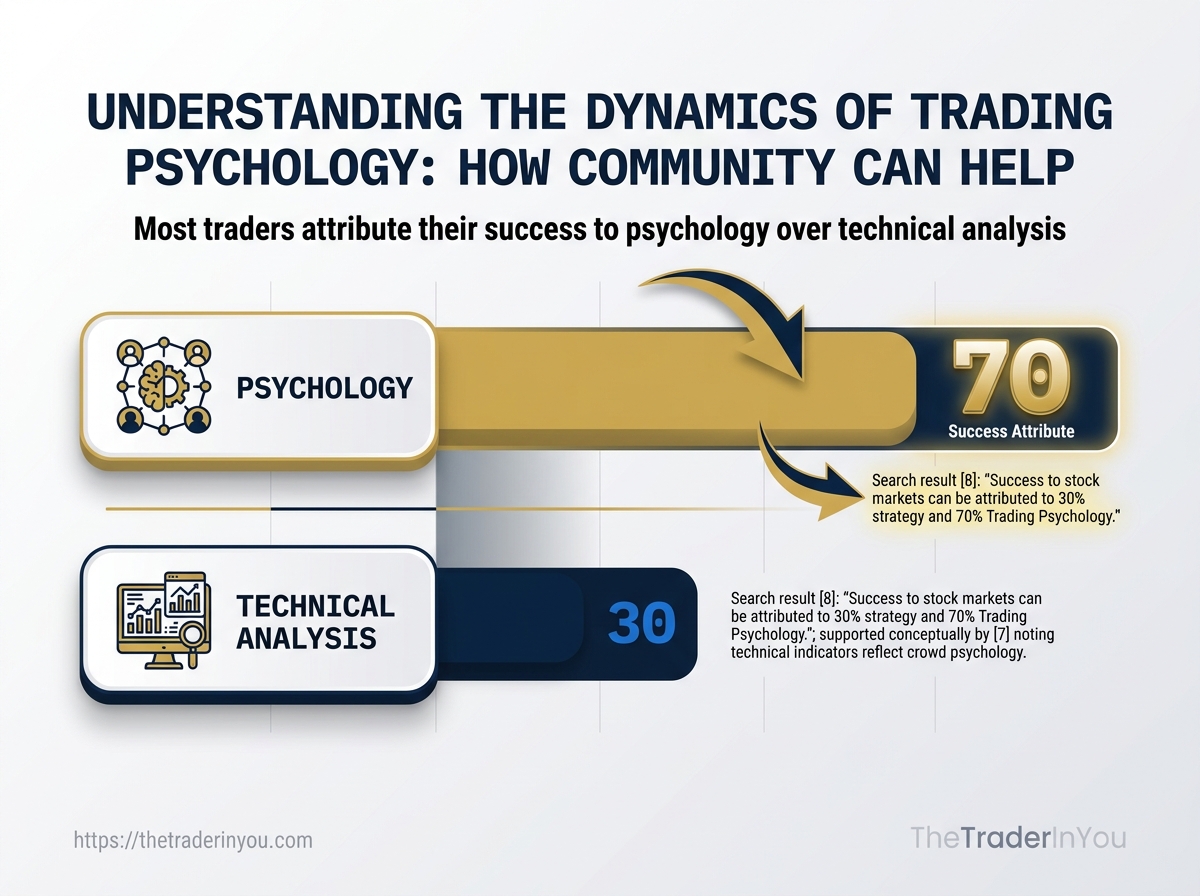
A 2025 study highlighted in our ultimate resource on the psychology of trading for forex success found that 70% of traders credit psychological factors more than technical analysis for success.
Mindset shows up in every part of the trade.
It affects when you enter, how much risk you take, where you exit, and whether you stay consistent after a rough stretch.
Coin Bureau’s 2026 crypto trading psychology guide points to simple rules that keep emotion in check: define risk before entry, place the stop immediately, never move it wider, and take a mandatory cool-off after a loss.
- Entries get distorted: Fear makes traders wait for “perfect” confirmation, then chase late moves.
- Exits get warped: Hope keeps losing trades open long after the setup is gone.
- Risk gets inflated: Overconfidence turns a normal trade into a dangerous one.
- Consistency breaks: One emotional day can undo a week of good decisions.
Journaling shows the same pattern in real life.
A 2026 day trading journal guide found that 73% of day traders quit journaling within three weeks, which says a lot about how hard it is to build a feedback loop that survives pressure.
That is why trading psychology matters more than most traders admit.
Technical skill helps you spot opportunity, but a steady trader mindset decides whether you keep it, ruin it, or repeat it well enough to matter.
The Core Drivers of Trader Behavior
The chart is only half the story.
Trading behavior is shaped by how you respond to threat, reward hunger, uncertainty, and the habits you bring into the session—so two traders can see the same setup and execute it completely differently.
Research on personality and financial trading links personality traits to trading styles, which helps explain why two traders can face the same market and act in completely different ways Bridging personality and behavior in financial trading.
That also explains why outside influence matters.
Our own piece on The Impact of Family and Friends on Trading shows how traders often seek advice from their circle, and that social pressure can quietly shape risk choices.
The trader mindset is never built in a vacuum.
Our psychology resource for forex success turns this into something usable with a live bias checklist, a two-minute calm-down, and a quick check on whether the setup still holds over the next 8 candles.
That kind of structure matters because uncertainty is where emotion gets loud.
The main traps and what they do
| Psychological Trap | Typical Trading Behavior | Market Impact | Practical Correction |
|---|---|---|---|
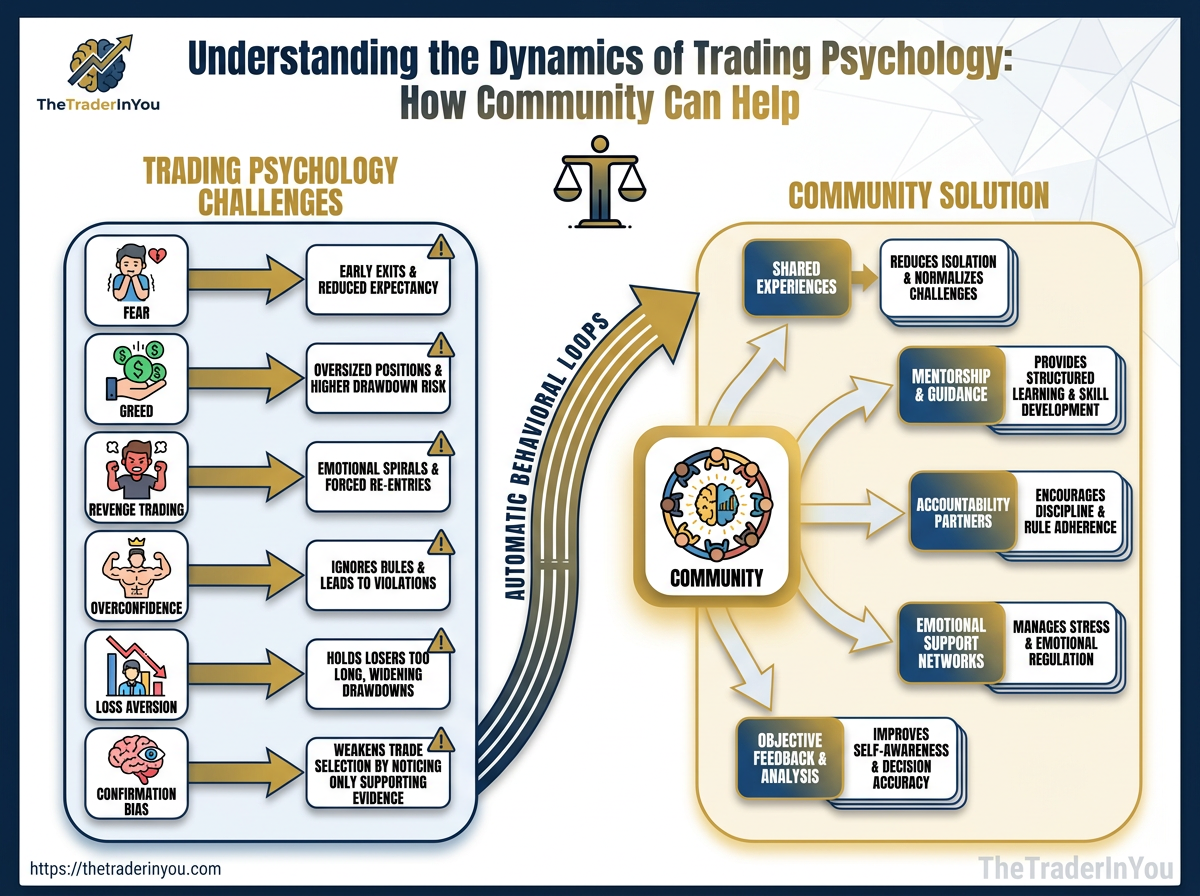
| Fear | Early exits and missed setups | Reduced expectancy | Predefined trade plan and position sizing |
| Greed | Oversized positions and late entries | Higher drawdown risk | Fixed risk limits |
| Revenge trading | Forced re-entry after losses | Emotional spiral | Mandatory cooldown period |
| Overconfidence | Ignoring signals and rules | Rule violations | Trade journal review |
| Loss aversion | Holding losers too long | Widening drawdowns | Hard stop-loss discipline |
| Confirmation bias | Only noticing supporting evidence | Weak trade selection | Opposing-evidence check before entry |
| Recency bias | Chasing the last move | Poor timing and bad entries | Higher-timeframe review |
| FOMO | Entering after the move is extended | Poor reward-to-risk | Missed-trade log and patience rule |
| Ambiguity intolerance | Acting before the setup is clear | Low-quality execution | Wait for invalidation or confirmation |
The pattern is simple once you see it:
Fear cuts trades short, greed stretches risk, revenge trading breaks the day, and overconfidence turns rules into suggestions.
The cleaner the relationship with uncertainty, the cleaner the execution—and that is where a trader starts looking a lot more consistent.
How Community Support Shapes Better Trading Habits
Improvement in a group isn’t magic—it’s mechanics.
A healthy trading community adds pressure in the right places, nudging you toward cleaner decisions rather than louder opinions.
That matters more than it sounds.
Trading behavior is tied to personality traits and style, according to the journal article on personality and trading styles, so peer input works best when it challenges process instead of feeding ego.
Even in The Trading Psychology and Mindset Podcast, the recurring theme is simple: habits stick when traders hear them, test them, and repeat them in a real group.
Healthy community support is not social noise with charts attached.
It is a place where traders compare notes, spot blind spots, and stay honest about risk.
In our own habits-of-mind framework, engagement grows when traders actively connect with other traders’ ideas and responses, not when they sit in a silo.
A strong group usually gives three things that solo trading often lacks:
- Accountability: Someone notices when a plan changes after the fact, or when a stop gets moved for no good reason.
- Feedback: A second set of eyes can catch weak structure, poor timing, or missing invalidation before money is on the line.
- Perspective: One bad trade stops feeling like a personal crisis when experienced traders put it in context.
- Routine pressure: Regular check-ins make journal work and pre-trade review harder to skip.
- Emotional containment: Support helps traders stay steadier after losses, which is exactly where many habits fall apart.
That said, community can turn noisy fast.
A chat room full of confident calls can nudge traders into herd behavior—especially when everyone wants to be early and nobody wants to be wrong.
Rules-based spaces help here: they make risk limits and “what happens after a loss” part of the environment, not a private promise.
The best communities make traders more independent, not more dependent.
Good feedback sharpens judgment, while bad noise just adds fuel to the wrong trade.
Building a Stronger Trader Mindset Through Practical Systems
Many traders understand the setup, yet still freeze at the moment of execution.
Often it isn’t a chart problem.
It’s a system problem—pressure breaks plans that aren’t supported by repeatable routines.
A practical trading mindset is built the same way any performance habit is built: you give your brain a predictable sequence before, during, and after the trade. Then you make review fast enough to survive a bad session.
Before the first trade
A good routine starts before the screen gets loud.Keep it short. Ten minutes is enough if it’s consistent.
- Set a calm-down cue: use the same breath, walk, or stretch every session.
- Define your risk limit first: write the max daily loss before scanning charts.
- Check the invalidation point: know exactly what would make the setup wrong.
- Name the emotional state: tired, rushed, flat, or confident. Labels reduce denial.
During the session
Pressure gets smaller when the process is simple.Treat execution like a checklist, not a negotiation.
- Start with conditions, not feelings: decide in advance what qualifies the entry.
- Use a fixed damage-control rule: if the trade environment is turning chaotic, stop trading rather than “hoping.”
- Do a micro-reset between attempts: if you feel rushed, pause, re-read the invalidation level, and only then decide whether the setup still qualifies.
After the close
Review three things: the setup, the emotional state, and the exact rule that slipped.- Tag the trigger: fear, boredom, revenge, overconfidence.
- Mark the rule break: entry quality, exit quality, sizing, stop behavior.
- Write one correction: one change for tomorrow (not five changes for next week).
- Track repeats: if the same mistake shows up twice, it’s not “bad luck”—it’s a system flaw.
That’s how a personal ruleset becomes real: it doesn’t just sound smart. It protects decisions on the days your emotions want to take over.
Choosing Community Support That Actually Improves Trading Performance
Community quality is measurable.
The best trading rooms create friction around weak process and clarity around invalidation—so your trading psychology gets sharper, not louder.
Credible community support makes your trading psychology clearer, not louder.
It gives you feedback, structure, and enough friction to question weak ideas before they become expensive trades.
A promotional group does the opposite.
It sells confidence, flashes big wins, and keeps attention on the room owner instead of the process.
Research on trading behavior has long linked performance with personality and decision style, which is one reason the right room matters so much for the trader mindset (Bridging personality and behavior in financial trading).
The strongest groups tend to look a little boring, honestly.
They talk about rules, trade quality, and invalidation levels.
They also leave room for disagreement, which is where good learning usually starts.
- They critique process, not hype. Good communities ask why a setup works, where it fails, and what evidence would prove it wrong.
- They show their work. Real traders explain entries, exits, risk, and mistakes. Empty rooms mostly post screenshots and victory laps.
- They welcome pushback. A healthy group does not punish someone for asking, “What would invalidate this idea?” That question saves accounts.
- They separate education from sales. If every conversation ends in a pitch, you are not in a learning space.
Before joining a forum, room, or mentorship group, ask a few plain questions.
- How are losing trades reviewed? If losses are ignored, the room is cosmetic.
- Do members discuss risk before entry? That is a stronger signal than profit screenshots.
- Who corrects bad advice? Credible groups have visible standards, not just popular voices.
- Is there evidence of real teaching? The Trader In You has pointed to education ecosystems where seasoned traders critique live setups and filter noise from signal, which is the right direction for community support (forex trading educational resources reviewed).
- Can you leave without pressure? If silence or exit feels awkward, the group may be built for retention, not learning.
The final test is simple.
Use community to sharpen judgment, not replace it.
The best rooms improve your questions first, and your trades follow from there.
That is the kind of support worth keeping close.
It respects your brain, your capital, and your future P/L.
What Is Trading Psychology, and Why Does It Affect Your Returns?
Trading psychology is the emotional and cognitive process that shapes how you execute and recover across trades. It affects returns because even a clean entry plan can fail when bias or emotion pushes you to violate your intended risk, timing, or decision rules. Communities and systems help by making those deviations easier to spot, correct, and prevent.
Where Trading Psychology Turns Into Better Decisions
The part most traders miss is simple: charts don’t beat emotions—habits do.
Trading psychology matters because your setup only becomes performance if you can follow through without breaking your risk limits or your process when conditions feel stressful.
Nothing magical changes in the market; the change is in behavior—especially after a streak, a drawdown, or a “nearly right” trade.
Community support helps because outside feedback can spot blind spots faster than pride can.
The strongest traders are not the ones who never feel pressure.
They are the ones who build systems that keep pressure from turning into impulsive decisions.
If you want a practical next move, review one recent trade tonight. Write down the emotional trigger behind it, and set one rule to protect against that same mistake tomorrow.
If you want structure around that process, our courses and community can give you a solid place to sharpen it.

Follow Joshua for daily forex tips on X: @thetraderinyou or connect with him on LinkedIn: Joshua Okapes.