
A clean chart can still tell a messy story.
That is usually where traders get stuck: price looks active, but the next move feels uncertain, and every candle seems to argue with the last one.
Technical indicators help turn that noise into something readable.
They do not predict the market with magic, but they can show momentum, volatility, and timing in a way raw price alone often misses.
That matters most in Forex, where small moves, fast reactions, and overlapping sessions can make good judgment hard to hold onto.
A tool like RSI can reveal when momentum is stretched, while Bollinger Bands can show when price is moving with unusual force or resting inside a tighter range.
The real edge comes from knowing how to use indicators without letting them fight each other.
A trend cue and a timing cue can work well together when they are tied to the same pair, the same timeframe, and clear rules instead of gut feeling.
That is why Forex trading tools matter just as much as the indicators themselves.
A charting platform, a scripting language, or a testing setup gives those rules structure, so a trading idea becomes something you can actually judge instead of just hope for.
Why Technical Indicators Matter in Forex Trading
Why do some traders pile on five indicators and still miss the move? Because technical indicators Forex traders rely on are not crystal balls.
They are measurement tools, and they work best when they describe price behavior instead of pretending to predict it.
An RSI reading between 0 and 100 can show momentum pressure, and Bollinger Bands can show volatility and relative position inside the range.
But neither one tells you the future with certainty.
A 14-period RSI can warn that buyers are getting tired, while a 20-period Bollinger setup with 2 standard deviations can show that price is stretching away from its mean.
That distinction matters in real trading. Professional traders use indicators for confirmation, not prophecy. They want proof that price action, trend, momentum, and volatility are telling the same story before they commit.
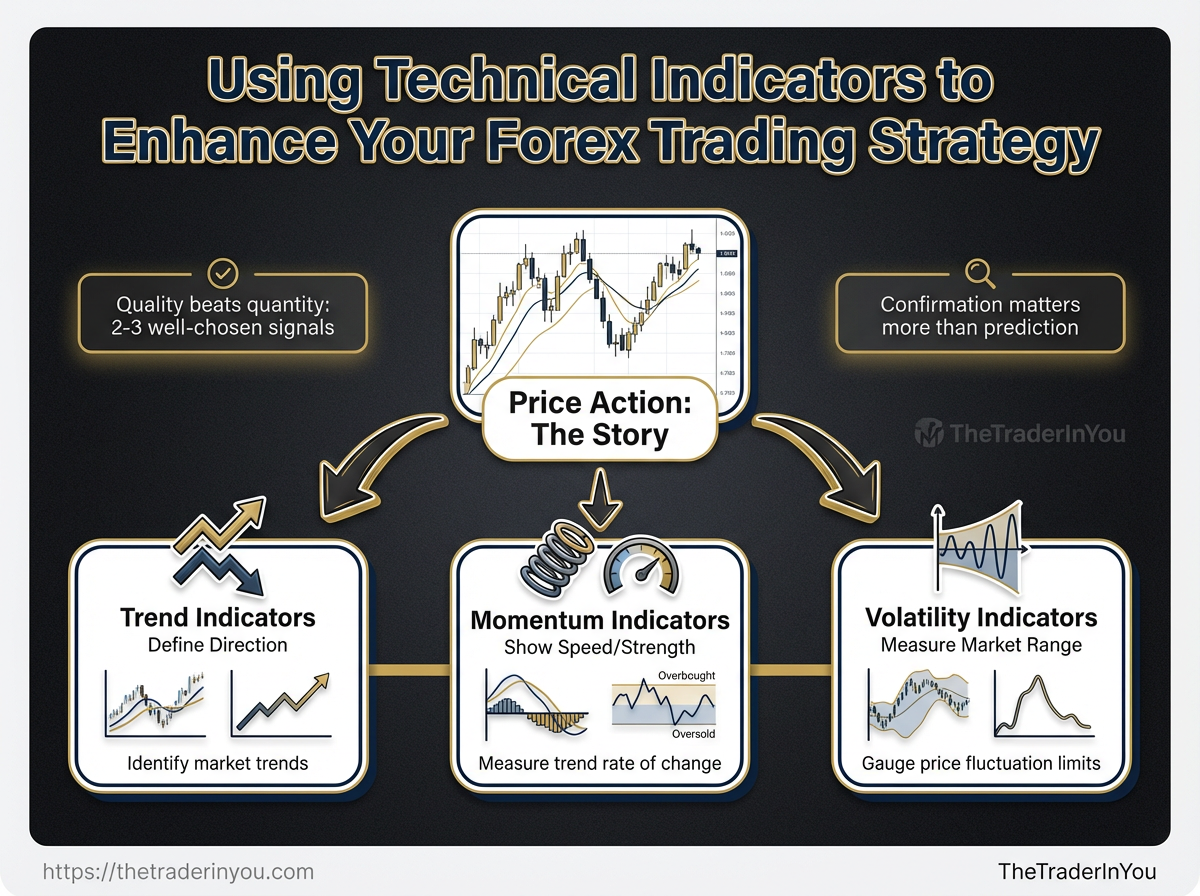
The concept map makes that relationship easier to see.
Price action sits at the center, while trend, momentum, and volatility indicators feed into the decision, not the other way around.
What indicators can tell you: direction, strength, volatility, and whether price is stretched or calm.
What they cannot tell you: exactly when a candle will reverse, how far a move will run, or whether news will break the setup.
How pros read them: one trend cue, one timing cue, and a clear rule set.
Why fewer signals often work better: three indicators saying the same thing can still be one idea in disguise.
This is where signal quality beats indicator quantity.
A clean setup on TradingView or MetaTrader 5 can be built from just one trend filter and one timing filter, especially when the rules are tested in Pine Script v5 or MQL5.
A crowded chart often feels smarter than a simple one.
In practice, it usually just slows you down.
When the indicators agree with price action, the trade has structure.
When they disagree, the market is usually telling you to wait a little longer.
Core Technical Indicators Every Forex Trader Should Know
Do you really need ten indicators glowing on the screen? Usually not.
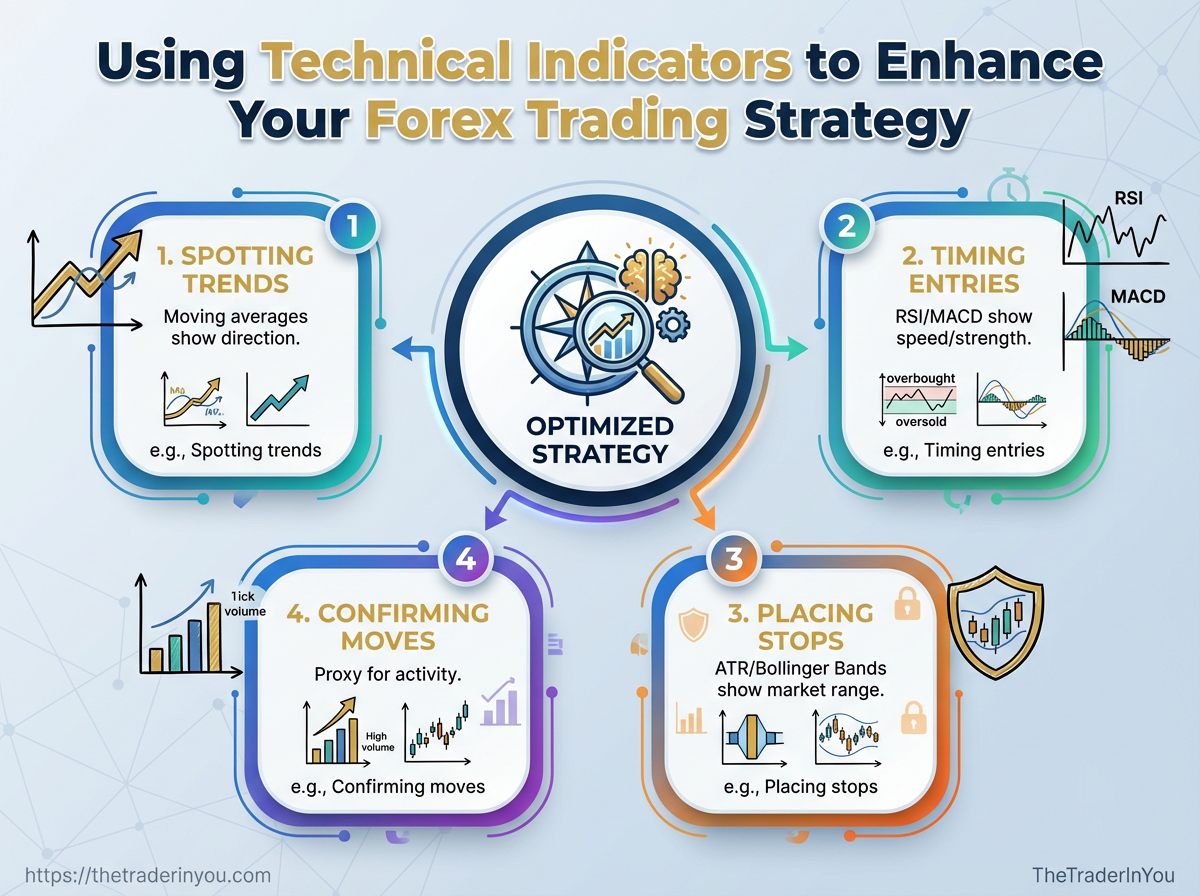
Most forex setups come back to four families: trend, momentum, volatility, and volume.
Moving averages help with direction.
RSI and MACD help with timing.
ATR and Bollinger Bands tell you whether the market is quiet or explosive, while tick volume gives a rough read on participation.
The cleanest way to use indicators is to make each one do one job.
One tool should tell you the market’s direction, another should tell you whether momentum is still alive, and a third should tell you if the move has enough room to breathe.
How the main indicator families compare
| Indicator Category | What It Measures | Best Use Case | Common Mistake | Best Market Condition | |—|—|—|—|—| | Trend | Direction of price over time, usually through moving averages | Spotting whether a pair is generally rising, falling, or stuck | Treating a moving average crossover as an instant entry without context | Persistent directional moves | | Momentum | Speed and strength of price movement, often with RSI or MACD | Confirming whether a move still has energy left | Buying because RSI is low without checking the broader trend | Breakouts, reversals, and trend continuation | | Volatility | How far price is moving around its average, often with ATR or Bollinger Bands | Setting stops, targets, and expectations for range expansion | Using tight stops in a volatile pair and getting clipped out | Expanding ranges or post-news swings | | Volume / Tick Volume | Activity behind the move, often estimated in forex with tick count | Checking whether a breakout has real participation | Assuming more ticks always means stronger direction | Breakout attempts and session opens |
A moving average is the simplest trend filter because it smooths noise.
A 50-period line may not predict anything, but it does show whether price is spending more time above or below a middle line.
RSI deserves a spot on almost every forex chart.
Wilder’s original version uses a 14-period lookback and reads from 0 to 100, which makes it easy to compare momentum across pairs and timeframes.
Bollinger Bands and ATR do a different job.
Bollinger Bands use a moving average with upper and lower bands, often set at 20 periods and 2 standard deviations, while ATR focuses on how much price is moving rather than where it sits.
Tick volume is the quiet one people ignore.
In spot forex, it is not exchange volume, but it still helps show when a breakout has energy versus when it is fading fast.
Once these indicator families are clear, the chart stops feeling noisy.
That makes it much easier to build a rule set that fits one pair, one timeframe, and one job.
How to Use Indicators Together Without Creating Conflicting Signals
A chart can look bullish and overbought at the same time.
That is not a bug; it is usually a clue that the tools are answering different questions.
That is where most technical indicators Forex traders use go wrong.
They stack two momentum tools, or three volatility tools, and end up with four opinions about one candle.
The cleaner way is simple: pick one trend filter, one momentum tool, and one risk measure.
On a practical level, that might mean a moving average for direction, RSI for timing, and Bollinger Bands for context.
RSI still matters because it stays bound between 0 and 100, and the classic Bollinger setup still uses a 20-period moving average with bands at 2 standard deviations.
Trend filter: Decide whether the market is generally rising, falling, or flat.
Momentum tool: Check whether price is stretched, fading, or building pressure.
Risk measure: Judge whether current volatility makes the trade worth taking.
The mistake is using indicators that overlap too much.
Two momentum tools often say the same thing in different clothes.
One trend filter plus one timing tool usually gives cleaner reads.
A simple confirmation process keeps the noise down:
Check the trend first. Trade only in the direction your filter supports.
Wait for momentum to agree. Use RSI, or a similar oscillator, to see whether the move has room.
Confirm the trade against volatility. Bollinger Bands can tell you whether price is unusually extended or still normal for that pair.
That sequence matters because it turns indicators into a decision chain, not a crowd.
When indicators disagree, do not force a trade.
If trend says up but RSI is rolling over, you may be seeing a pause rather than a reversal.
On platforms like TradingView or MetaTrader, keeping the pair and timeframe aligned across all indicators helps avoid those false clashes, and it makes backtesting far less messy.
If the signals still fight each other, stand down, shrink size, or wait for the next candle to settle.
Clean alignment beats confident confusion every time, and disciplined use of Forex trading tools makes that much easier to spot.
Practical Forex Indicator Setups for Real Market Conditions
Ever notice how the same indicator looks brilliant one day and useless the next? That is usually a market-condition problem, not an indicator problem.
A trend day wants different tools than a sleepy range.
And a breakout session, especially around London or New York opens, demands stricter confirmation than either of those.
For strong directional moves, keep the setup plain.
Use a sloping moving average for context, then let RSI hold above 50 in an uptrend or below 50 in a downtrend while price stays on the correct side of the middle band.
On a pair like EUR/USD, that often means buying pullbacks during a clean climb instead of chasing the first spike.
Indicator setups by market condition
| Market Condition | Primary Indicators | Entry Confirmation | Risk Control | Typical Error | |—|—|—|—|—| | Trending Market | Moving average slope, RSI, Bollinger middle band | Price pulls back to the moving average, RSI holds trend bias, candle closes back with the trend | Stop behind the latest swing or beyond the moving average cluster | Buying too late after an extended run | | Ranging Market | Bollinger Bands, RSI, recent support and resistance | RSI reaches an extreme near the band edge, then price shows rejection back into the range | Stop just outside the range boundary | Fading every touch without waiting for rejection | | Breakout Market | Bollinger Band squeeze, session range, RSI expansion | Candle closes outside the range, band starts expanding, RSI confirms fresh momentum | Stop inside the broken range or behind the breakout candle | Entering before the close and getting trapped |
In a sideways market, the job changes completely.
You are no longer hunting continuation.
You are waiting for price to stretch to an edge, stall, and snap back toward the middle.
That is where ranges reward patience and punish impatience.
A clean example is a pair trapped between Asia session highs and lows, with Bollinger Bands flattening and RSI bouncing between midline extremes.
The best trades usually come from the edges, not the center, because the middle of a range is where risk gets messy.
Breakouts need a different lens again.
A tight band, compressed candles, and a sudden close beyond the prior range often matter more than a perfect oscillator reading.
If the move happens on the first clean expansion after compression, the odds improve; if the candle only pokes through and falls back, that is usually noise.
On platforms like TradingView or MT5, the real advantage is consistency.
Build the same rule set on the same timeframe you trade, then test it across a few sessions before trusting it with live risk.
These setups are not magic.
They work because they match the indicator to the market mood, which is exactly where technical indicators Forex traders use them best.
Risk Management and Trade Planning with Indicators
Why do so many solid setups still lose money? Usually, the trade was fine, but the stop and target were guessed instead of planned.
That is where indicators earn their keep.
In technical indicators Forex traders use for planning, the real edge comes from tying risk to current volatility and recent price structure, not from chasing every blinking signal.
A clean workflow is simple.
Use a volatility tool like ATR to size the stop, use the chart’s recent swing points to avoid placing it in obvious noise, and set the profit target from the same market context.
In TradingView or MetaTrader 5, that kind of rule-based planning is easy to test because the indicator stays on the same pair and timeframe as the trade.
Stops that respect the market
ATR is useful because it tells you how much the pair is moving right now.
If the market is quiet, a tight stop can work.
If the market is jumpy, the same stop gets clipped for no good reason.
A better habit is to place the stop beyond a recent structure point and give it room for normal movement.
A long trade might sit below the last swing low, with extra space based on ATR, while a short trade does the opposite.
Use recent structure first: Swing highs and lows matter more than a random fixed number.
Add ATR as a buffer: Volatile sessions need more breathing room than calm ones.
Avoid obvious round numbers: Stops sitting right on the obvious level often get tested first.
Keep the stop tied to the setup: If the level invalidates the idea, the trade is wrong.
Targets that fit the context
Profit targets work best when they reflect how far price usually travels before stalling.
A pair grinding through a narrow range does not owe you a massive breakout target.
For that reason, the target should match the day’s volatility and the nearby chart structure.
A logical target might be the next resistance area, a measured move from the current range, or a multiple of the ATR if price is moving cleanly.
Match target to volatility: Quiet markets usually reward smaller ambitions.
Use nearby structure: Previous highs, lows, and range edges are natural exit zones.
Scale out when needed: Taking partial profit can reduce pressure on the full position.
Avoid fantasy targets: A target that ignores the chart usually becomes wishful thinking.
Keeping signals from turning into overtrading
Too many indicator signals can feel like opportunity.
Most of the time, it is just noise dressed up as urgency.
The fix is a rule limit.
Trade only when the setup meets every condition, and cap the number of attempts per pair or session.
That stops the classic mistake of taking five nearly identical trades because the chart keeps “looking good.”
A disciplined plan protects capital and attention.
That is the real job of indicators in trade planning: not more trades, just better ones.
Common Mistakes Traders Make with Technical Indicators
Why do so many charts look “confirmed” and still fail? Usually because the indicator readout is being treated like a trading verdict instead of one clue in a larger process.
That mistake shows up fast with technical indicators Forex traders use every day.
RSI sits between 0 and 100, Bollinger Bands often use a 20-period moving average with 2 standard deviations, and both can look convincing on their own.
None of that means the next candle is obligated to cooperate.
The problem gets worse when traders stack tools without a real rule set.
A chart full of signals can feel smarter, but it often just creates noise, delay, and second-guessing.
Trading an indicator like it is the trade
RSI is a momentum oscillator, not a buy button.
Bollinger Bands describe volatility and price location, not a guaranteed reversal.
That distinction matters because indicators answer different questions.
An RSI reading near the top of its 0–100 range may show strong momentum, while Bollinger Bands may show price pushing outside a normal envelope.
Neither one says, by itself, that entry is safe.
A cleaner habit is to use indicators as confirmation inside a rule set.
On platforms like MT5 or TradingView, that usually means the indicator helps define conditions, while price action still makes the final case.
Cluttering the chart with too many tools
Three indicators can already repeat the same message.
Seven can turn a chart into a confession booth.
This is where a lot of traders lose timing.
They add a momentum tool, a volatility tool, and two trend tools, then discover that all four are reacting to the same move at different speeds.
Redundant signals: Two indicators that track similar behavior rarely add much clarity.
Slower decisions: Extra confirmation often means worse entries.
Mixed rules: One tool says momentum is fading, another says trend is intact, and the trader freezes.
Ignoring timeframe and market context
A setup that looks clean on a 15-minute chart can look messy on a 4-hour chart.
That is normal, not a glitch.
The chart walkthrough below shows why timeframe alignment matters so much.
The same indicator can flip from useful to misleading when the broader trend is moving in the opposite direction.
Broader context matters too.
A momentum dip inside a strong trend is not the same thing as a reversal signal.
Traders who ignore that difference often enter late, exit early, or both.
For traders building rules in Forex trading tools, this is where discipline pays off.
If the higher timeframe disagrees with the lower one, the lower one usually loses.
A cleaner approach beats a crowded chart every time.
The best technical indicators Forex traders use are the ones that fit the timeframe, the market condition, and the rule set without trying to do everyone’s job at once.
Conclusion
Read the Chart, Not the Noise
The most important thing to remember is simple: technical indicators in Forex are not there to predict the future.
They are there to help you read probability with a little more discipline, especially when price action looks messy and tempting.
The traders who improve fastest usually stop asking for the perfect signal and start asking whether their indicators agree with the market context.
That was the real lesson behind combining tools like a moving average, RSI, and ATR.
One shows direction, one shows momentum, and one helps frame risk, which is far more useful than stacking five indicators that all say the same thing in different colors.
Knowing how to use indicators well means using fewer of them with more purpose.
So pick one pair, one timeframe, and one setup today, then test it on a small sample of trades before adding anything else.
If you want a structured place to keep that process organized, tools like thetraderinyou.com can be a practical next step.
Clean charts do not win trades; disciplined decisions do.

Follow Joshua for daily forex tips on X: @thetraderinyou or connect with him on LinkedIn: Joshua Okapes.
- Using Technical Indicators to Enhance Your Forex Trading Strategy - April 6, 2026
- Cultivating Self-Discipline in Forex Trading: Tips for Long-Term Success - April 1, 2026
- Risk Management Techniques Every Forex Trader Should Master - March 24, 2026