
Why does a trade look obvious after the market closes, then feel messy and uncertain while it is still moving? That gap is where many traders stall.
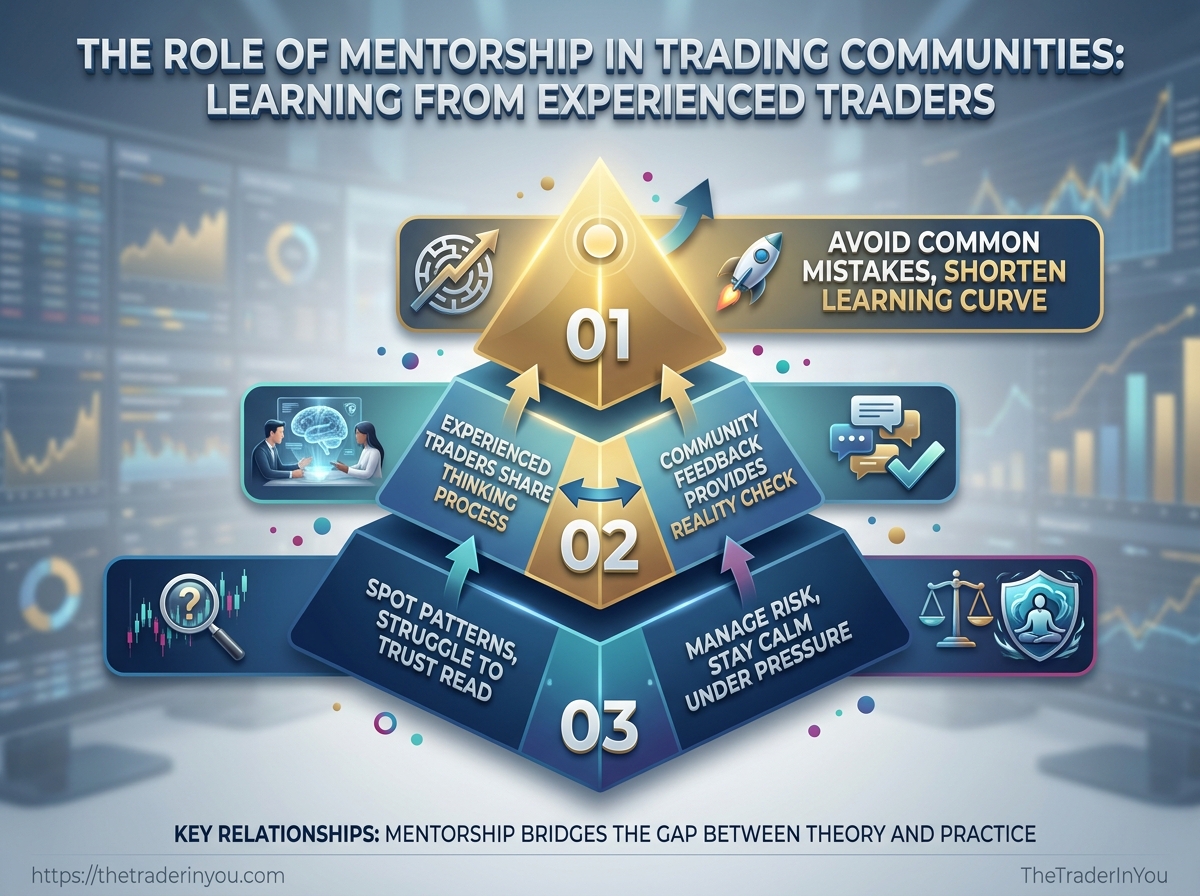
They can spot patterns, but they struggle to trust their read, manage risk, and stay calm when the pressure rises.
That is where trader mentorship changes the picture.
Good guidance is not about handing someone a magic setup.
It is about hearing how experienced traders think through entries, exits, and mistakes, then using that thinking to sharpen your own decisions.
The best trading communities add something even more useful: community support.
A lone trader can spiral after a bad trade or overtrade after a win, but shared feedback creates a reality check.
A quick chart review from someone who has seen the same mistake hundreds of times can save weeks of frustration.
According to Quantified Strategies, mentors can give immediate feedback and help traders avoid common mistakes.
That matters because market skill is rarely built in a straight line.
It usually grows through correction, repetition, and the steady habit of learning from people who have already paid for the lesson.
Quick Answer: Effective trader mentorship in trading communities improves live decision-making by converting discussion into decision rules you can run under pressure. Instead of receiving entries/exits, you learn how experienced traders define the trade thesis, specify where invalidation lives, and translate that into a simple plan → execute → debrief loop—so repeated risk or timing mistakes get corrected before they become habits.
Why Mentorship Matters in Trading Communities
Why do so many traders stare at the same chart and still walk away with different lessons? Because charts only show price, volume, and time.
They do not correct sloppy thinking, spot repeated mistakes, or tell you when your risk is drifting out of bounds.
That gap is where trader mentorship earns its place.
A strong community gives traders something a platform cannot: fast feedback, shared context, and a reality check from people who have already made the expensive mistakes.
Research on trading mentorship keeps pointing to the same pattern, especially around immediate feedback and practical guidance from experienced traders who can spot errors before they become habits (Quantified Strategies on mentorship in trading).
Our own view at The Trader In You is simple: community support should sharpen judgment, not replace it.
The best groups do not hand out signals like candy.
They help traders explain why a setup matters, where the risk sits, and what would prove the trade wrong.
That’s a different job entirely, and it lines up with what group mentorship programs emphasize about practical learning and shared skill-building (Group Trading Mentorship Sessions overview).
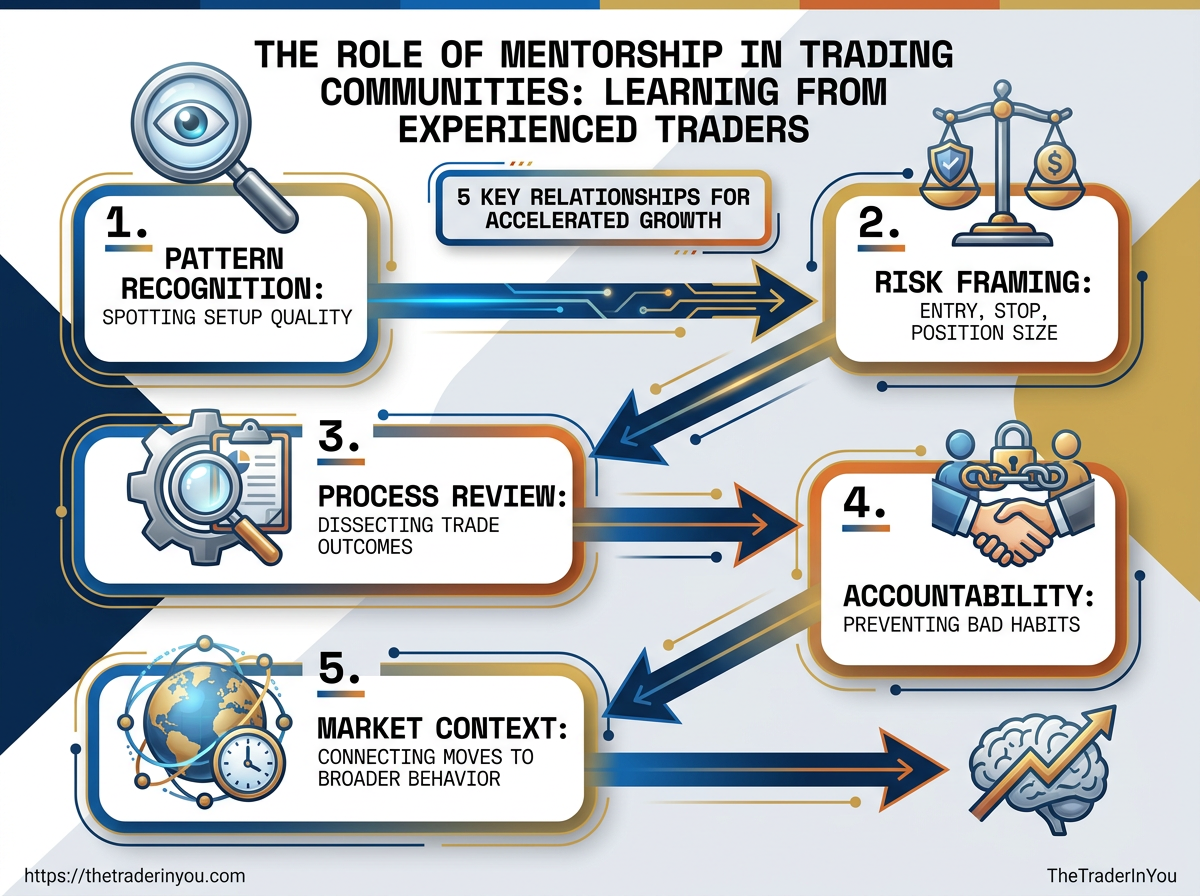
Experienced traders contribute far more than market opinions.
- Pattern recognition: They notice when a setup is clean, stretched, or just looks tempting.
- Risk framing: They keep the conversation on entry, stop placement, and position size.
- Process review: They help dissect why a trade worked or failed, without the emotional fog.
- Accountability: They make it harder to keep repeating the same bad habit.
- Market context: They connect today’s move to broader behavior, not just one candle.
Mentorship also shortens the learning curve because it compresses trial and error.
That does not mean taking away independent decision-making.
It means traders learn to think faster, with fewer blind spots and less expensive guesswork, which is exactly why well-run trading communities tend to build stronger discipline over time (Best Trading Mentorship Programs for 2026).
A good community does not trade for you.
It teaches you how to see more clearly, act with more discipline, and stop paying tuition for the same lesson twice.
What Effective Mentorship Looks Like in Practice
A good trading mentor does not hand over secret signals and disappear.
They show how decisions get made, repeat the process until it sticks, and make the risk rules obvious enough to challenge.
That distinction matters more than most new traders admit.
A 2026 review of trading mentorship programs highlights structured tracks from firms like SMB Capital and Bear Bull Traders because the teaching is disciplined, not flashy (Best Trading Mentorship Programs for 2026).
The best trader mentorship feels calm and slightly unglamorous.
That is usually a good sign.
Consistency is the first giveaway.
Credible experienced traders explain the same setup the same way, whether the market is quiet or chaotic, and they do not rewrite rules after one bad day.
Transparency comes next.
If a mentor cannot explain why a trade exists, where the risk sits, and what would invalidate the idea, the lesson is too thin.
Research on mentorship in trading points to immediate feedback and clearer mistake correction as major advantages of guided learning (The Importance of Mentorship in Trading & Finding Guidance in the Markets).
Guided learning versus copy-following behavior
| Dimension | Guided Mentorship | Signal-Chasing Behavior | Trading Impact |
|---|---|---|---|
| Decision ownership | You make the call with review from the mentor. | You mirror entries without understanding them. | Guided learning builds judgment; copy-following builds dependence. |
| Risk management | Position size, stops, and invalidation points are explained. | Risk is treated like an afterthought. | Better risk control usually means fewer emotional blowups. |
| Learning speed | Slower at first, then faster once patterns click. | Looks fast, but knowledge stays shallow. | Real progress lasts longer because the logic is learned. |
| Accountability | Trades are reviewed, questioned, and refined. | Nobody checks whether the trade made sense. | Mistakes turn into lessons instead of repeated habits. |
| Long-term skill development | Focuses on process, review, and adaptation. | Focuses on entries and exits only. | Durable skill grows; guesswork usually does not. |
In group settings, traders often compare notes, catch blind spots, and see how other people frame the same setup (Group Trading Mentorship Sessions).
A mentor who only names entry and exit levels is teaching a recipe.
A mentor who explains the trade thesis, context, and failure point is teaching judgment.
That is the real filter.
Strong mentorship produces traders who can think under pressure, not just repeat a pattern when someone else calls it out.
At The Trader In You, that kind of community support matters because it keeps the learning honest and tied to process, not hype.
When a trader is alone, the market gets loud fast.
A rough morning can turn into revenge trading, oversized entries, or one more “just this once” setup that breaks the plan.
Community support changes that dynamic because it makes behavior visible.
Traders are far less likely to drift when experienced traders are watching the same rules, the same levels, and the same excuses.
Peer groups also catch what solo review misses.
A trader may think the setup failed, while someone else notices the entry came after the move was already stretched.
That outside view matters, especially in trader mentorship settings where feedback is immediate and specific.
Research on group trading mentorship sessions highlights a supportive, practical environment—and broader mentorship research continues to show that regular feedback improves performance and confidence over time, including findings summarized in mentorship research roundups.
The best trading communities do more than cheer people on.
They create a habit of honesty.
During high-volatility sessions, shared market context becomes even more useful.
One trader may notice that spreads are widening, another sees institutions defending a level, and a third spots that the move is more news-driven than trend-driven.
That kind of live read helps experienced traders avoid treating every sharp candle as a signal.
- Accountability: A posted plan is harder to abandon when peers expect a review later.
- Blind-spot checks: Another trader may catch weak risk placement, late entries, or overconfidence before those habits compound.
- Market context: In fast conditions, group discussion helps separate real opportunity from noise.
- Behavior under pressure: Community feedback makes emotional patterns easier to spot, especially after a loss or a missed trade.
A useful model is simple: trade, review, compare notes, repeat.
This rhythm is common in structured mentorship programs because they emphasize planned review—not just trading ideas.
Community support does not remove risk.
It just makes poor habits harder to hide and better habits easier to keep.
That’s where trading behavior starts to improve for real.
Would you trust a trader who never shows a losing week?
That is usually the first filter.
Real experienced traders can explain their process, show how they handle risk, and point to a track record that holds up under questions.
Instead of looking for charisma, look for structure. Many credible mentorship programs—especially those built around staged learning or prop-style evaluation—share the same non-negotiables: disciplined instruction, planned reviews, and explicit risk expectations.
The strongest signal is not charisma.
It is clarity.
Credible mentors talk about entries, exits, sizing, invalidation, and what they do after a loss.
That matters because mentorship works best when feedback is immediate and specific—not vague and motivational, as noted in mentorship research and practitioner write-ups.
If someone can’t explain the logic behind a trade in plain English, they probably do not understand it deeply enough to teach it.
Red flags to watch for
Suspiciously smooth equity curves, cropped screenshots, guaranteed returns, and endless screenshots of wins usually signal performance marketing, not real expertise.
The same caution applies to communities that feel energetic but never discuss loss management. A busy room is not the same thing as a useful one; group feedback is only helpful when the discussion stays educational and disciplined.
Trading Community Due-Diligence Checklist
| Evaluation Criterion | What Good Looks Like | Warning Signs | Your Notes |
|---|---|---|---|
| Mentor transparency | Shows live or timestamped trades, explains setup rules, and answers follow-up questions clearly. | Vague claims, edited screenshots, or “trust me” language. | |
| Verified track record | Results are dated, consistent, and tied to a clear method. | Cherry-picked wins or no verifiable record at all. | |
| Risk management emphasis | Talks about stop size, position sizing, and losing streaks as part of the plan. | Only talks about profit targets and “home runs.” | |
| Process clarity | Explains why a trade is taken, not just where to enter. | Rote signals without reasoning. | |
| Community moderation | Questions are answered, spam is controlled, and debate stays constructive. | Hype, tribalism, or banned criticism. | |
| Educational structure | Lessons follow a sequence, with reviews, examples, and repetition. | Random posts with no learning path. | |
| Evidence of real trades | Market context, time stamps, and rationale match the trade record. | Screenshots with no context or missing timestamps. | |
| Realistic expectations | Discusses drawdowns, trade frequency, and patience. | Promises fast income or “easy” setups. |
That is where the real value shows up: in the quality of the questions, the moderation, and the trader’s willingness to be questioned.
If the answers stay specific and the risk talk is honest, you are probably looking at real trader mentorship.
If everything sounds polished but nothing can be checked, keep walking.
Ever leave a mentor chat feeling smarter, but not sharper?
That happens when feedback stays at the level of ideas instead of turning into rules you can actually repeat.
The useful part of trader mentorship is not the opinion itself.
It is the pattern hiding inside the opinion.
A strong mentor comment should tell you when a setup is valid, when it fails, and what market context changes the trade.
A clean way to turn discussion into repeatable process is to ask three questions after every conversation:
- What was the trigger?
- What would make it wrong?
- What would make it better?
Write those answers down the same day.
Over time, that becomes a playbook built from experienced traders, not a pile of scattered notes.
Structured programs make this easier to see in practice because they center repetition and planned review—so your feedback doesn’t disappear between sessions.
Here’s a simple template to turn discussions into something usable:
- Tag the setup. Give each trade idea a name, like breakout pullback or opening range fade.
- Define the invalidation. Write the exact point where the trade idea stops making sense.
- Record the context. Note trend, volatility, and session time before the trade.
- Add one review line. Capture what changed your mind after the trade.
Group learning can help too, but only if you filter it.
Use the room to spot blind spots, then go back to your rules and ask whether the new idea improves your edge or just adds noise.
When that habit sticks, community support starts sharpening your decisions instead of crowding them out.
Can a broker tutorial tell you when to stand aside? Not really.
It can show you how to place a trade, set stops, and read the platform, but it cannot tell you whether the setup is worth your risk in that moment.
That is where trader mentorship fits.
It sits between self-study and real-time decision-making, adding context, judgment, and accountability when charts start looking too similar.
Community support and experienced traders matter most when the learning path is connected, not scattered.
Broker education covers the machinery
Broker education is the manual for the car.
It teaches order types, margin rules, platform functions, and risk controls, which keeps beginners from making avoidable mistakes.
But knowing the controls is not the same as knowing the road.
In Forex, a setup can look clean at 7 a.m. and fall apart once London volatility or a news release hits.
Mentorship fills the judgment gap
That gap is where mentorship earns its place. The clearest benefit of mentorship is immediate, specific feedback—especially when you translate that feedback into repeatable decision rules (not just opinions).
Mentorship also matters when you already know the basics but still hesitate at the exact moment decisions count. Structured tracks (whether prop-style challenges or staged learning communities) help because they require planned review, risk transparency, and iteration.
Where Forex traders feel it most
Forex rewards context more than guesswork.
Session overlap, spreads, and macro news can change the quality of a setup in minutes, so self-study alone often leaves too many blind spots.
Mentorship helps most when a trader already has a routine but needs sharper review, better timing, and cleaner risk habits.
It is less about learning what a candle means and more about learning when that candle should be ignored.
That is how we think about education at The Trader In You: broker basics, market research, self-study, and trader mentorship each do a different job.
The next pillar content should keep that structure intact, so every piece builds the next one instead of repeating the same lesson.
What Matters When the Trade Is Still Live
Trading improves when your process still works at the exact moment you feel tempted to improvise.
Mentorship counts most when it changes the decision you make while the trade is forming—not when you simply agree with someone after the fact.
Start today with a short “live decision” audit: 1) Pick one recent trade where you hesitated (or deviated from your plan). 2) Identify the precise decision point that went fuzzy (e.g., thesis confirmation, invalidation placement, or sizing after volatility spiked). 3) Ask an experienced trader: “What would you do differently at that moment, and what rule would you write to prevent this next time?”
Then apply the answer to your next similar setup: write the rule you will follow, the condition that makes you change your mind, and the point where you admit the idea is wrong.
If the feedback stays general (“good idea,” “trust the trend,” “wait and see”) without a concrete decision rule, treat it as commentary—not mentorship.

Follow Joshua for daily forex tips on X: @thetraderinyou or connect with him on LinkedIn: Joshua Okapes.