
Price can look clean on the chart and still flip hard at the next session open.
When EUR/USD breaks a level, traders quickly ask the same thing: is this move real, or is the crowd just piling in late?
That is where sentiment analysis starts to matter.
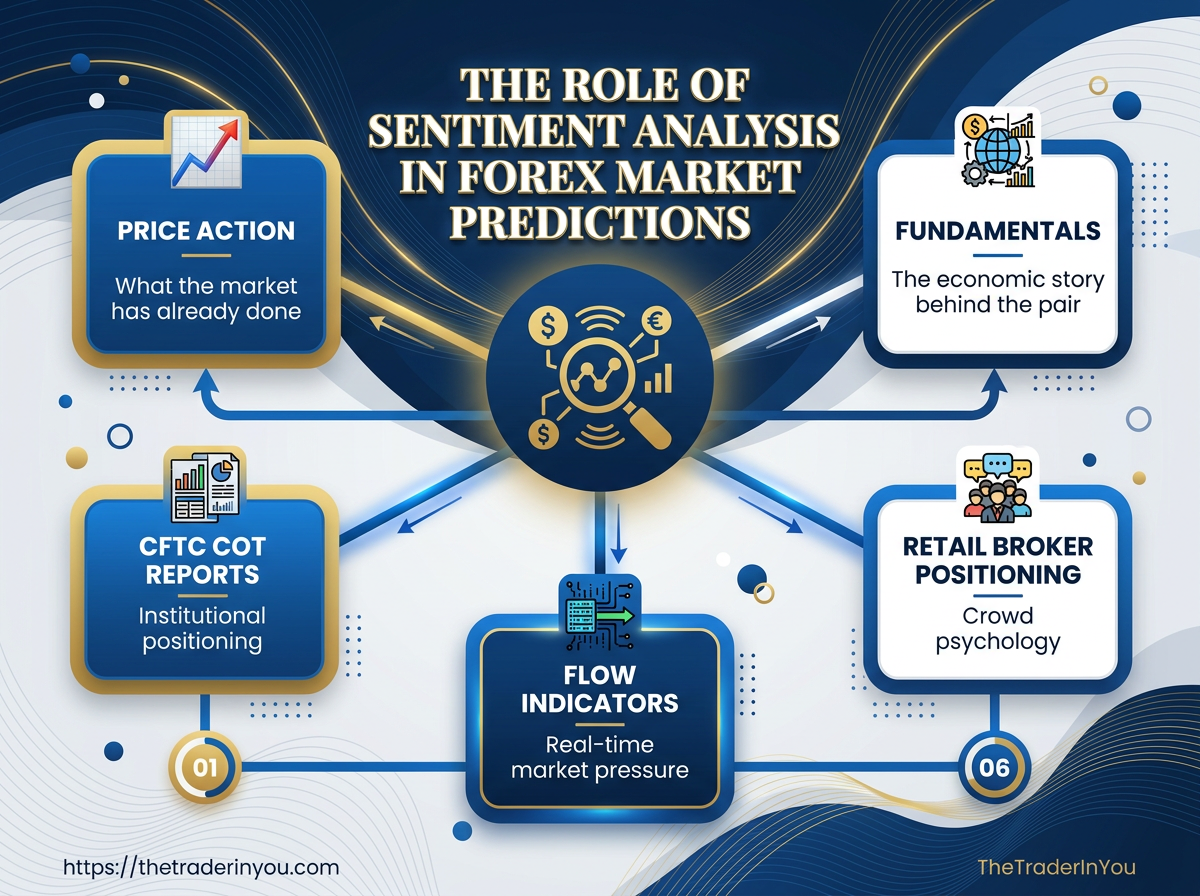
In forex, it is not about guessing moods; it is about reading positioning and crowd psychology through tools like CFTC COT reports, retail broker positioning, and flow indicators.
When those signals get stretched, a breakout can lose steam fast.
The FX market runs on disagreement.
A pair can grind higher for days, then stall the moment too many traders are leaning the same way.
That is why market predictions improve when price action and sentiment agree, and get shaky when they clash.
The tricky part is that sentiment is useful, not magical.
Used well, it sharpens forex trading strategies by showing when a trend has support and when it is running on fumes.
Used badly, it becomes just another noisy screen full of opinions.
Quick Answer: Sentiment analysis improves forex market predictions by identifying when positioning is crowded—using inputs like CFTC COT reports and retail/flow positioning—so breakouts that look clean on the chart may fail without follow-through. Recent research reports a domain-adapted fine-tuned FinBERT contextual sentiment model reached 84.33% out-of-sample forecasting accuracy (2026). Because sentiment signals can be adversarially manipulated, use robust validation and combine sentiment with technical and fundamental analysis before trading.
What sentiment analysis means in forex trading
Why does the euro jump on one headline and ignore another? In forex, that usually comes down to market mood, not just the headline itself.
At its core, sentiment analysis in forex tracks how traders are positioned and how optimistic or fearful they feel about a currency pair.
Here at The Trader In You, we treat it as a read on crowd psychology using inputs like CFTC COT reports, retail broker positioning, and flow indicators (our market analysis guide).
When positioning gets stretched, a clean technical breakout can fail fast because too many traders are already on the same side.
That matters because currencies are always relative.
A strong dollar is not just “strong”; it is often stronger than the euro, yen, or pound at that moment.
Sentiment also sits in a different lane from price action and fundamentals. Price action shows what the market has already done. Fundamentals explain the economic story behind the pair. Sentiment shows how traders are leaning right now, which is why it can flag crowded trades before they unwind.
A good example is the 2026 Applied Soft Computing study on EUR/USD, where fine-tuned FinBERT models built contextual sentiment indices and improved forecasting when added to LSTM-based models (ScienceDirect paper on contextual sentiment indices for exchange-rate forecasting).
That same idea shows up in live positioning data.
Saxo’s weekly COT update tracked a 20% reduction in gross USD longs to $11.7 billion in April 2026, a real sign that sentiment can shift before the chart fully catches up (Saxo COT on forex and commodities update).
- Price action: tells you where the pair moved.
- Fundamentals: tell you why the longer trend may exist.
- Sentiment: shows whether the crowd is crowded, nervous, or quietly turning.
That mix is why sentiment analysis can sharpen market predictions and improve forex trading strategies without pretending to replace the chart.
Used well, it gives you context.
Used alone, it becomes noise.
The main sources of forex sentiment data
Why do two traders stare at the same euro headline and leave with opposite trades? Usually because they are reading different sentiment inputs.
A clean sentiment read in forex rarely comes from one feed.
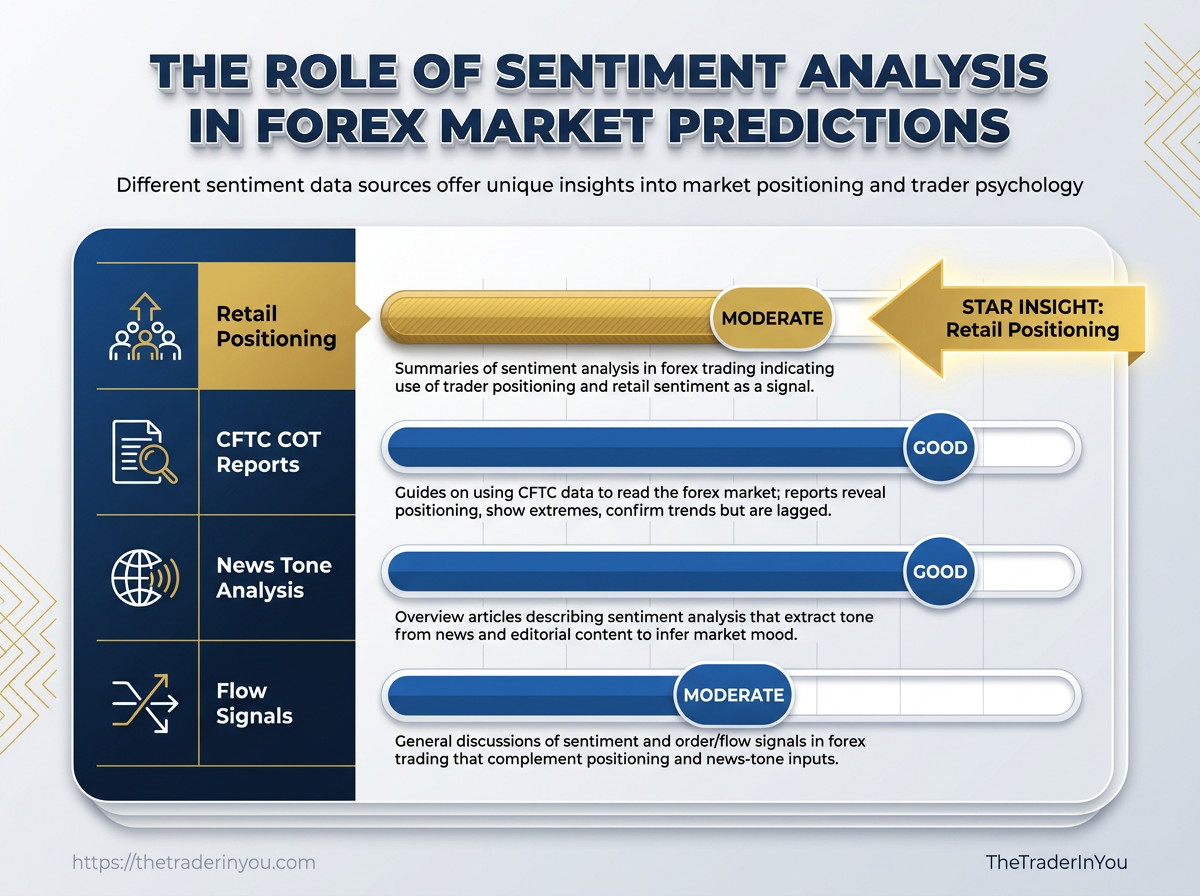
It usually comes from a mix of retail positioning, broker client data, open interest, news tone, and flow signals.
Our market-analysis framework starts with CFTC COT reports, retail broker positioning, and flow indicators because each one tells a different part of the story.
Institutions do the same thing, just with bigger pipes.
How the main buckets compare
| Data source | What it measures | Typical update frequency | Strengths | Limitations | Best use case |
|---|---|---|---|---|---|
| Retail positioning | Long vs short split at retail brokers | Intraday to daily | Fast crowd read; easy to spot extremes | Broker-specific sample; can stay stretched | Contrarian timing around breakouts |
| CFTC Commitment of Traders reports | Futures positioning by large specs, hedgers, and small traders, plus open interest | Weekly | Strong institutional context | Lagged and spot forex is not fully captured | Medium-term bias and crowding |
| Broker client sentiment dashboards | Live client long/short ratios | Real time to intraday | Useful for crowd psychology | Only one broker’s book | Short-term reversal spotting |
| Open interest data | Total outstanding futures contracts | Daily or weekly | Shows whether participation is building | Does not show direction by itself | Confirming whether a move has fuel |
| Options skew / risk reversals | Demand for calls vs puts and hedging pressure | Intraday to daily | Good for event risk and tail views | More relevant for hedging than pure direction | Central bank events and volatility |
| News sentiment feeds | Tone from headlines, transcripts, and articles | Real time | Picks up event-driven shifts early | Noisy without currency-pair filters | Macro shocks and policy surprises |
| Social chatter | Emotion and volume across social platforms | Real time | Catching retail panic or euphoria early | Easy to distort with bots and spikes | Fast sentiment shifts after news |
| Event-driven tone | Market reaction around scheduled data or speeches | Real time around releases | Captures the “so what” after the headline | Needs context; raw surprise is not enough | NFP, CPI, and central bank decisions |
COT and open interest tell you where the bigger money is parked, while broker dashboards and social chatter show where the crowd is leaning right now.
News sentiment deserves its own respect, though.
Work on domain-adapted, contextual sentiment (for example, fine-tuned FinBERT approaches for EUR/USD) suggests that currency-pair-specific models can improve forecasting signal quality—especially when the model output is paired with market structure and the macro catalyst behind the move.
When these sources agree, the move often has cleaner follow-through.
When they clash, that is usually where the interesting trades start.
When a trade feels “too obvious,” that is often the warning sign.
Extreme crowd agreement can push price beyond what fundamentals alone would justify—but it also increases the odds that marginal buyers/sellers stop showing up. In practice, sentiment helps you translate crowd data into concrete trade conditions.
It doesn’t need to call the exact top or bottom. It needs to flag three actionable conditions:
1) Crowding risk: Positioning stays one-sided too long. 2) Breakout quality: Price moves, and the crowd’s positioning doesn’t show heavy opposition building underneath. 3) Exhaustion signals: Price keeps advancing while the sentiment “support” for that direction stops improving.
Research on contextual sentiment models has shown that pair- and event-specific sentiment can add forecasting lift versus using generic text features alone. Operationally, the key is what you do with that output: treat sentiment as structured input for decision rules.
Crowded positioning: If sentiment remains stubbornly one-sided for multiple sessions, reversals become more likely—not because sentiment alone predicts the future, but because the side that’s already crowded has fewer incremental participants left to push flow.
Breakout confirmation: A breakout is higher quality when the crowd isn’t positioned heavily against it. Use live retail bias and positioning updates (e.g., COT-style reporting, retail client ratios) to check whether the move has “fuel” behind it.
Exhaustion clues: Watch for divergence. If price continues in the same direction while sentiment stalls or shifts away from the direction that should be supporting it, follow-through tends to get harder.
Turn those signals into rules for timing (wait vs enter), setup selection (which breakout to trust), and risk calibration (how much room you need before invalidation).
Ever seen sentiment scream “sell” while price keeps climbing?
That’s the trap: traders sometimes treat sentiment like the main thesis instead of a timing and selection filter.
Sentiment earns its place when it’s tied to structure, positioning, and event timing—and when you know what would invalidate the idea.
Contrarian entries when positioning is stretched
Contrarian setups make sense when:- positioning is clearly one-sided, and
- price stops confirming the crowd’s direction.
In practice, don’t fade the mood on the first sign of noise. Wait for a failure (e.g., rejection at a key level, a reversal candle, or a break-and-revert).
Trend-following setups when sentiment and price align
Trend setups get cleaner when sentiment improvements track what price is already doing.If the crowd continues to lean with the trend and price keeps printing higher highs/lows (or a clear continuation pattern), the better trade is often a pullback rather than an early top call.
Event trading around central banks and macro releases
Events are where sentiment can move fastest—and where whipsaw is most common.A workable approach is: 1) map bias before the release (positioning + news tone), then 2) trade the reaction window rather than the first headline.
If the market reprices quickly and price breaks structure in the direction implied by the pre-event bias, the setup is more tradable. If the reaction contradicts the bias, stand aside or reduce risk.
Keep the strategy honest
Text and news-derived sentiment can be noisy and sensitive to wording; that’s why your strategy should rely on confirmation from price/structure before sizing up. Apply the specific false-signal controls (confirmation rules, event-risk caps, and scaling discipline) from the Risk controls section when you translate sentiment into position size.A bullish sentiment read means very little when EUR/USD is parked under resistance and the next central bank statement still leans hawkish.
Sentiment works best as a timing filter, not as the whole thesis.
The three-layer decision stack
- Fundamentals set the bias. Rates, inflation, growth, and policy tone decide whether the market should be looking higher or lower.
- Technicals set the location. Trend structure, support, resistance, and volatility tell you where price is likely to react.
- Sentiment sets the timing. Positioning and crowd mood show whether a move still has fuel—or whether everyone is already leaning the same way.
This sequencing aligns with how live positioning tools are used: sentiment matters most near inflection points where traders are deciding whether to chase, hedge, or exit.
Where sentiment integration goes wrong
Crowd mood can stay extreme far longer than expected. A stretched positioning read is useful, but it can also tempt traders into “fast reversal” thinking.Also, sentiment signals (especially those derived from text/news) are not immune to distortion. That’s exactly why integration should be rules-based: require alignment between sentiment shifts and the market structure you’re trading.
The execution constraint
Even if the sentiment story is correct, performance will suffer if your signal arrives after the move is already underway or if liquidity/spreads make entries unreliable.So the practical rule is simple: align sentiment with the technical map and the fundamental catalyst, then size only when the tape confirms that the crowd read is translating into price behavior.
Are you trading the pair, or just reacting to noise?
That question matters more than most traders admit.
Good sentiment analysis only improves market predictions when it is tied to:
- one currency pair, and
- one fresh catalyst.
Step 1: Define the pair and the catalyst
Start with one pair and one event.If you are trading EUR/USD, name the driver: ECB language, U.S. inflation, a risk-off move, or a meaningful shift in positioning.
A broad “dollar strength” narrative is usually too loose for actionable sentiment work. Ask a tighter question instead: what changed, and why would traders care right now?
Step 2: Check positioning, headlines, and price structure
Use positioning and crowd-bias tools to answer three questions:- Is the crowd already leaning hard?
- Did the news tone shift in a direction that matches the setup?
- Is price behavior confirming (or rejecting) the crowd?
You can pull these signals from live positioning dashboards and COT-style reports, then cross-check with the chart near a clear level.
Pre-trade sentiment checklist
| Check | What to review | Bullish signal | Bearish signal | Trade implication |
|---|---|---|---|---|
| Positioning | CFTC COT, retail broker dashboards, flow/positioning data | Crowded shorts unwind or positioning becomes balanced | Crowded longs build late in the move | Stronger case for a long when downside positioning is trapped (and vice versa) |
| News tone | Economic calendar + trusted headlines/transcripts | Headlines increasingly support the bullish thesis | Headlines turn mixed or contradict the bullish thesis | Wait if the story is not stabilizing |
| Trend direction | Price chart and structure | Higher highs/lows or clean breakout follow-through | Lower highs / failed breakouts / rejection at resistance | Trade with structure, not against it |
| Volatility regime | Recent range, session swings, event reaction quality | Calm expansion after the catalyst | Whipsaws, unstable spikes, wide erratic candles | Reduce size when conditions are noisy |
| Event risk | Central bank schedule and major releases | No high-impact release minutes ahead | High-impact release is imminent | Stand aside or shrink size until the reaction |
Step 3: Decide whether to trade, wait, or reduce size
Alignment across pair + catalyst + crowd + chart supports a full-sized entry.Mixed signals call for patience, not heroics.
Execution still matters: if the sentiment read is right but the entry timing is poor, performance will suffer—so when the picture is shaky, start smaller.
In short: use sentiment to improve the quality of your selection and timing, then confirm with price behavior before committing risk.
Risk controls for sentiment-based trading
“What happens when the headline is right, but the trade is still wrong?” Sentiment traders know that feeling well.
A clean-looking signal can turn messy fast when a tweet gets rewritten, a number misses expectations by a hair, or the market is already leaning too far in one direction.
That is why false-signal control matters as much as the signal itself.
A 2026 ScienceDirect paper on adversarial attacks against financial sentiment classifiers found that subtle paraphrases can meaningfully change model predictions and degrade accuracy (with the effect varying by setup). If software can be nudged that easily, traders need a second layer of judgment before risking real money.
News filters help, but they are not enough on their own.
LSEG notes that BERT-based sentiment models can run fast in production, yet speed does not protect you from a bad read when the market is reacting to thin liquidity or a crowded positioning profile (LSEG on BERT for financial market data).
The practical fix is boring and effective: demand agreement between sentiment, price action, and positioning before sizing up.
- Require confirmation: Treat a single headline or social burst as a prompt, not a trade.
- Cap event risk: Keep smaller size around central bank statements, inflation prints, and surprise political news.
- Scale in, not all in: Start with partial size, then add only after the market holds the move.
- Use a conflict rule: If sentiment turns fast but price refuses to follow, stand aside.
Position sizing matters most when crowd mood flips quickly.
In that kind of tape, full size is a gift to volatility.
A simple rule works well: risk less when the market is loud, and even less when the move is driven by a single headline.
That keeps sentiment analysis useful without letting noise dictate the size of the loss.
Tools and platforms traders use to track sentiment
A sentiment dashboard can look decisive—and still be stale.
The better setups do three jobs at once: they show positioning, flag the specific news that can flip it, and tell you whether the signal is arriving fast enough to matter for your trade horizon.
What to look for in real tools
Live positioning pages like Dukascopy’s SWFX Sentiment Index and Saxo’s weekly COT on forex and commodities update are useful because they show crowd exposure instead of vague “market mood.” Pair that with a solid economic calendar, and you get guardrails: you can see when a central bank decision, inflation release, or major speech is approaching and anticipate volatility-driven distortions.News scanners help too—especially when they are filtered to the currencies and phrasing that actually move the pair. The goal isn’t more information; it’s better signal triage.
How to evaluate whether a sentiment tool is trustworthy
Trust is where most traders get lazy. A sentiment tool is only as good as its source mix, update cadence, and methodology transparency.- Source transparency: Look for clear inputs (broker positioning, COT data, specific news text). Avoid tools that only show a colored gauge with no explainable source.
- Asset specificity: A tool built for general equities often misses forex-specific drivers. Pair- or currency-aware sentiment models tend to align better with how FX reacts.
- Update cadence: If you trade around scheduled releases, you need timely feeds—not just end-of-day aggregation.
- Methodology clarity: If the platform hides how sentiment is scored, treat outputs as directional hints at best.
- Robustness to distortion: Text-based sentiment can be brittle—headline wording, paraphrasing, or processing differences can shift the signal. Build in confirmation rules rather than trusting one reading.
- Execution reality: If slippage and spreads can ruin entries, a “perfect” sentiment read is still a bad trade.
The best tools don’t promise magic. They help you react faster, reduce bad guesses, and keep your sentiment interpretation anchored to positioning and market structure.
Where this article fits in the forex analysis cluster
Why put sentiment analysis in its own lane at all? Because forex traders don’t just need another opinion about price.
They need a way to read crowd positioning, broker flow, and the “why now” mood behind a move—then combine that read with the rest of the decision stack.
That’s why this article sits in the middle of the cluster, not at the edge. It connects sentiment to:
- market structure (where price can react),
- broker evaluation (how execution and liquidity affect what you can actually trade), and
- trading psychology (how herd behavior shows up before full price adjustment).
Cluster links you can expect
- Broker evaluation: Focus on slippage, spread stability, and order fills when sentiment is moving fast.
- Market structure: Compare retail crowd bias with positioning context (e.g., COT-style positioning and dealer/news flow) to avoid treating a sentiment spike as direction.
- Trading psychology: Track fear, confirmation bias, and herding so you can anticipate when a setup becomes crowded.
- Cluster expansion: Look for linked coverage on execution quality, positioning extremes, and how sentiment changes across intraday vs. swing vs. longer-horizon setups.
At The Trader In You, this cluster is designed to make the path from reading sentiment to placing a trade clearer—so the next pieces in the series build on the same conversation, just one level deeper.
How is sentiment analysis used to predict forex market movements?
Sentiment analysis predicts forex moves by identifying when trader positioning is crowded and whether price is getting real follow-through. It flags three conditions: one-sided crowding risk, breakout quality (moves supported by expanding backing rather than fighting the crowd), and exhaustion signals when price keeps pushing but sentiment momentum stops. Forex predictions improve when sentiment and price action agree and get shaky when they clash.
Which sentiment data sources (e.g., CFTC COT, retail broker positioning, news sentiment) work best for forex trading strategies?
The most useful sentiment inputs come from combining multiple sources, not relying on a single feed. Key options include CFTC COT reports for institutional positioning, retail broker positioning and client flow data for crowd behavior, and flow/open-interest indicators for positioning intensity. News tone and contextual sentiment models (e.g., a domain-adapted fine-tuned FinBERT model) can add forecasting lift, but they should be validated and paired with technical and fundamental analysis because sentiment signals can be manipulated.
Reading the Crowd Without Chasing It
The strongest traders don’t treat sentiment as destiny.
They use it to set expectations and boundaries before the order goes in—especially when a move looks tidy on paper but the crowd is already fully committed.
A practical way to apply this on EUR/USD (or any major pair) is to treat sentiment as the input that helps you answer two questions:
1) Is the crowd aligned with the scenario you’re trading? 2) What would prove you wrong if the crowd is wrong?
Once positioning is stretched, your edge shifts from “predict the turn” to “trade the confirmation.” That means you only build the trade idea when the sentiment read matches the market structure and the catalyst timeline—and you define what price action would invalidate the setup.
If you want a structured habit, use the same routine every time: pick one pair, choose one fresh catalyst, check positioning/news bias against the chart’s key levels, then size and timing based on whether price confirms that the crowd is actually underwriting the move.

Follow Joshua for daily forex tips on X: @thetraderinyou or connect with him on LinkedIn: Joshua Okapes.
- The Role of Sentiment Analysis in Forex Market Predictions - May 13, 2026
- Understanding Fundamental Analysis: Key Indicators for Forex Traders - May 11, 2026
- Mistakes Traders Make When Analyzing Forex Markets - May 8, 2026